
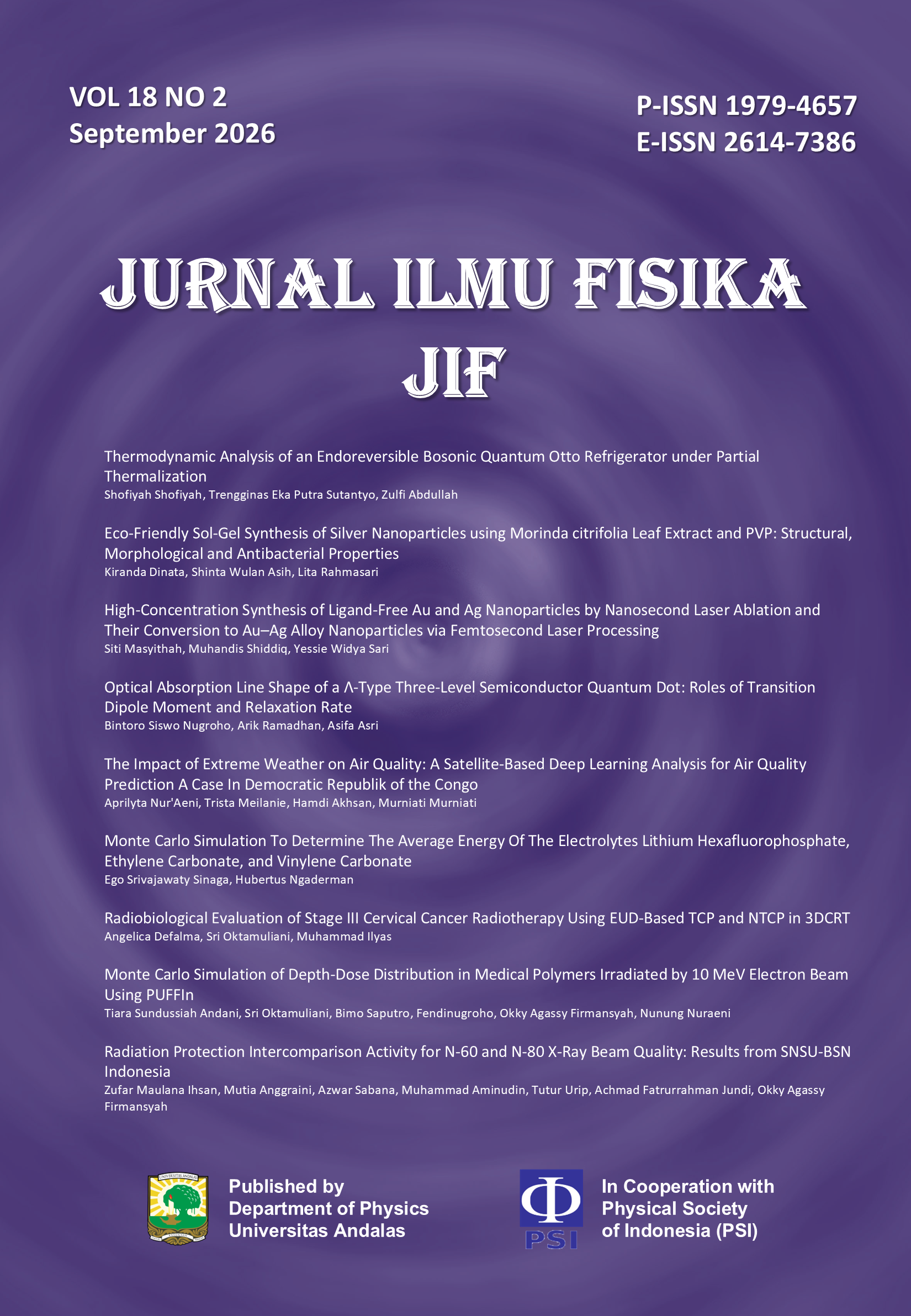
Monte Carlo Simulation of Depth-Dose Distribution in Medical Polymers Irradiated by 10 MeV Electron Beam Using PUFFIn
DOI:
https://doi.org/10.25077/jif.18.2.210-218.2026Keywords:
radiation dose distribution, medical polymers, electron beam sterilization, Monte Carlo simulation, PUFFInAbstract
Polymers are widely used in disposable medical devices that must fulfill strict safety and effectiveness standards, including radiation sterilization. The effectiveness of electron-beam (e-beam) sterilization depends critically on the uniformity of the absorbed radiation dose distribution. This study investigates the absorbed dose depth distribution in 11 industrial polymer materials irradiated by a 10 MeV e-beam accelerator (BRIN specifications) using PUFFIn-based Monte Carlo simulations. Target materials were modeled as 100 × 25.5 × 10 cm blocks with observation points spaced 1 mm along the z-axis. The percentage depth dose (PDD) curves show that maximum dose depth Zmax ranges from 1.85 to 3.05 cm across the studied polymers. High-density materials such as Polycarbonate (PC, 1.35 g/cm3) exhibit shallower penetration (Zmax = 1.85 cm), whereas low-density materials like Polyolefin Elastomer (POE, 0.87 g/cm3) allow deeper penetration (Zmax = 3.05 cm). At equivalent densities, materials with higher effective atomic numbers (Zeff) tend to show slightly higher maximum doses (Dmax), likely due to enhanced electron interaction and backscattering probabilities. These quantitative insights provide a scientific basis for optimizing industrial e-beam processing parameters and material selection for medical device manufacturing.
Downloads
References
Bliznyuk, U. A., Borshchegovskaya, P. Y., Zolotov, S. A., Ipatova, V. S., Krusanov, G. A., Nikitchenko, A. D., Studenikin, F. R., & Chernyaev, A. P. (2022). Determining the Electron Beam Spectrum after Passing Through Aluminum Plates. Moscow University Physics Bulletin, 77(4), 615–621. https://doi.org/10.3103/S0027134922040038
Danyo, E. K., Ivantsova, M. N., & Selezneva, I. S. (2024). Ionizing Radiation Effects on Microorganisms and Its Applications in the Food Industry. Foods and Raw Materials, 12(1), 1–12. https://doi.org/10.21603/2308-4057-2024-1-583
Fielding, A. L. (2023). Monte-Carlo Techniques for Radiotherapy Applications II: Equipment and Source Modelling, Dose Calculations and Radiobiology. Journal of Radiotherapy in Practice, 22, e81, 1–6. https://doi.org/10.1017/S1460396923000080
Fifield, L. S., Pharr, M., Staack, D., Pillai, S. D., Nichols, L., McCoy, J., Faucette, T., Bisel, T. T., Huang, M., Hasan, M. K., Perkins, L., Cooley, S. K., & Murphy, M. K. (2021). Direct Comparison of Gamma, Electron Beam and X-ray Irradiation Doses on Characteristics of Low-Density Polyethylene, Polypropylene Homopolymer, Polyolefin Elastomer and Chlorobutyl Rubber Medical Device Polymers. Radiation Physics and Chemistry, 186, 109505. https://doi.org/10.1016/j.radphyschem.2021.109505
Greening, J. R. (1985). Fundamentals of Radiation Dosimetry (2nd ed.). CRC Press.
Hansen, J. M., Fidopiastis, N., Bryans, T., Luebke, M., & Rymer, T. (2020). Radiation Sterilization: Dose Is Dose. Biomedical Instrumentation & Technology, 54(S3), 45–52. https://doi.org/10.2345/0899-8205-54.s3.45
International Atomic Energy Agency. (2021). Radiation Effects on Polymer Materials Commonly Used in Medical Devices (Coordinated Research Project F23035, 1st RCM Report). IAEA.
Kurudirek, M., & Özdemir, Y. (2011). Energy Absorption and Exposure Build-up Factors for Some Polymers and Tissue Substitute Materials: Photon Energy, Penetration Depth and Chemical Composition Dependence. Journal of Radiological Protection, 31(1), 117–128. https://doi.org/10.1088/0952-4746/31/1/008
Li, D., Bisel, T. T., Cooley, S. K., Ni, Y., Murphy, M. K., Spencer, M. P., Hasan, M. K., Fifield, L. S., Pharr, M., Staack, D., Huang, M., Pillai, S. D., Nichols, L., Parker, R., & Gustin, E. (2025). Gamma, Electron Beam and X-ray Irradiation Effects on Polymers in an Advanced Bone Cement Mixer Device. Radiation Physics and Chemistry, 226, 112188. https://doi.org/10.1016/j.radphyschem.2024.112188
Liu, M., He, C., Feng, J., Xun, M., Sun, J., Li, Y., & Guo, Q. (2023). Analysis of Difference in Areal Density Aluminum Equivalent Method in Ionizing Total Dose Shielding Analysis of Semiconductor Devices. Electronics, 12(19), 4181. https://doi.org/10.3390/electronics12194181
Malinowski, M. (2021). Using X-ray Technology to Sterilize Medical Devices. American Journal of Biomedical Science & Research, 12(3), 272–276. https://doi.org/10.34297/AJBSR.2021.12.001755
McEvoy, B., Maksimovic, A., Howell, D., Reppert, P., Ryan, D., Rowan, N., & Michel, H. (2023). Studies on the Comparative Effectiveness of X-Rays, Gamma Rays and Electron Beams to Inactivate Microorganisms at Different Dose Rates in Industrial Sterilization of Medical Devices. Radiation Physics and Chemistry, 208, 110915. https://doi.org/10.1016/j.radphyschem.2023.110915
Osman, N. M., Mohamad Tajudin, S., Aminordin Sabri, A. H., Mohd Noor, A. F., & Abdul Aziz, M. Z. (2022). Evaluation of Scattering Effects for Radiation Shielding or Filter Materials by Using Monte Carlo Simulation. IOP Conference Series: Materials Science and Engineering, 1231(1), 012007. https://doi.org/10.1088/1757-899X/1231/1/012007
Podgorsak, E. B. (Ed.). (2005). Radiation Oncology Physics: A Handbook for Teachers and Students. International Atomic Energy Agency.
Pomatsalyuk, R. I., Titov, V. Y., Titov, D. V., Uvarov, V. L., Shevchenko, V. A., & Zakharchenko, A. A. (2021). Monitoring of Critical Parameters of Radiation Sterilization Process at an Industrial Electron Accelerator. RAP Conference Proceedings, 6, 39–43. https://doi.org/10.37392/RapProc.2021.08
Rahmawati, I., Jumpeno, B. Y. E. B., Mellawati, J., & Ramlan. (2023). Analisis Tingkat Absorpsi Berkas Sinar-X pada Sintesis Komposit Kaktus (Opuntia spp.) dan Timbal (II) Asetat (Pb(CH3COO)2) sebagai Material Apron. Ganendra: Majalah IPTEK Nuklir, 26(2), 82–90. https://doi.org/10.55981/gnd.2023.6870
Schwarz, R. A., Azuma, M., Boutros, C., Murphy, M. K., & Pagh, J. R. (2025). PUFFIn Software Modeling for Quality Management (PNNL-37351). Pacific Northwest National Laboratory.
Schwarz, R., Salvat, F., Sunderland, D., Azuma, M., Boutros, C., Pillai, S. D., Kuntz, F., Nasreddine, A., Pagh, J., Wootan, D., & Murphy, M. K. (2024). PUFFIn – A User Friendly Fast Interface for Calculating and Visualizing the Dose Distribution in Materials. Radiation Physics and Chemistry, 222, 111774. https://doi.org/10.1016/j.radphyschem.2024.111774
Schwarz, R. A., & Sunderland, D. J. (2023). PUFFIn User’s Manual: Penelope User Friendly Fast Interface (PNNL-34009). Pacific Northwest National Laboratory.
Spunei, M., Malaescu, I., Mihai, M., & Marin, C. N. (2014). Absorbing Materials with Applications in Radiotherapy and Radioprotection. Radiation Protection Dosimetry, 162(1–2), 167–170. https://doi.org/10.1093/rpd/ncu252
Tuan, N. A., Van Tao, C., & Rangacharyulu, C. (2019). The Depth-Dose Curve Depends on the Inhomogeneity of the Material Irradiated by Electron Beam. Radiation Physics and Chemistry, 163, 22–25. https://doi.org/10.1016/j.radphyschem.2019.05.001
Wulandari, I., Shafii, M. A., Adrial, R., & Diyona, F. (2022). Distribusi Dosis Radiasi Foton Berdasarkan Variasi Kedalaman dan Luas Lapangan Penyinaran pada Fantom Menggunakan Pesawat Linac Tipe Clinac CX. Jurnal Fisika Unand, 11(1), 89–96. https://doi.org/10.25077/jfu.11.1.89-96.2022
Yani, S. (2022). Analisis Performa Timbal dan Besi Meredam Radiasi Foton 2 MeV dengan Simulasi Monte Carlo. Journal Online of Physics, 7(2), 13–18. https://doi.org/10.22437/jop.v7i2.18224
Downloads
Published
How to Cite
Issue
Section
Citation Check
License
Copyright (c) 2026 Tiara Sundussiah Andani, Sri Oktamuliani, Bimo Saputro, Fendinugroho, Okky Agassy Firmansyah, Nunung Nuraeni

This work is licensed under a Creative Commons Attribution-NonCommercial 4.0 International License.
Please find the rights and licenses in JIF (Jurnal Ilmu Fisika).
1. License
The non-commercial use of the article will be governed by the Creative Commons Attribution license as currently displayed on Creative Commons Attribution-NonCommercial 4.0 International License.
2. Author's Warranties
The author warrants that the article is original, written by stated author(s), has not been published before, contains no unlawful statements, does not infringe the rights of others, is subject to copyright that is vested exclusively in the author and free of any third party rights, and that any necessary written permissions to quote from other sources have been obtained by the author(s).
3. User Rights
JIF's spirit is to disseminate articles published are as free as possible. Under the Creative Commons license, JIF permits users to copy, distribute, display, and perform the work for non-commercial purposes only. Users will also need to attribute authors and JIF on distributing works in the journal.
4. Rights of Authors
Authors retain the following rights:
- Copyright, and other proprietary rights relating to the article, such as patent rights,
- The right to use the substance of the article in future own works, including lectures and books,
- The right to reproduce the article for own purposes, provided the copies are not offered for sale,
- The right to self-archive the article.
5. Co-Authorship
If the article was jointly prepared by other authors, the signatory of this form warrants that he/she has been authorized by all co-authors to sign this agreement on their behalf, and agrees to inform his/her co-authors of the terms of this agreement.
6. Termination
This agreement can be terminated by the author or JIF upon two months's notice where the other party has materially breached this agreement and failed to remedy such breach within a month of being given the terminating party's notice requesting such breach to be remedied. No breach or violation of this agreement will cause this agreement or any license granted in it to terminate automatically or affect the definition of JIF.
7. Royalties
This agreement entitles the author to no royalties or other fees. To such extent as legally permissible, the author waives his or her right to collect royalties relative to the article in respect of any use of the article by JIF or its sublicensee.
8. Miscellaneous
JIF will publish the article (or have it published) in the journal if the article's editorial process is successfully completed and JIF or its sublicensee has become obligated to have the article published. JIF may conform the article to a style of punctuation, spelling, capitalization, referencing and usage that it deems appropriate. The author acknowledges that the article may be published so that it will be publicly accessible and such access will be free of charge for the readers.