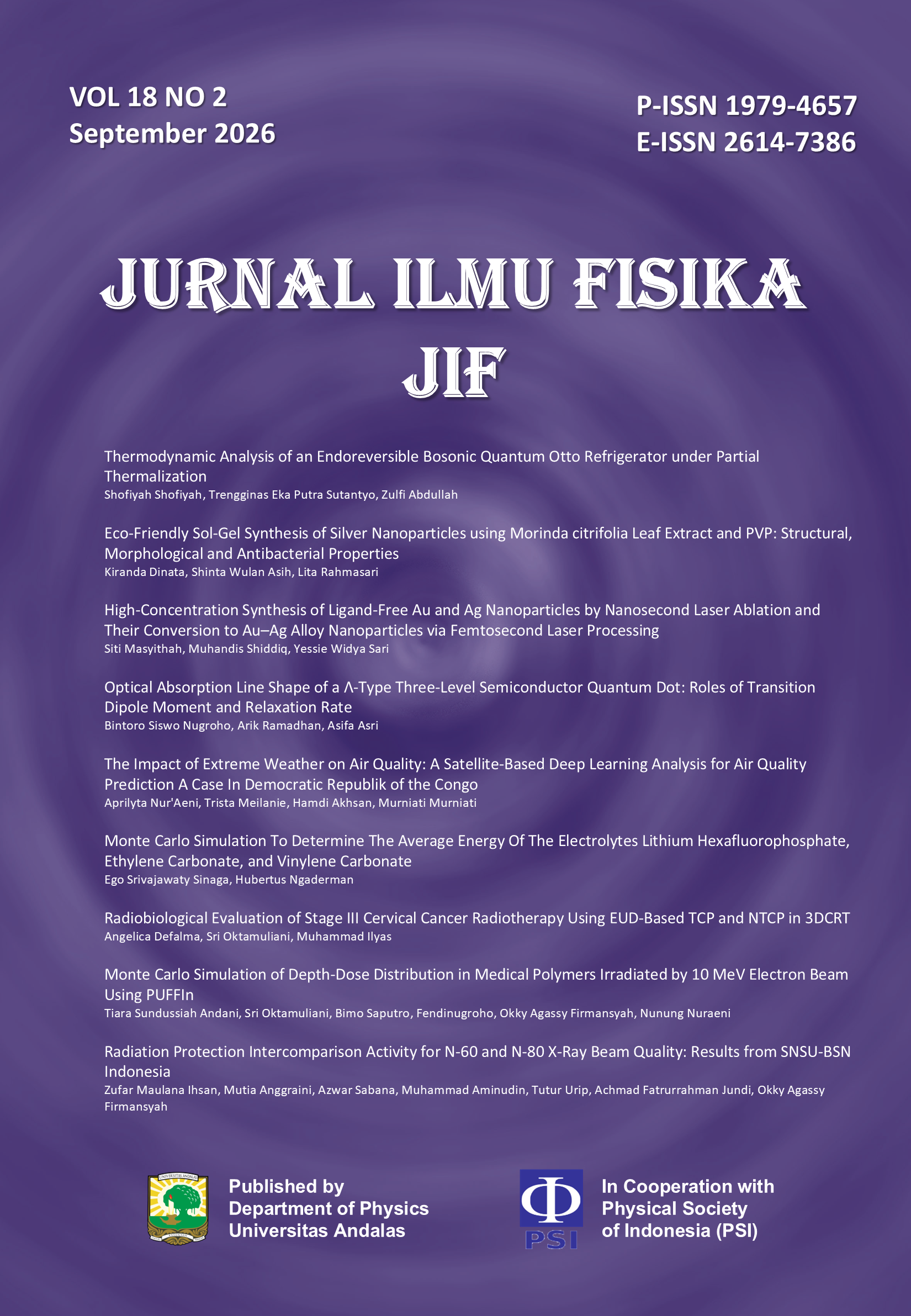
Radiation Protection Intercomparison Activity for N-60 and N-80 X-ray Beam Qualities: Results from SNSU-BSN Indonesia
DOI:
https://doi.org/10.25077/jif.18.2.219-229.2026Keywords:
air kerma, optical simulated luminescence, radiation metrology, measurement uncertainty, proficiency testingAbstract
The Ionizing Radiation Metrology Laboratory of Indonesia’s National Metrology Institute participated in an international intercomparison of air kerma from the narrow-spectrum protection-level X-ray beam quality N-60 and N-80, as part of quality assurance efforts and preparation for expanding service scope. The measurements used X-ray beams based on the International Atomic Energy Agency (IAEA) Safety Report Series (SRS) No.16 for the N-60 and N-80 beam qualities, in accordance with ISO 4037, and under irradiation conditions specified by the intercomparison protocol from the Office of Atoms for Peace, Thailand (OAP). The air kerma rates measured from the experiments were used to determine the irradiation durations for the optically stimulated luminescence dosimeters (OSLDs). The results showed good agreement with the reference values. The mean air kerma deviated from the 2 mGy reference value by −0.63% for N-60 and −3.25% for N-80, both within the expanded measurement uncertainty of the laboratory (3.43% and 3.38%, k = 1.96). These results supported the laboratory’s technical competence in radiation protection measurements and provided a basis for expanding its calibration service scope.
Downloads
References
Aspradakis, M. M., Buchillier, T., Kohler, G., Kottler, C., & Krayenbühl, J. (2023). SSRMP Recommendations No 9: Reference dosimetry in low and medium energy x-ray beams. Zeitschrift Für Medizinische Physik, 33(4), 601–617.
Bairlein, K., Behnke, B., & Hupe, O. (2020). Development of a new secondary standard for H*(10). Radiation Protection Dosimetry, 188(4), 428–432. https://doi.org/10.1093/rpd/ncz296
Bouzegzi, K., Amroun-Frahi, A., & Medjadj, T. (2023). A new proposed procedure for calibrating personal dosemeters for X and gamma radiations, based on Hp(30)water. Radiation Protection Dosimetry, 199(18–19), 2140–2147. https://doi.org/10.1093/rpd/ncad291
Chu, C.-H., Butler, D. J., & Tanaka, T. (2023). APMP/TCRI key comparison report of measurement of air kerma for medium-energy x-rays (APMP.RI(I)-K3.2013). Metrologia, 60(1A), 06009. https://doi.org/10.1088/0026-1394/60/1A/06009
Dang, T. M. L., Nguyen, N. Q., Bui, D. K., & Duong, T. N. (2024). Characteristics of the reference X-ray narrow-spectrum series at SSDL of Institute for Nuclear Science and Technology. Nuclear Science and Technology, 12(4). https://doi.org/10.53747/nst.v12i4.387
Ekendahl, D., Čemusová, Z., Kurková, D., & Kapuciánová, M. (2020). Response of current photon personal dosemeters to new operational quantities. Radiation Protection Dosimetry, 188(1), 78–84. https://doi.org/10.1093/rpd/ncaa078
Eurachem. (2022). How can proficiency testing help my laboratory? https://www.eurachem.org/
Firmansyah, A. F., Firmansyah, O. A., & Melinda, R. S. (2021). Batan Personal Dose Equivalent Hp (10) and HP (3) Intercomparison Results at 2018 & 2019. Jurnal Standardisasi, 23(2), 163–170.
Fukuda, A., Matsubara, K., & Miyati, T. (2015). Long-term stability of beam quality and output of conventional X-ray units. Radiological Physics and Technology, 8(1), 26–29.
Gao, F., Wang, F., Yang, X., & Zhang, X. (2021). The in-situ calibration method for ambient dose equivalent dosemeters. Radiation Protection Dosimetry, 194(1), 10–17. https://doi.org/10.1093/rpd/ncab130
Gondhowiardjo, S. A., Prajogi, G. Ben, & Sekarutami, S. M. (2008). History and growth of radiation oncology in Indonesia. Biomedical Imaging and Intervention Journal, 4(3), e42.
IAEA. (2000). IAEA Safety Related Publications. www.iaea.org/ns/coordinet
IAEA. (2025). IAEA/WHO Network of Secondary Standards Dosimetry Laboratories (SSDL). International Atomic Energy Agency.
Iafrati, A. C., Cappadozzi, G., Silvestri, C., & Pinto, M. (2024). An Italian InterLaboratory comparison on personal dose equivalent for dosimetry services: promoting measurements reliability and addressing new digital challenges. European Physical Journal Plus, 139(3).
ICRP. (2007). The 2007 Recommendations of the International Commission on Radiological Protection. www.iso.org
ISO. (2017). General requirements for the competence of testing and calibration laboratories Exigences générales concernant la compétence des laboratoires d’étalonnages et d’essais Copyright Protected Document. www.iso.org
ISO. (2019). Radiological protection-X and gamma reference radiation for calibrating dosemeters and doserate meters and for determining their response as a function of photon energy-Part 1: Radiation characteristics and production methods. www.iso.org
ISO. (2022). ISO 13528:2022(E) Copyright Protected Document Iteh Standard Preview (standards.iteh.ai).
JCGM. (2008). Evaluation of measurement data—Guide to the expression of uncertainty in measurement. Int. Organ. Stand. Geneva ISBN, 50, 134.
Khoury, H. J., de Barros, V. S. M., & Asfora, V. K. (2021). First Latin American and Caribbean interlaboratory comparison exercise for SSDLs on reference irradiation capabilities in personal dose equivalent. Journal of Radiological Protection, 41(2), 397–410. https://doi.org/10.1088/1361-6498/abe16f
Le, H. L., Nguyen, H. L., Ong, Q. S., Ho, M. D., Dao, V. H., Truong, T. S., Vo, V. T., & Le, Q. V. (2023). Establishment and quality assessment of X-ray narrow spectrum series according to ISO 4037:2019 at SSDL of center for nuclear technologies. Nuclear Science and Technology, 12(1), 01–11.
Mcwhan, A. F., Dobrzynska, W., Stadtmann, H., Grimbergen, T. W. M., Figel, M., & Romero, A. M. (2023). EURADOS Intercomparison 2018 for Whole Body Dosemeters-Summary of Procedures, Results and Conclusions.
OAP. (2022). Technical protocol of the radiation protection comparison.
Romero, A., Figel, M., & Grimbergen, T. (2023). EURADOS whole-body dosemeters intercomparisons: lessons learnt from individual results. Radiation Protection Dosimetry, 199(6), 607–616. https://doi.org/10.1093/rpd/ncad010
Saroka, S., Salas, G. W., & Luchian, E. (2023). COOMET regional comparison of the national standards of air kerma for x-radiation qualities used for radiation protection and diagnostic radiology (COOMET.RI(I)-S3). Metrologia, 60(1A), 06025. https://doi.org/10.1088/0026-1394/60/1a/06025
Živanović, M. Z., Hupe, O., & Zutz, H. (2023). EURAMET DOSEtrace supplementary comparison in terms of the ambient dose equivalent/rate for photon radiation (EURAMET.RI(I)-S18). Metrologia, 60(1A), 06017. https://doi.org/10.1088/0026-1394/60/1A/06017
Downloads
Published
How to Cite
Issue
Section
Citation Check
License
Copyright (c) 2026 Zufar Maulana Ihsan, Mutia Anggraini, Azwar Sabana, Muhammad Aminudin, Tutur Urip, Achmad Faturrahman Jundi, Okky Agassy Firmansyah

This work is licensed under a Creative Commons Attribution-NonCommercial 4.0 International License.
Please find the rights and licenses in JIF (Jurnal Ilmu Fisika).
1. License
The non-commercial use of the article will be governed by the Creative Commons Attribution license as currently displayed on Creative Commons Attribution-NonCommercial 4.0 International License.
2. Author's Warranties
The author warrants that the article is original, written by stated author(s), has not been published before, contains no unlawful statements, does not infringe the rights of others, is subject to copyright that is vested exclusively in the author and free of any third party rights, and that any necessary written permissions to quote from other sources have been obtained by the author(s).
3. User Rights
JIF's spirit is to disseminate articles published are as free as possible. Under the Creative Commons license, JIF permits users to copy, distribute, display, and perform the work for non-commercial purposes only. Users will also need to attribute authors and JIF on distributing works in the journal.
4. Rights of Authors
Authors retain the following rights:
- Copyright, and other proprietary rights relating to the article, such as patent rights,
- The right to use the substance of the article in future own works, including lectures and books,
- The right to reproduce the article for own purposes, provided the copies are not offered for sale,
- The right to self-archive the article.
5. Co-Authorship
If the article was jointly prepared by other authors, the signatory of this form warrants that he/she has been authorized by all co-authors to sign this agreement on their behalf, and agrees to inform his/her co-authors of the terms of this agreement.
6. Termination
This agreement can be terminated by the author or JIF upon two months's notice where the other party has materially breached this agreement and failed to remedy such breach within a month of being given the terminating party's notice requesting such breach to be remedied. No breach or violation of this agreement will cause this agreement or any license granted in it to terminate automatically or affect the definition of JIF.
7. Royalties
This agreement entitles the author to no royalties or other fees. To such extent as legally permissible, the author waives his or her right to collect royalties relative to the article in respect of any use of the article by JIF or its sublicensee.
8. Miscellaneous
JIF will publish the article (or have it published) in the journal if the article's editorial process is successfully completed and JIF or its sublicensee has become obligated to have the article published. JIF may conform the article to a style of punctuation, spelling, capitalization, referencing and usage that it deems appropriate. The author acknowledges that the article may be published so that it will be publicly accessible and such access will be free of charge for the readers.