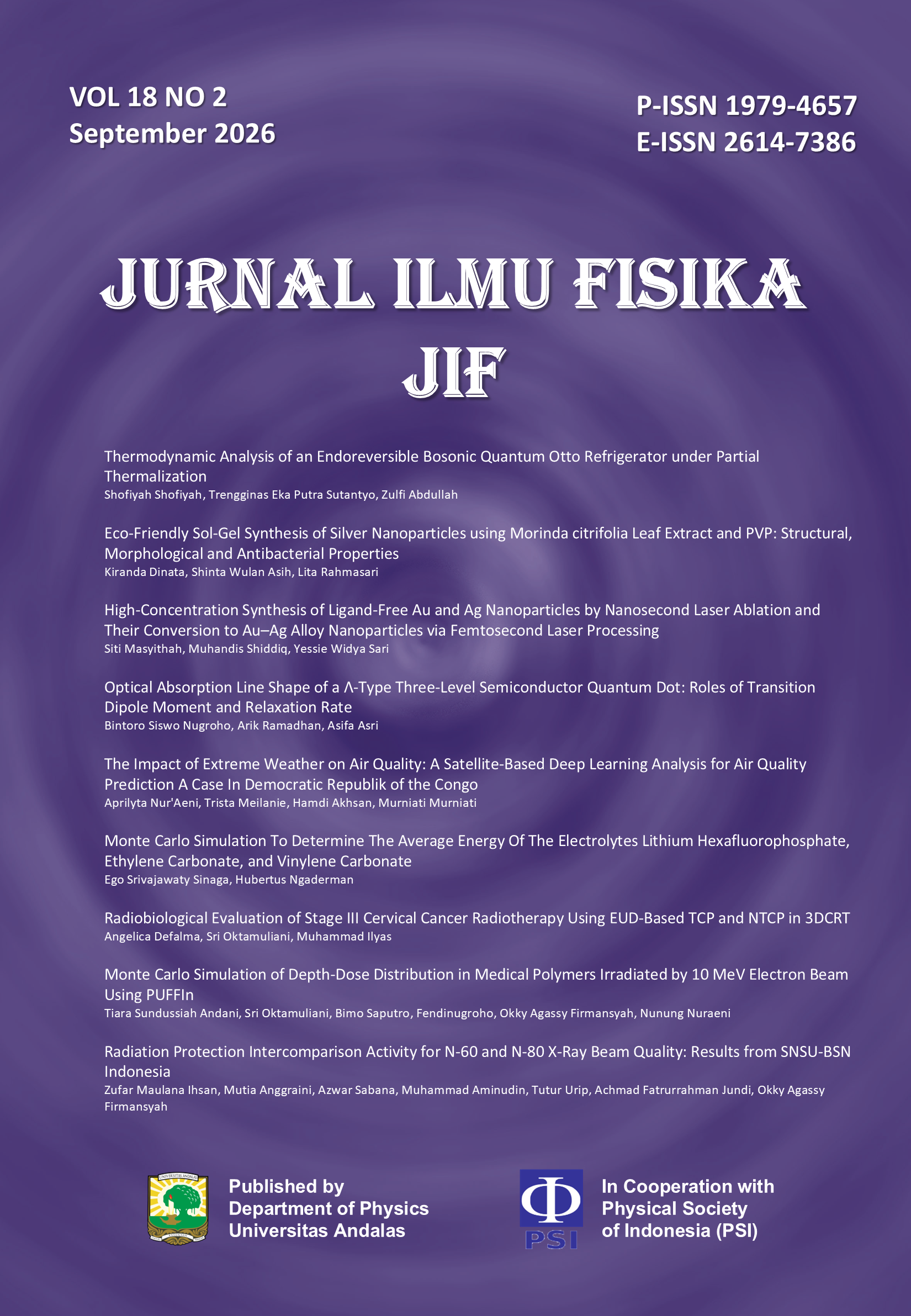
High-Concentration Synthesis of Ligand-Free Au and Ag Nanoparticles by Nanosecond Laser Ablation and Their Conversion to Au–Ag Alloy Nanoparticles via Femtosecond Laser Processing
DOI:
https://doi.org/10.25077/jif.18.2.145-157.2026Keywords:
Laser ablation , Femtosecond processing , Au–Ag nanoparticles , Ligand-free synthesis, Colloidal stabilityAbstract
A laser processing strategy is presented for the high-concentration synthesis of ligand-free Au, Ag, and Au–Ag alloy nanoparticles. Monometallic Au and Ag nanoparticles were first synthesized independently by nanosecond pulsed laser ablation in liquid (PLAL), producing stable ligand-free colloids. The Au and Ag colloids were then mixed in an equimolar ratio and irradiated with femtosecond laser pulses to induce alloy formation without chemical stabilizers or reducing agents. Ultraviolet–visible (UV–vis) spectroscopy shows a single localized surface plasmon resonance peak that shifts from 400 nm (Ag) to 509 nm (Au), with the Au–Ag alloy peak located between the two, confirming alloy formation. Transmission electron microscopy (TEM) reveals spherical Au, Au–Ag alloy, and Ag nanoparticles with average diameters of 11.8 ± 8.1 nm, 18.8 ± 5.9 nm, and 20.3 ± 9.4 nm, respectively, with the alloy nanoparticles exhibiting a narrower size distribution. Zeta potential measurements of −36.4, −41.2, and −48.1 mV for Ag, Au, and Au–Ag nanoparticles indicate good colloidal stability, with the alloy nanoparticles showing the highest stability. This laser-based approach provides a chemical-free route for producing high-concentration noble metal and alloy nanoparticles with tunable plasmonic and colloidal properties.
Downloads
References
AdibAmini, S., Sari, A. H., & Dorranian, D. (2023). Optical properties of synthesized Au/Ag Nanoparticles using 532 nm and 1064 nm pulsed laser ablation: Effect of solution concentration. SN Applied Sciences, 5(4), 122. https://doi.org/10.1007/s42452-023-05310-1
Amendola, V., & Meneghetti, M. (2009). Laser ablation synthesis in solution and size manipulation of noble metal nanoparticles. Physical Chemistry Chemical Physics, 11(20), 3805–3821. https://doi.org/10.1039/B900654K
Anees Ahmad, S., Sachi Das, S., Khatoon, A., Tahir Ansari, M., Afzal, Mohd., Saquib Hasnain, M., & Kumar Nayak, A. (2020). Bactericidal activity of silver nanoparticles: A mechanistic review. Materials Science for Energy Technologies, 3, 756–769. https://doi.org/10.1016/j.mset.2020.09.002
Baygar, T., Saraç, N., & Uğur, A. (2022). Cytotoxicity and Wound Healing Capacity of Biologically Synthesized Silver Nanoparticles. Mugla Journal of Science and Technology, 8(1), 63–68. https://doi.org/10.22531/muglajsci.1087581
Besner, S., & Meunier, M. (2010). Femtosecond Laser Synthesis of AuAg Nanoalloys: Photoinduced Oxidation and Ions Release. The Journal of Physical Chemistry C, 114(23), 10403–10409. https://doi.org/10.1021/jp102461u
Chen, W., Chu, R., Li, H., Hua, T., Chen, H., Li, R., Zhou, D., Cao, S., Ye, S., & Li, H. (2023). A novel wound dressing based on a gold nanoparticle self-assembled hydrogel to promote wound healing. Materials Advances, 4(14), 2918–2925. https://doi.org/10.1039/D3MA00130J
Coviello, V., Forrer, D., & Amendola, V. (2022). Recent Developments in Plasmonic Alloy Nanoparticles: Synthesis, Modelling, Properties and Applications. ChemPhysChem, 23(21), e202200136. https://doi.org/10.1002/cphc.202200136
Damle, A., Sundaresan, R., Rajwade, J. M., Srivastava, P., & Naik, A. (2022). A concise review on implications of silver nanoparticles in bone tissue engineering. Biomaterials Advances, 141, 213099. https://doi.org/10.1016/j.bioadv.2022.213099
Dell’Aglio, M., & De Giacomo, A. (2020). Plasma charging effect on the nanoparticles releasing from the cavitation bubble to the solution during nanosecond Pulsed Laser Ablation in Liquid. Applied Surface Science, 515, 146031. https://doi.org/10.1016/j.apsusc.2020.146031
Fatmawati, T., Shiddiq, M., Armynah, B., & Tahir, D. (2023). Synthesis Methods of Fe3 O4 Nanoparticles for Biomedical Applications. Chemical Engineering & Technology, 46(11), 2356–2366. https://doi.org/10.1002/ceat.202200384
Franková, J., Pivodová, V., Vágnerová, H., Juráňová, J., & Ulrichová, J. (2016). Effects of Silver Nanoparticles on Primary Cell Cultures of Fibroblasts and Keratinocytes in a Wound-Healing Model. Journal of Applied Biomaterials & Functional Materials, 14(2), 137–142. https://doi.org/10.5301/jabfm.5000268
Herbani, Y., Nakamura, T., & Sato, S. (2016). Spectroscopic monitoring on irradiation-induced formation of AuAg alloy nanoparticles by femtosecond laser. AIP Conference Proceedings, 1711(1), 030005. https://doi.org/10.1063/1.4941620
Hidayah, A. N., & Herbani, Y. (2020). Femtosecond laser melting and alloying in Au-Ag nanoalloys from colloid mixture of gold-silver nanoparticles, 2256(1), 020006. https://doi.org/10.1063/5.0018421
Hidayah, A. N., Herbani, Y., Steven, E., Subhan, A., Triyono, D., Isnaeni, Suliyanti, M. M., & Shiddiq, M. (2022). Tuning the electrical properties of colloidal nanoalloys by varying their composition. Colloids and Surfaces A: Physicochemical and Engineering Aspects, 641, 128496. https://doi.org/10.1016/j.colsurfa.2022.128496
Julita, M., Shiddiq, M., & Khair, M. (2022). Determination of band gap energy of ZnO/Au nanoparticles resulting in laser ablation in liquid. Indonesian Journal of Chemical Research, 10(2), 83–87.
Khan, Md. A. R., Al Mamun, M. S., Habib, Md. A., Islam, A. B. M. N., Mahiuddin, Md., Karim, K. Md. R., Naime, J., Saha, P., Dey, S. K., & Ara, M. H. (2022). A review on gold nanoparticles: Biological synthesis, characterizations, and analytical applications. Results in Chemistry, 4, 100478. https://doi.org/10.1016/j.rechem.2022.100478
Kurniawan, Salamah, U., Herbani, Y., Isnaeni, & Shiddiq, M. (2022). Fabrication of Cu nanoparticles using pulsed laser ablation in ethylene glycol. AIP Conference Proceedings, 2652(1), 020003. https://doi.org/10.1063/5.0107576
Lazar, O. A., Nikolov, A. S., Moise, C. C., Enachescu, M., Lazar, O. A., Nikolov, A. S., Moise, C. C., & Enachescu, M. (2023). Pulsed Laser Ablation in Liquids for Fabrication of Noble Metal Nanostructures. In Laser Ablation—Applications and Modeling. IntechOpen. https://doi.org/10.5772/intechopen.111550
Lin, Z., Luo, Y., Liu, P., Li, Y., Yue, J., & Jiang, L. (2021). Atomic-engineering Au-Ag nanoalloys for screening antimicrobial agents with low toxicity towards mammalian cells. Colloids and Surfaces B: Biointerfaces, 204, 111831. https://doi.org/10.1016/j.colsurfb.2021.111831
Majhi, J. K., & Kuiri, P. K. (2020). Spectral Tuning of Plasmon Resonances of Bimetallic Noble Metal Alloy Nanoparticles Through Compositional Changes. Plasmonics, 15(3), 797–804. https://doi.org/10.1007/s11468-019-01103-8
Masyithah, S., Alfaruqi, M. H., Yudasari, N., & Shiddiq, M. (2024). Fabrications of ZnO and Zn nanoparticles by pulsed laser ablation in water and acetone. AIP Conference Proceedings, 3003(1), 020122. https://doi.org/10.1063/5.0186540
Mateos, H., Picca, R. A., Mallardi, A., Dell’Aglio, M., Giacomo, A. D., Cioffi, N., & Palazzo, G. (2020). Effect of the Surface Chemical Composition and of Added Metal Cation Concentration on the Stability of Metal Nanoparticles Synthesized by Pulsed Laser Ablation in Water. Applied Sciences, 10(12). https://doi.org/10.3390/app10124169
Mkhondwane, S. T., & Pullabhotla, V. S. R. (2024). Synergistic effect in bimetallic gold catalysts: Recent trends and prospects. Physical Sciences Reviews, 9(3), 1523–1551. https://doi.org/10.1515/psr-2022-0269
Moreira, M., Hillenkamp, M., Rodrigues, V., & Ugarte, D. (2024). Ag Surface Segregation in Sub-10-nm Bimetallic AuAg Nanoparticles Quantified by STEM-EDS and Machine Learning: Implications for Fine-Tuning Physicochemical Properties for Plasmonics and Catalysis Applications. ACS Applied Nano Materials, 7(1), 1369–1378. https://doi.org/10.1021/acsanm.3c05495
Nene, A., Antarnusa, G., Dulta, K., Sadeghzade, S., Wang, L., Ravikumar, C. H., Aman, J., Khongthaw, B., Kandwal, A., Somani, P., Kumar, A., Ramachandran, K., Subramaniam, V., Galluzzi, M., Dou, S., & Liu, X. (2025). Au–Ag bimetallic nanoparticles: Synthesis, structure, and application in sensing. ChemPhysMater, 4(4), 331–343. https://doi.org/10.1016/j.chphma.2025.02.006
Nguyen, T. B., Nguyen, T. D., Tran, T. D., & Thi, T. H. N. (2015). Laser-Induced Synthesis of Au–Ag Alloy Nanoparticles in Polyvinylpyrrolidone (C6H9NO)n Solution. Journal of Cluster Science, 26(5), 1787–1799. https://doi.org/10.1007/s10876-015-0877-7
Norsyuhada, W., Shukri, W. M., Bidin, N., Islam, S., & Krishnan, G. (2018). Synthesis of Au-Ag Alloy Nanoparticles in Deionized Water by Pulsed Laser Ablation Technique. Journal of Nanoscience and Nanotechnology, 18(7), 4841–4851. https://doi.org/10.1166/jnn.2018.15358
Padmos, J. D., Langman, M., MacDonald, K., Comeau, P., Yang, Z., Filiaggi, M., & Zhang, P. (2015). Correlating the Atomic Structure of Bimetallic Silver–Gold Nanoparticles to Their Antibacterial and Cytotoxic Activities. The Journal of Physical Chemistry C, 119(13), 7472–7482. https://doi.org/10.1021/acs.jpcc.5b00145
Pannerselvam, B., Dharmalingam Jothinathan, M. K., Rajenderan, M., Perumal, P., Pudupalayam Thangavelu, K., Kim, H. J., Singh, V., & Rangarajulu, S. K. (2017). An in vitro study on the burn wound healing activity of cotton fabrics incorporated with phytosynthesized silver nanoparticles in male Wistar albino rats. European Journal of Pharmaceutical Sciences, 100, 187–196. https://doi.org/10.1016/j.ejps.2017.01.015
Papagiannouli, I., Aloukos, P., Rioux, D., Meunier, M., & Couris, S. (2015). Effect of the Composition on the Nonlinear Optical Response of AuxAg1–x Nano-Alloys. The Journal of Physical Chemistry C, 119(12), 6861–6872. https://doi.org/10.1021/jp512404a
Qayyum, H., Amin, S., Ahmed, W., Mohamed, T., Ur Rehman, Z., & Hussain, S. (2022). Laser-based two-step synthesis of Au-Ag alloy nanoparticles and their application for surface-enhanced Raman spectroscopy (SERS) based detection of rhodamine 6G and urea nitrate. Journal of Molecular Liquids, 365, 120120. https://doi.org/10.1016/j.molliq.2022.120120
Rehbock, C., Jakobi, J., Gamrad, L., Meer, S. van der, Tiedemann, D., Taylor, U., Kues, W., Rath, D., & Barcikowski, S. (2014). Current state of laser synthesis of metal and alloy nanoparticles as ligand-free reference materials for nano-toxicological assays. Beilstein Journal of Nanotechnology, 5(1), 1523–1541. https://doi.org/10.3762/bjnano.5.165
Rodriguez-Loya, J., Lerma, M., & Gardea-Torresdey, J. L. (2023). Dynamic Light Scattering and Its Application to Control Nanoparticle Aggregation in Colloidal Systems: A Review. Micromachines, 15(1). https://doi.org/10.3390/mi15010024
Ruth, F., Soeratri, W., Hariyadi, D. M., Septiana, E., Muttaqien, S. E., Munfadlila, A. W., Sekaringtyas, F. C., & Rosyidah, A. (2025). Gold Nanoparticle Synthesized from Centella asiatica: Emphasis on Optimization, Characterization, Antioxidant, Antiglycation, and Cytotoxicity Effect as an Anti-aging Cosmetic Ingredient. BioNanoScience, 15(1), 45. https://doi.org/10.1007/s12668-024-01713-5
Sakthi Devi, R., Girigoswami, A., Siddharth, M., & Girigoswami, K. (2022). Applications of Gold and Silver Nanoparticles in Theranostics. Applied Biochemistry and Biotechnology, 194(9), Article 9. https://doi.org/10.1007/s12010-022-03963-z
Schmidt, H. G. (2022). Safe Piranhas: A Review of Methods and Protocols. ACS Chemical Health & Safety, 29(1), 54–61. https://doi.org/10.1021/acs.chas.1c00094
Situ, X., Bayram, S. S., & Blum, A. S. (2023). Two-Step Synthesis of Large Gold–Silver Alloy Nanoparticles via the Combination of Seeded Growth and Citrate Co-reduction. The Journal of Physical Chemistry C, 127(22), 10888–10895. https://doi.org/10.1021/acs.jpcc.3c03095
Subha, V. (2021). Silver Nanoparticles Impregnated Nanocollagen as Scaffold for Soft Tissue Repair-Synthesis, Characterization, and In vitro Investigation. International Journal of Medical Nano Research, 8(1), 034. https://doi.org/10.23937/2378-3664.1410034
Sudarman, F., Shiddiq, M., Armynah, B., & Tahir, D. (2023a). Silver nanoparticles (AgNPs) synthesis methods as heavy-metal sensors: A review. International Journal of Environmental Science and Technology, 20(8), 9351–9368. https://doi.org/10.1007/s13762-022-04745-0
Tang, J., Shi, H., Ma, G., Luo, L., & Tang, Z. (2020). Ultrasmall Au and Ag Nanoclusters for Biomedical Applications: A Review. Frontiers in Bioengineering and Biotechnology, 8. https://www.frontiersin.org/articles/10.3389/fbioe.2020.01019
Toczek, J., Sadłocha, M., Major, K., & Stojko, R. (2022). Benefit of Silver and Gold Nanoparticles in Wound Healing Process after Endometrial Cancer Protocol. Biomedicines, 10(3), 679. https://doi.org/10.3390/biomedicines10030679
Tsalsabila, A., Herbani, Y., & Widya Sari, Y. (2024). Investigation of pH effect on lysine-capped gold nanoparticles to induce hydroxyapatite formation. AIP Conference Proceedings, 3210(1), 020004. https://doi.org/10.1063/5.0229963
Zhang, D., Gökce, B., & Barcikowski, S. (2017). Laser Synthesis and Processing of Colloids: Fundamentals and Applications. Chemical Reviews, 117(5), 3990–4103. https://doi.org/10.1021/acs.chemrev.6b00468
Zhang, G., Ma, Y., Liu, F., Nie, Y., Liu, Z., Fu, X., Luan, X., Qu, F., Liu, M., & Zheng, Y. (2020). Seeded growth of gold–silver ultrathin wire–dot hybrid nanostructures. CrystEngComm, 22(35), 5768–5775. https://doi.org/10.1039/D0CE01009J
Zhang, J., Chaker, M., & Ma, D. (2017). Pulsed laser ablation based synthesis of colloidal metal nanoparticles for catalytic applications. Journal of Colloid and Interface Science, Laser Synthesis, 489, 138–149. https://doi.org/10.1016/j.jcis.2016.07.050
Zhu, B., Li, X., Li, Y., Liu, J., & Zhang, X. (2023). Boosting the Photocatalysis of Plasmonic Au-Cu Nanocatalyst by AuCu-TiO2 Interface Derived from O2 Plasma Treatment. International Journal of Molecular Sciences, 24(13), 10487. https://doi.org/10.3390/ijms241310487
Downloads
Published
How to Cite
Issue
Section
Citation Check
License
Copyright (c) 2026 Siti Masyithah, Muhandis Shiddiq, Yessie Widya Sari

This work is licensed under a Creative Commons Attribution-NonCommercial 4.0 International License.
Please find the rights and licenses in JIF (Jurnal Ilmu Fisika).
1. License
The non-commercial use of the article will be governed by the Creative Commons Attribution license as currently displayed on Creative Commons Attribution-NonCommercial 4.0 International License.
2. Author's Warranties
The author warrants that the article is original, written by stated author(s), has not been published before, contains no unlawful statements, does not infringe the rights of others, is subject to copyright that is vested exclusively in the author and free of any third party rights, and that any necessary written permissions to quote from other sources have been obtained by the author(s).
3. User Rights
JIF's spirit is to disseminate articles published are as free as possible. Under the Creative Commons license, JIF permits users to copy, distribute, display, and perform the work for non-commercial purposes only. Users will also need to attribute authors and JIF on distributing works in the journal.
4. Rights of Authors
Authors retain the following rights:
- Copyright, and other proprietary rights relating to the article, such as patent rights,
- The right to use the substance of the article in future own works, including lectures and books,
- The right to reproduce the article for own purposes, provided the copies are not offered for sale,
- The right to self-archive the article.
5. Co-Authorship
If the article was jointly prepared by other authors, the signatory of this form warrants that he/she has been authorized by all co-authors to sign this agreement on their behalf, and agrees to inform his/her co-authors of the terms of this agreement.
6. Termination
This agreement can be terminated by the author or JIF upon two months's notice where the other party has materially breached this agreement and failed to remedy such breach within a month of being given the terminating party's notice requesting such breach to be remedied. No breach or violation of this agreement will cause this agreement or any license granted in it to terminate automatically or affect the definition of JIF.
7. Royalties
This agreement entitles the author to no royalties or other fees. To such extent as legally permissible, the author waives his or her right to collect royalties relative to the article in respect of any use of the article by JIF or its sublicensee.
8. Miscellaneous
JIF will publish the article (or have it published) in the journal if the article's editorial process is successfully completed and JIF or its sublicensee has become obligated to have the article published. JIF may conform the article to a style of punctuation, spelling, capitalization, referencing and usage that it deems appropriate. The author acknowledges that the article may be published so that it will be publicly accessible and such access will be free of charge for the readers.