
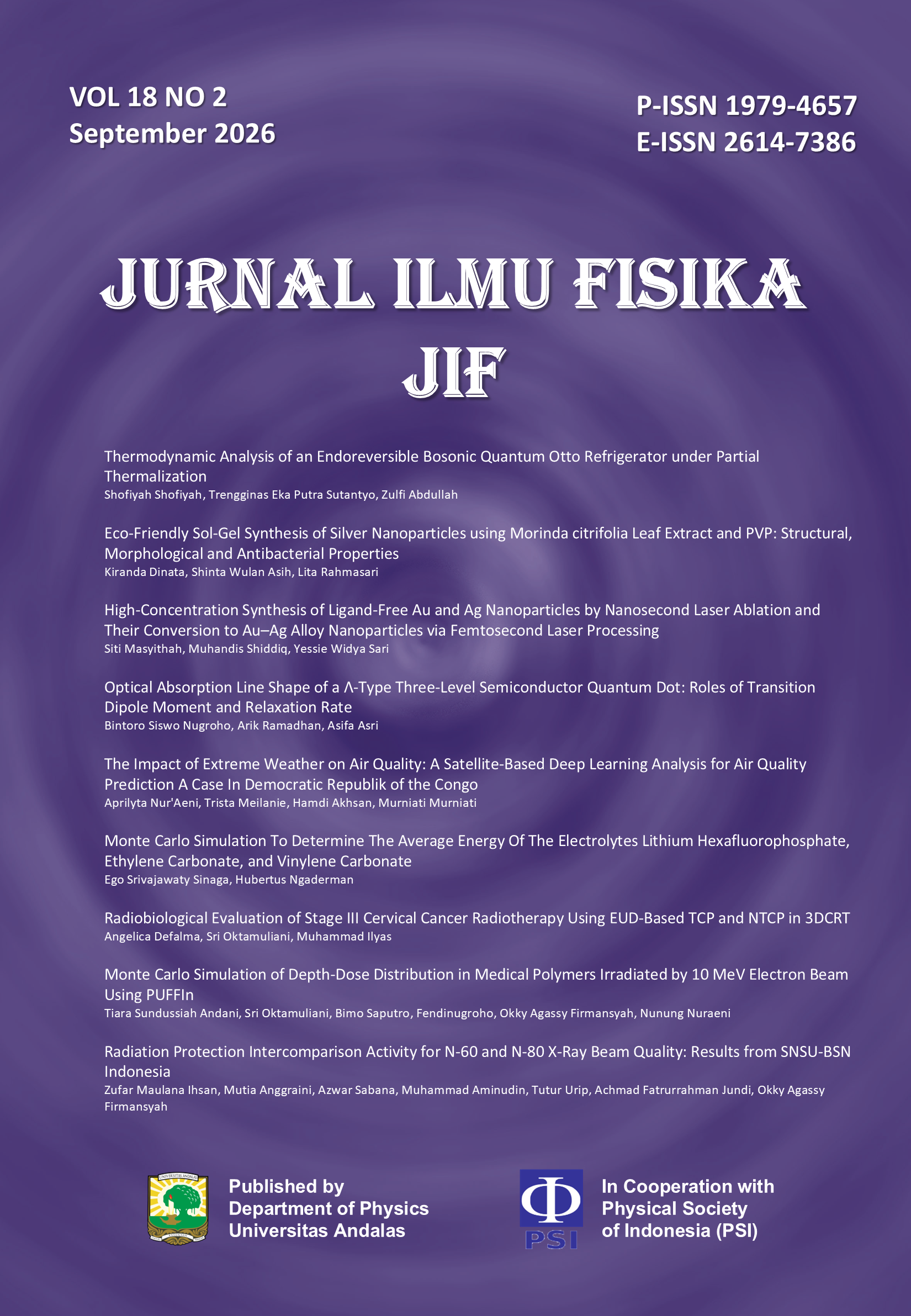
Radiobiological Evaluation of Stage III Cervical Cancer Radiotherapy Using EUD-Based TCP and NTCP in 3DCRT
DOI:
https://doi.org/10.25077/jif.18.2.199-209.2026Keywords:
Cervical Cancer, Radiotherapy, Homogeneity Index , Conformity Index, Equivalent Uniform DoseAbstract
This study evaluated the dosimetric and radiobiological parameters in 24 patients with Stage III cervical cancer treated with Three-Dimensional Conformal Radiation Therapy (3DCRT) at Universitas Andalas Hospital, using an Indonesian clinical dataset for context-specific radiobiological evaluation. Physical dose quality was assessed using the Homogeneity Index (HI) and Conformity Index (CI). Biological effectiveness was evaluated using Niemierko’s Equivalent Uniform Dose (EUD) model to determine Tumor Control Probability (TCP) and Normal Tissue Complication Probability (NTCP). Dose-volume histogram (DVH) data were extracted from the Eclipse TPS and processed via Python. Physical planning demonstrated acceptable conformity (CI = 0.9695 ± 0.0084) and homogeneity (HI = 0.0739 ± 0.0129). Mean TCP for the external beam radiotherapy phase (50 Gy in 25 fractions) was 41.36% ± 0.31%, representing moderate biological control prior to brachytherapy. Organs at risk exhibited low toxicity for the rectum (NTCP = 0.40% ± 0.18%) and bowel (NTCP = 2.06% ± 3.00%). Conversely, the bladder showed the highest complication risk (NTCP = 83.16% ± 26.78%, EUD = 93.57 ± 9.99 Gy), frequently exceeding tolerance limits due to anatomical proximity and volume variability. 3DCRT yields satisfactory physical coverage and rectal/bowel sparing, but requires standardized bladder protocols to minimize toxicity.
Downloads
References
Antony, F., Mathew Varghese, K., Jomon Raphael, C., Paul Gopu, G., & Sivakumar, S. (2021). Dosimetric comparison of organs at risk with three-dimensional conformal radiation, intensity-modulated radiation and volumetric-modulated arc therapy in cervical cancer: A cross-sectional study. International Journal of Advances in Medicine, 8(4), 586–590. https://doi.org/10.18203/2349-3933.ijam20210978
Cherry, P., & Duxbury, A. M. (Eds.). (2009). Practical Radiotherapy: Physics and Equipment (2nd ed.). Wiley-Blackwell. ISBN 978-1-4051-8426-7.
Effina, A., Milvita, D., & Ilyas, M. (2022). Distribusi dosis radiasi foton pada treatment planning system menggunakan teknik 3DCRT dan IMRT untuk terapi kanker serviks. Jurnal Fisika Unand, 11(1), 126–130. https://doi.org/10.25077/jfu.11.1.126-130.2022
Fader, A. N. (2018). Surgery in cervical cancer. New England Journal of Medicine, 379(20), 1955–1957. https://doi.org/10.1056/NEJMe1814034
Fatimah, N., & Widita, R. (2018). Penentuan Tumor Control Probability (TCP) dengan memperhitungkan efek repair menggunakan model Equivalent Uniform Dose (EUD). Prosiding SKF 2018, 108–113.
Gonultas, L. (2026). Determining optimal conformity index values in pelvic region radiotherapy planning under ICRU 50/62, ICRU 83, and RTOG/NRG guidelines. Journal of Applied Clinical Medical Physics, 27(5), e70635. https://doi.org/10.1002/acm2.70635
Khatun, S. (2018). Prevention of cervical cancer. Bangladesh Journal of Obstetrics & Gynaecology, 33(1), 1–3. https://doi.org/10.3329/bjog.v33i1.43266
Gulliford, S. L., Partridge, M., Sydes, M. R., Webb, S., Evans, P. M., & Dearnaley, D. P. (2012). Parameters for the Lyman Kutcher Burman (LKB) model of Normal Tissue Complication Probability (NTCP) for specific rectal complications observed in clinical practise. Radiotherapy and Oncology, 102(3), 347–351. https://doi.org/10.1016/j.radonc.2011.10.022
Li, S., Gong, Y., Yang, Y., Guo, Q., Qian, J., & Tian, Y. (2020). Evaluation of small bowel motion and feasibility of using the peritoneal space to replace bowel loops for dose constraints during intensity-modulated radiotherapy for rectal cancer. Radiation Oncology, 15(1), 211. https://doi.org/10.1186/s13014-020-01650-z
Malafi, M. E. (2024). The lives saved: A literature review on the role of radiotherapy improving prognosis in cancer patients. Journal of Quality in Health Care & Economics, 7(1), 1–3. https://doi.org/10.23880/jqhe-16000360
Mayadev, J. S., Ke, G., Mahantshetty, U., Pereira, M. D., Tarnawski, R., & Toita, T. (2022). Global challenges of radiotherapy for the treatment of locally advanced cervical cancer. International Journal of Gynecological Cancer, 32(3), 436–445. https://doi.org/10.1136/ijgc-2021-003001
Mazonakis, M., Tzanis, E., Lyraraki, E., & Damilakis, J. (2022). Automatic radiobiological comparison of radiation therapy plans: An application to gastric cancer. Cancers, 14(24), 6098. https://doi.org/10.3390/cancers14246098
Mazonakis, M., Kachris, S., Tolia, M., & Damilakis, J. (2023). NTCP calculations of five different irradiation techniques for the treatment of thymoma. Current Oncology, 30(8), 7740–7752. https://doi.org/10.3390/curroncol30080561
Nadova, K., Burghardtova, M., Fejfarova, K., Reginacova, K., & Malikova, H. (2021). Late radiation-related toxicities in patients treated for early-stage cervical carcinoma by surgery and adjuvant radiotherapy: A retrospective imaging study. Pathology and Oncology Research, 27, 1609915. https://doi.org/10.3389/pore.2021.1609915
Nuraini, R., & Widita, R. (2019). Tumor Control Probability (TCP) and Normal Tissue Complication Probability (NTCP) with consideration of cell biological effect. Journal of Physics: Conference Series, 1245(1), 012092. https://doi.org/10.1088/1742-6596/1245/1/012092
Okunieff, P., Morgan, D., Niemierko, A., & Suit, H. D. (1995). Radiation dose-response of human tumors. International Journal of Radiation Oncology, Biology, Physics, 32(4), 1227–1237. https://doi.org/10.1016/0360-3016(94)00475-Z
Pandey, U., & Bansal, P. (2017). What is cervical cancer? Journal of Gynecology and Women’s Health, 2(5), 555599. https://doi.org/10.19080/JGWH.2017.02.555599
Pratista, T. A., & Widita, R. (2023). Determination of fractionation scheme based on repair effect using Equivalent Uniform Dose (EUD) model. Indonesian Journal of Physics, 34(2), 8–13. https://doi.org/10.5614/itb.ijp.2023.34.2.2
Rather, S. A., Banday, M. S., & Qureshi, M. Z. (2024). Dosimetric analysis and radiobiological impact of radiotherapy planning techniques for esophageal squamous cell carcinoma in terms of Tumor Control Probability and Normal Tissue Complication Probability. Journal of Radiation and Cancer Research, 16(1), 8–16. https://doi.org/10.4103/jrcr.jrcr_2_24
Zhang, F., Zhou, M., Wang, G., Li, X., Yue, L., Deng, L., Chi, K., Chen, K., Qi, Z., Deng, X., Peng, Y., & Liu, Y. (2023). Evaluation of bladder filling effects on the dose distribution during radiotherapy for cervical cancer based on daily CT images. Journal of Applied Clinical Medical Physics, 24(11), e14097. https://doi.org/10.1002/acm2.14097
Downloads
Published
How to Cite
Issue
Section
Citation Check
License
Copyright (c) 2026 Angelica Defalma, Sri Oktamuliani, Muhammad Ilyas

This work is licensed under a Creative Commons Attribution-NonCommercial 4.0 International License.
Please find the rights and licenses in JIF (Jurnal Ilmu Fisika).
1. License
The non-commercial use of the article will be governed by the Creative Commons Attribution license as currently displayed on Creative Commons Attribution-NonCommercial 4.0 International License.
2. Author's Warranties
The author warrants that the article is original, written by stated author(s), has not been published before, contains no unlawful statements, does not infringe the rights of others, is subject to copyright that is vested exclusively in the author and free of any third party rights, and that any necessary written permissions to quote from other sources have been obtained by the author(s).
3. User Rights
JIF's spirit is to disseminate articles published are as free as possible. Under the Creative Commons license, JIF permits users to copy, distribute, display, and perform the work for non-commercial purposes only. Users will also need to attribute authors and JIF on distributing works in the journal.
4. Rights of Authors
Authors retain the following rights:
- Copyright, and other proprietary rights relating to the article, such as patent rights,
- The right to use the substance of the article in future own works, including lectures and books,
- The right to reproduce the article for own purposes, provided the copies are not offered for sale,
- The right to self-archive the article.
5. Co-Authorship
If the article was jointly prepared by other authors, the signatory of this form warrants that he/she has been authorized by all co-authors to sign this agreement on their behalf, and agrees to inform his/her co-authors of the terms of this agreement.
6. Termination
This agreement can be terminated by the author or JIF upon two months's notice where the other party has materially breached this agreement and failed to remedy such breach within a month of being given the terminating party's notice requesting such breach to be remedied. No breach or violation of this agreement will cause this agreement or any license granted in it to terminate automatically or affect the definition of JIF.
7. Royalties
This agreement entitles the author to no royalties or other fees. To such extent as legally permissible, the author waives his or her right to collect royalties relative to the article in respect of any use of the article by JIF or its sublicensee.
8. Miscellaneous
JIF will publish the article (or have it published) in the journal if the article's editorial process is successfully completed and JIF or its sublicensee has become obligated to have the article published. JIF may conform the article to a style of punctuation, spelling, capitalization, referencing and usage that it deems appropriate. The author acknowledges that the article may be published so that it will be publicly accessible and such access will be free of charge for the readers.