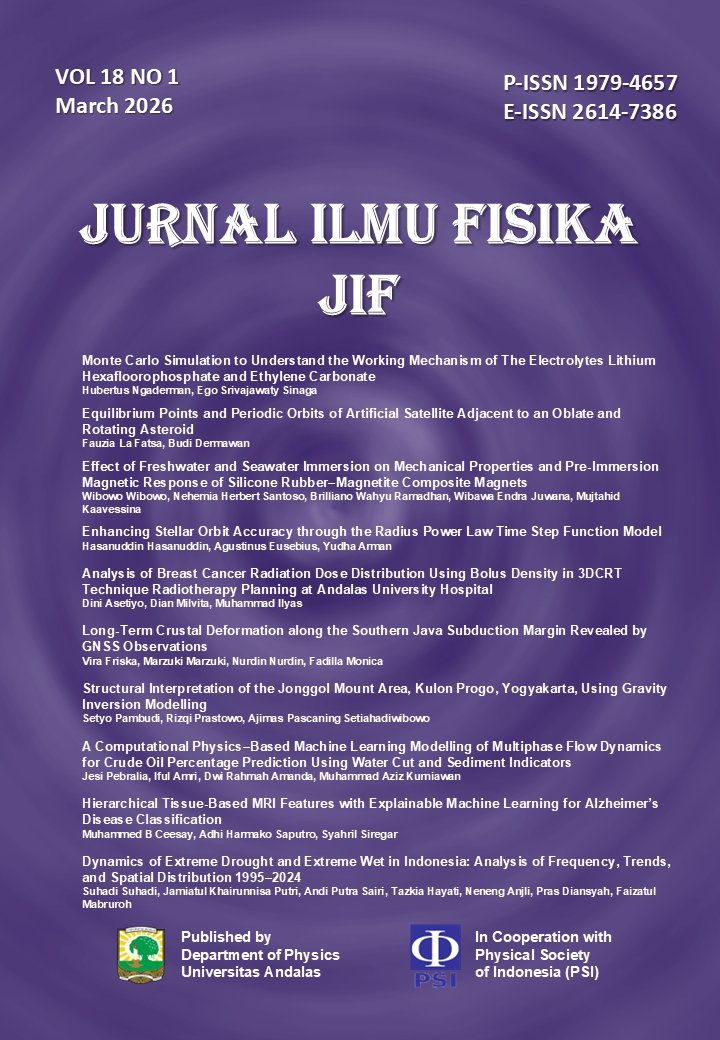
Structural Interpretation of the Jonggol Mount Area, Kulon Progo, Yogyakarta, Using Gravity Inversion Modelling
DOI:
https://doi.org/10.25077/jif.18.1.67-79.2026Keywords:
Andesite Formation, Gravity Inversion Modeling, Jonggrangan Formation, Mount Jonggol, Structural InterpretationAbstract
The Mount Jonggol region in Kulon Progo, Yogyakarta, constitutes an important segment of the Sunda–Banda magmatic arc system; however, its subsurface structural configuration remains insufficiently understood. This study aims to interpret subsurface structures and lithological boundaries through derivative analysis and three-dimensional gravity inversion modelling. The gravity dataset was obtained from the Global Gravity Model Plus (GGMplus), which provides absolute gravity acceleration measurements with high spatial resolution. The data were processed using sequential corrections, including normal gravity, free-air, simple Bouguer, and terrain corrections, to generate the Complete Bouguer Anomaly (CBA). The resulting CBA data were analyzed using the First and Second Horizontal Derivative (FHD and SHD) methods to delineate structural discontinuities, fault planes, and density contrasts. Furthermore, three-dimensional inversion modelling was conducted to visualize subsurface density variations to a depth of approximately 3.5 km. The results indicate that Mount Jonggol is situated at the tectono-lithological boundary between the low-density Jonggrangan Formation (2.0–2.4 g/cc) and the high-density Old Andesite Formation (2.7–3.0 g/cc). The gravity anomaly pattern reveals a northwest–southeast-oriented magmatic corridor controlled by thrust and strike-slip fault systems, providing important insights into the tectono-magmatic evolution and uplift mechanisms of southern Central Java.
Downloads
References
Blakely, R. J. (1996). Potential theory in gravity and magnetic applications. Cambridge university press.
Bondan, A., Suntoko, H., & Ryanto, T. A. (2019). Studi Geologi Kabupaten Kulon Progo Sebagai Alternatif Tapak Instalasi Nuklir.
Clements, B., Hall, R., Smyth, H. R., & Cottam, M. A. (2009). Thrusting of a volcanic arc: A new structural model for Java. Petroleum Geoscience, 15(2), 159–174.
Hall, R. (2012). Late Jurassic–Cenozoic reconstructions of the Indonesian region and the Indian Ocean. Tectonophysics, 570, 1–41.
Hall, R., Clements, B., Smyth, H. R., & Cottam, M. A. (2007). A new interpretation of Java’s structure.
Hall, R., & Smyth, H. R. (2008). Cenozoic arc processes in Indonesia: Identification of the key influences on the stratigraphic record in active volcanic arcs.
Hamilton, W. B. (1979). Tectonics of the Indonesian region (Issue 1078). US Government Printing Office.
Hammer, S. (1982). Critique of terrain corrections for gravity stations. Geophysics, 47(5), 839–840.
Hinze, W. J., Von Frese, R. R. B., Von Frese, R., & Saad, A. H. (2013). Gravity and magnetic exploration: Principles, practices, and applications. Cambridge University Press.
Hirt, C., Claessens, S., Fecher, T., Kuhn, M., Pail, R., & Rexer, M. (2013). New ultrahigh‐resolution picture of Earth’s gravity field. Geophysical Research Letters, 40(16), 4279–4283.
Hirt, C., Rexer, M., Scheinert, M., Pail, R., Claessens, S., & Holmes, S. (2016). A new degree-2190 (10 km resolution) gravity field model for Antarctica developed from GRACE, GOCE and Bedmap2 data. Journal of Geodesy, 90(2), 105–127.
Katili, J. (1967). On the occurrence of large transcurrent faults in Sumatra, Indonesia. J. Geosci. Osaka City Univ., 10, 5–17.
Koulali, A., Susilo, S., McClusky, S., Meilano, I., Cummins, P., Tregoning, P., Lister, G., Efendi, J., & Syafi’i, M. (2016). Crustal strain partitioning and the associated earthquake hazard in the eastern Sunda‐Banda Arc. Geophysical Research Letters, 43(5), 1943–1949.
Kusuma, H. D., Ramadhani, H., Novian, M. I., Furqon, M. A., Arimawan, Y., & Citra, I. A. (2019). Fasies dan Lingkungan Pengendapan Formasi Jonggrangan pada Jalur Lintasan Sentul-Gunung Jonggol, Pegunungan Kulon Progo Bagian Timur. RISET Geologi Dan Pertambangan, 29(2), 141–152.
Nabighian, M. N., Grauch, V., Hansen, R., LaFehr, T., Li, Y., Peirce, J. W., Phillips, J. D., & Ruder, M. (2005). The historical development of the magnetic method in exploration. Geophysics, 70(6), 33ND-61ND.
Nugraha, A. M. S., & Hall, R. (2018). Late cenozoic palaeogeography of Sulawesi, Indonesia. Palaeogeography, Palaeoclimatology, Palaeoecology, 490, 191–209.
Nurfiyanto, D., & Pandita, H. (2017). Studi Fasies Formasi Jonggrangan di Lintasan Jatimulyo, Girimulyo, Kulonprogo.
Pambudi, S., Isnaniawardhani, V., & Sudradjat, A. (2017). Microfacies of lower Jonggrangan Formation at Brajan Section, Banjararum, Kulon Progo, Indonesia. 268–273.
Pascaning Setiahadiwibowo, A., Setiawan, A., Husein, S., & Sismanto, S. (2025). Subsurface Structural Modelling using the Gravity Method in the Pacitan Area, Indonesia based on Derivative Analysis and Model Inversion. Rudarsko-Geološko-Naftni Zbornik, 40(1), 51–61.
Pirttijärvi, M. (2012). Bloxer Interactive Visualization and Editing Software for 3-D Block Models. User’s Guide to Version 1.6 c.
Pirttijarvi, M. (2014). Gravity interpretation and modeling software based on a 3-D block model. University of Oulu.
Pubellier, M., Ego, F., Chamot-Rooke, N., & Rangin, C. (2003). The building of pericratonic mountain ranges: Structural and kinematic constraints applied to GIS-based reconstructions of SE Asia. Bulletin de La Société Géologique de France, 174(6), 561–584.
Rahardjo, W., Sukandarrumidi, & H.M.D, R. (2012). Peta Geologi Lembar Yogyakarta, Jawa, skala 1: 100.000, cetakan ke 3.
Scotese, C. R., Vérard, C., Burgener, L., Elling, R. P., & Kocsis, A. T. (2025). The Cretaceous world: Plate tectonics, palaeogeography and palaeoclimate. Geological Society, London, Special Publications, 544(1), 31–202.
Setijadji, L. D., Kajino, S., Imai, A., & Watanabe, K. (2006). Cenozoic island arc magmatism in Java Island (Sunda Arc, Indonesia): Clues on relationships between geodynamics of volcanic centers and ore mineralization. Resource Geology, 56(3), 267–292.
Simandjuntak, T., & Barber, A. (1996). Contrasting tectonic styles in the Neogene orogenic belts of Indonesia. Geological Society, London, Special Publications, 106(1), 185–201.
Smyth, H., Hall, R., Hamilton, J., & Kinny, P. (2005). East Java: Cenozoic basins, volcanoes and ancient basement.
Telford, W. M., Geldart, L. P., & Sheriff, R. E. (1990). Applied geophysics. Cambridge university press.
Verdiansyah, O. (2019). A desktop study to determine mineralization using lineament density analysis at Kulon Progo Mountains, Yogyakarta and Central Java province, Indonesia. The Indonesian Journal of Geography, 51(1), 31–41.
Widagdo, A., Pramumijoyo, S., & Harijoko, A. (2018). Tectonostratigraphy-volcanic of Gajah-Ijo-Menoreh Tertiary volcanic formations in Kulon Progo mountain area, Yogyakarta-Indonesia. IOP Conference Series: Earth and Environmental Science, 212(1), 012052. https://doi.org/10.1088/1755-1315/212/1/012052
Downloads
Published
How to Cite
Issue
Section
Citation Check
License
Copyright (c) 2025 Setyo Pambudi, Rizqi Prastowo, Ajimas Pascaning Setiahadiwibowo

This work is licensed under a Creative Commons Attribution-NonCommercial 4.0 International License.
Please find the rights and licenses in JIF (Jurnal Ilmu Fisika).
1. License
The non-commercial use of the article will be governed by the Creative Commons Attribution license as currently displayed on Creative Commons Attribution-NonCommercial 4.0 International License.
2. Author's Warranties
The author warrants that the article is original, written by stated author(s), has not been published before, contains no unlawful statements, does not infringe the rights of others, is subject to copyright that is vested exclusively in the author and free of any third party rights, and that any necessary written permissions to quote from other sources have been obtained by the author(s).
3. User Rights
JIF's spirit is to disseminate articles published are as free as possible. Under the Creative Commons license, JIF permits users to copy, distribute, display, and perform the work for non-commercial purposes only. Users will also need to attribute authors and JIF on distributing works in the journal.
4. Rights of Authors
Authors retain the following rights:
- Copyright, and other proprietary rights relating to the article, such as patent rights,
- The right to use the substance of the article in future own works, including lectures and books,
- The right to reproduce the article for own purposes, provided the copies are not offered for sale,
- The right to self-archive the article.
5. Co-Authorship
If the article was jointly prepared by other authors, the signatory of this form warrants that he/she has been authorized by all co-authors to sign this agreement on their behalf, and agrees to inform his/her co-authors of the terms of this agreement.
6. Termination
This agreement can be terminated by the author or JIF upon two months's notice where the other party has materially breached this agreement and failed to remedy such breach within a month of being given the terminating party's notice requesting such breach to be remedied. No breach or violation of this agreement will cause this agreement or any license granted in it to terminate automatically or affect the definition of JIF.
7. Royalties
This agreement entitles the author to no royalties or other fees. To such extent as legally permissible, the author waives his or her right to collect royalties relative to the article in respect of any use of the article by JIF or its sublicensee.
8. Miscellaneous
JIF will publish the article (or have it published) in the journal if the article's editorial process is successfully completed and JIF or its sublicensee has become obligated to have the article published. JIF may conform the article to a style of punctuation, spelling, capitalization, referencing and usage that it deems appropriate. The author acknowledges that the article may be published so that it will be publicly accessible and such access will be free of charge for the readers.