
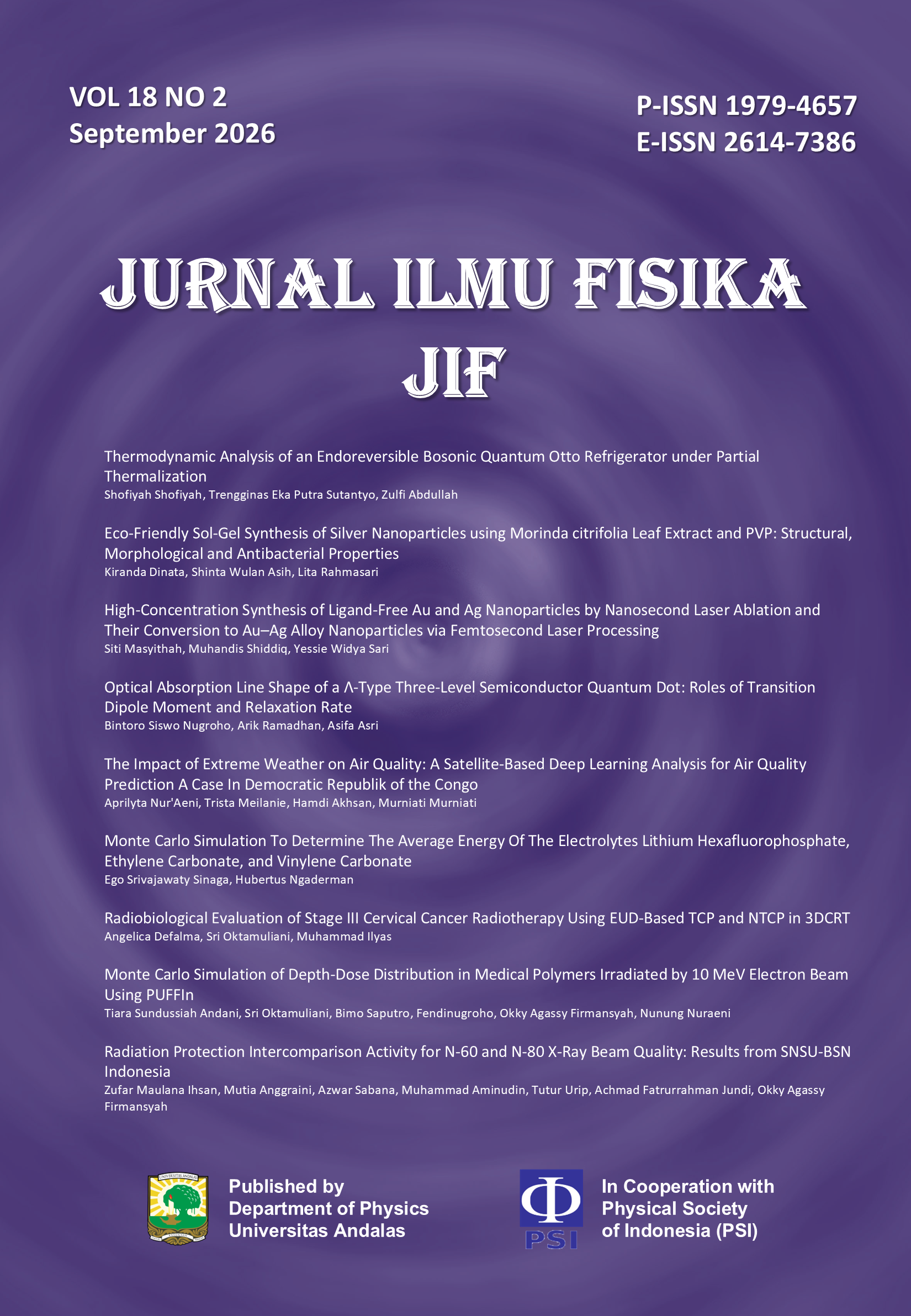
Thermodynamic Analysis of an Endoreversible Bosonic Quantum Otto Refrigerator under Partial Thermalization
DOI:
https://doi.org/10.25077/jif.18.2.117-128.2026Keywords:
Coefficient of Performance (COP), Cubic Potential, Otto Cycle, Partial Thermalization, Quantum RefrigeratorAbstract
Quantum refrigerators (QRs) are pivotal in exploring thermodynamic behavior at microscopic scales. This study investigates a quantum Otto refrigerator using a bosonic gas confined in a cubic potential, operating under finite-time thermalization. We derive key thermodynamic quantities analytically, including the coefficient of performance (COP), cooling power, entropy, and cooling rate. Additionally, we investigate how partial thermalization during the isochoric heating and cooling stages influences overall system performance. The findings reveal a trade-off between COP and cooling power, emphasizing the importance of thermalization duration. Notably, by extending the cooling time relative to heating, the COP can be significantly improved, offering a practical approach to optimizing QR performance under realistic conditions.
Downloads
References
Abah, O., & Lutz, E. (2016). Optimal performance of a quantum Otto refrigerator. Europhysics Letters, 113(6), 60002.
Abah, O., Paternostro, M., & Lutz, E. (2020). Shortcut-to-adiabaticity quantum Otto refrigerator. Physical Review Research, 2(2), 23120.
Altintas, F. (2025). Construction of a quantum Carnot refrigerator for general working substances. The European Physical Journal Plus, 140(5), 379.
Aveline, D. C., Williams, J. R., Elliott, E. R., Dutenhoffer, C., Kellogg, J. R., Kohel, J. M., Lay, N. E., Oudrhiri, K., Shotwell, R. F., & Yu, N. (2020). Observation of Bose–Einstein condensates in an Earth-orbiting research lab. Nature, 582(7811), 193–197.
Bagnato, V., Pritchard, D. E., & Kleppner, D. (1987). Bose-Einstein condensation in an external potential. Physical Review A, 35(10), 4354.
Behzadi, N. (2024). Refrigeration by modified Otto cycles and modified swaps through generalized measurements. Journal of Physics A: Mathematical and Theoretical, 57(29), 295308.
Belfaqih, I. H., Sutantyo, T. E. P., Prayitno, T. B., & Sulaksono, A. (2015). Quantum-Carnot engine for particle confined to 2D symmetric potential well. AIP Conference Proceedings, 1677(1).
Bhandari, B., & Jordan, A. N. (2021). Minimal two-body quantum absorption refrigerator. Physical Review B, 104(7), 75442.
Camati, P. A., Santos, J. F. G., & Serra, R. M. (2020). Employing non-Markovian effects to improve the performance of a quantum Otto refrigerator. Physical Review A, 102(1), 12217.
Çengel, Y. A. (2008). Thermodynamics : an Engineering Approach. McGraw-Hill Higher Education.
Chen, J.-F., Sun, C.-P., & Dong, H. (2019). Boosting the performance of quantum Otto heat engines. Physical Review E, 100(3), 32144.
Chen, J.-F., Sun, C. P., & Dong, H. (2021). Extrapolating the thermodynamic length with finite-time measurements. Physical Review E, 104(3), 34117.
Cleri, F. (2024). Quantum computers, quantum computing, and quantum thermodynamics. Frontiers in Quantum Science and Technology, 3, 1422257.
Contreras-Vergara, O., Valencia-Ortega, G., Sánchez-Salas, N., & Jiménez-Aquino, J. I. (2024). Performance at maximum figure of merit for a Brownian Carnot refrigerator. Physical Review E, 110(2), 24123.
Cruz, C., Rastegar-Sedehi, H.-R., Anka, M. F., de Oliveira, T. R., & Reis, M. (2023). Quantum Stirling engine based on dinuclear metal complexes. Quantum Science and Technology, 8(3), 35010.
Curzon, F. L., & Ahlborn, B. (1975). Efficiency of a Carnot engine at maximum power output. American Journal of Physics, 43(1), 22–24.
Deffner, S., & Campbell, S. (2019). Quantum Thermodynamics: An introduction to the thermodynamics of quantum information. Morgan & Claypool Publishers.
Fahriza, A., Sutantyo, T. E. P., & Abdullah, Z. (2022). Optimizations of multilevel quantum engine with N noninteracting fermions based on Lenoir cycle. The European Physical Journal Plus, 137(9), 1030.
Fei, Z., Chen, J.-F., & Ma, Y.-H. (2022). Efficiency statistics of a quantum Otto cycle. Physical Review A, 105(2), 22609.
Getie, M. Z., Lanzetta, F., Bégot, S., Admassu, B. T., & Hassen, A. A. (2020). Reversed regenerative Stirling cycle machine for refrigeration application: A review. International Journal of Refrigeration, 118, 173–187.
Griffiths, D. J., & Schroeter, D. F. (2018). Introduction to quantum mechanics. Cambridge university press.
He, Y., Ge, Y., Chen, L., & Feng, H. (2025). Exergy-based efficient ecological-function optimization for endoreversible Carnot refrigerators. Journal of Non-Equilibrium Thermodynamics, 0.
Hu, H., Yu, Z.-Q., Wang, J., & Liu, X.-J. (2021). First-order Bose-Einstein condensation with three-body interacting bosons. Physical Review A, 104(4), 43301.
Jiao, G., Xiao, Y., He, J., Ma, Y., & Wang, J. (2021). Quantum Otto refrigerators in finite-time cycle period. New Journal of Physics, 23(6), 63075.
Kaur, K., Rebari, S., & Singh, V. (2025). Performance analysis of quantum harmonic Otto engine and refrigerator under a trade-off figure of merit. Journal of Non-Equilibrium Thermodynamics, 50(1), 1–19.
Kurniasih, N., Kusmiyati, M., Nurhasnah, Puspita Sari, R., & Wafdan, R. (2019). Potensi Daun Sirsak (Annona muricata Linn), Daun Binahong (Anredera cordifolia (Ten) Steenis), dan Daun Benalu Mangga (Dendrophthoe pentandra) Sebagai Antioksidan Pencegah Kanker. Jurnal Istek, 9(1), 162–184.
Long, R., & Liu, W. (2015). Performance of quantum Otto refrigerators with squeezing. Physical Review E, 91(6), 62137.
Manikandan, S. K., Jussiau, É., & Jordan, A. N. (2020). Autonomous quantum absorption refrigerators. Physical Review B, 102(23), 235427.
Maslennikov, G., Ding, S., Hablützel, R., Gan, J., Roulet, A., Nimmrichter, S., Dai, J., Scarani, V., & Matsukevich, D. (2019). Quantum absorption refrigerator with trapped ions. Nature Communications, 10(1), 202.
Mohanraj, M., & Abraham, J. D. A. P. (2022). Environment friendly refrigerant options for automobile air conditioners: a review. Journal of Thermal Analysis and Calorimetry, 147(1), 47–72.
Mohapatra, A., Prusty, A. K., Nanda, J., Das, S. N., & Pandey, H. (2021). Potential Refrigerants and Their Effect on the Environment—A Review. Current Advances in Mechanical Engineering: Select Proceedings of ICRAMERD 2020, 239–249.
Myers, N. M., Peña, F. J., Negrete, O., Vargas, P., De Chiara, G., & Deffner, S. (2022a). Boosting engine performance with Bose–Einstein condensation. New Journal of Physics, 24(2), 25001.
Myers, N. M., Abah, O., & Deffner, S. (2022b). Quantum thermodynamic devices: From theoretical proposals to experimental reality. AVS Quantum Science, 4(2).
Nolte, D. D. (2019). Introduction to Modern Dynamics: Chaos, Networks, Space, and Time. Oxford University Press. https://doi.org/10.1093/oso/9780198844624.001.0001
Pathria, R. K., & Beale, P. D. (2011a). 1-the statistical basis of thermodynamics. Statistical Mechanics, 1–23.
Pathria, R. K., & Beale, P. D. (2011b). 15 - Fluctuations and Nonequilibrium Statistical Mechanics. In R. K. Pathria & P. D. Beale (Eds.), Statistical Mechanics (Third Edition) (Third Edit, pp. 583–635). Academic Press. https://doi.org/https://doi.org/10.1016/B978-0-12-382188-1.00015-3
Raja, S. H., Maniscalco, S., Paraoanu, G.-S., Pekola, J. P., & Gullo, N. Lo. (2021). Finite-time quantum Stirling heat engine. New Journal of Physics, 23(3), 33034.
Savitha, D. C., Ranjith, P. K., Talawar, B., & Rana Pratap Reddy, N. (2022). Refrigerants for sustainable environment–a literature review. International Journal of Sustainable Energy, 41(3), 235–256.
Singh, S., & Abah, O. (2020). Energy optimization of two-level quantum Otto machines. ArXiv Preprint ArXiv:2008.05002.
Singh, V., Singh, S., Abah, O., & Müstecaplıoğlu, Ö. E. (2022). Unified trade-off optimization of quantum harmonic Otto engine and refrigerator. Physical Review E, 106(2), 24137.
Sutantyo, T. (2020). Three-State Quantum Heat Engine Based on Carnot Cycle. Jurnal Fisika Unand, 9, 142–149. https://doi.org/10.25077/jfu.9.1.142-149.2020
Sutantyo, T. E. P., Zettira, Z., Fahriza, A., & Abdullah, Z. (2024). Performance of 3D quantum Otto engine with partial thermalization. Journal of Physics: Conference Series, 2734(1), 12031.
Sutantyo, T. E. P., Belfaqih, I. H., & Prayitno, T. B. (2015). Quantum-Carnot engine for particle confined to cubic potential. AIP Conference Proceedings, 1677(1), 40011.
Velasco, S., Roco, J. M. M., Medina, A., & Hernández, A. C. (1997). New performance bounds for a finite-time carnot refrigerator. Physical Review Letters, 78(17), 3241.
Wiedmann, M., Stockburger, J. T., & Ankerhold, J. (2021). Non-Markovian quantum Otto refrigerator: Dynamical operation through finite-time thermal coupling. The European Physical Journal Special Topics, 230(4), 851–857.
Xu, Y., Ruan, H., Luo, S., Guo, S., He, X., & Wang, J. (2025). Enhancing Otto refrigerator performance with a precooling strategy. Physical Review E, 111(2), L022101.
Yin, Y., Chen, L., & Wu, F. (2017). Optimal power and efficiency of quantum Stirling heat engines. The European Physical Journal Plus, 132, 1–10.
Zettili, N. (2009). Quantum mechanics: concepts and applications.
Zettira, Z., Sutantyo, T. E. P., & Abdullah, Z. (2024a). Efficiency at Maximum Power of Endoreversible Quantum Otto Engine with Partial Thermalization in 3D Harmonic Potential. JURNAL ILMU FISIKA| UNIVERSITAS ANDALAS, 16(1), 22–33.
Zettira, Z., Fahriza, A., Sutantyo, T. E. P., & Abdullah, Z. (2024b). Enhancing quantum Otto engine performance in generalized external potential on Bose–Einstein condensation regime. The European Physical Journal Plus, 139(3), 282.
Zhang, Y. (2020). Optimization performance of quantum Otto heat engines and refrigerators with squeezed thermal reservoirs. Physica A: Statistical Mechanics and Its Applications, 559, 125083.
Zhang, Z., Su, H., Dai, G., Li, X., & Zeng, L. (2023). Effects of variable-temperature heat reservoirs on performance of irreversible Carnot refrigerator with heat recovery. Scientific Reports, 13(1), 23068.
Downloads
Published
How to Cite
Issue
Section
Citation Check
License
Copyright (c) 2026 Shofiyah Shofiyah, Trengginas Eka Putra Sutantyo, Zulfi Abdullah

This work is licensed under a Creative Commons Attribution-NonCommercial 4.0 International License.
Please find the rights and licenses in JIF (Jurnal Ilmu Fisika).
1. License
The non-commercial use of the article will be governed by the Creative Commons Attribution license as currently displayed on Creative Commons Attribution-NonCommercial 4.0 International License.
2. Author's Warranties
The author warrants that the article is original, written by stated author(s), has not been published before, contains no unlawful statements, does not infringe the rights of others, is subject to copyright that is vested exclusively in the author and free of any third party rights, and that any necessary written permissions to quote from other sources have been obtained by the author(s).
3. User Rights
JIF's spirit is to disseminate articles published are as free as possible. Under the Creative Commons license, JIF permits users to copy, distribute, display, and perform the work for non-commercial purposes only. Users will also need to attribute authors and JIF on distributing works in the journal.
4. Rights of Authors
Authors retain the following rights:
- Copyright, and other proprietary rights relating to the article, such as patent rights,
- The right to use the substance of the article in future own works, including lectures and books,
- The right to reproduce the article for own purposes, provided the copies are not offered for sale,
- The right to self-archive the article.
5. Co-Authorship
If the article was jointly prepared by other authors, the signatory of this form warrants that he/she has been authorized by all co-authors to sign this agreement on their behalf, and agrees to inform his/her co-authors of the terms of this agreement.
6. Termination
This agreement can be terminated by the author or JIF upon two months's notice where the other party has materially breached this agreement and failed to remedy such breach within a month of being given the terminating party's notice requesting such breach to be remedied. No breach or violation of this agreement will cause this agreement or any license granted in it to terminate automatically or affect the definition of JIF.
7. Royalties
This agreement entitles the author to no royalties or other fees. To such extent as legally permissible, the author waives his or her right to collect royalties relative to the article in respect of any use of the article by JIF or its sublicensee.
8. Miscellaneous
JIF will publish the article (or have it published) in the journal if the article's editorial process is successfully completed and JIF or its sublicensee has become obligated to have the article published. JIF may conform the article to a style of punctuation, spelling, capitalization, referencing and usage that it deems appropriate. The author acknowledges that the article may be published so that it will be publicly accessible and such access will be free of charge for the readers.