
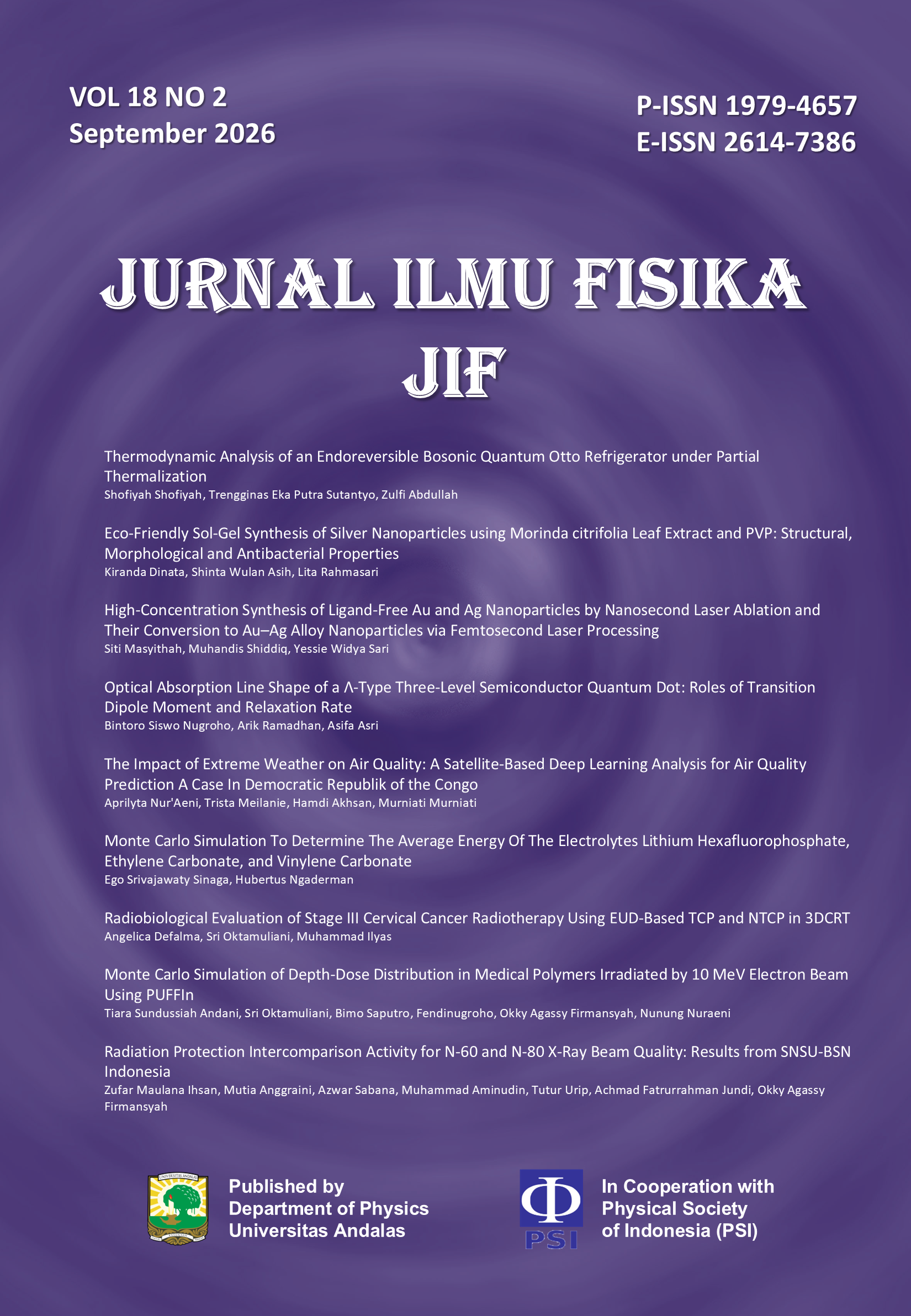
The Impact of Extreme Weather on Air Quality: A Satellite-Based Deep Learning Analysis for Air Quality Prediction—A Case Study in the Democratic Republic of the Congo
DOI:
https://doi.org/10.25077/jif.18.2.169-183.2026Keywords:
Extreme Weather, Air Quality, Satellite Data, PM2.5, Deep LearningAbstract
Air quality is vital for human health and environmental stability, particularly in tropical regions such as equatorial Africa where extreme weather and limited monitoring networks pose major challenges. This study examines how heat waves, heavy rainfall, and stagnant wind conditions influence fine particulate matter (PM₂.₅) in the Democratic Republic of Congo from 2014 to 2024. Satellite observations (TROPOMI, MODIS, GPM) combined with ERA5 reanalysis reveal that stagnant winds strongly enhance PM₂.₅ accumulation due to reduced atmospheric dispersion, while intense rainfall effectively decreases concentrations through wet deposition. High temperatures also intensify photochemical processes that increase surface ozone formation. To address the non-linear interactions among meteorological factors, the study develops deep learning prediction models (LSTM and CNN-LSTM) capable of forecasting PM₂.₅ levels up to 48 hours ahead with high accuracy. These models offer strong potential for integration into early warning systems to support public health protection and climate adaptation, especially in data-sparse regions. The results demonstrate that an interdisciplinary framework uniting hydrometeorology, remote sensing, and artificial intelligence provides a powerful approach for understanding air quality dynamics in complex tropical environments.
Downloads
References
Adeyemi, O., & Kamau, P. (2023). Climatic and Hydrometeorological Variability over Equatorial Africa. In Climate and Environmental Systems of Africa (pp. 155–180). Elsevier. https://doi.org/10.1016/B978-0-443-28867-8.00008-3 DOI: https://doi.org/10.1016/B978-0-443-28867-8.00008-3
Agbehadji, I. E., & Obagbuwa, I. C. (2024). Systematic review of machine learning and deep learning techniques for spatio-temporal air quality prediction. Atmosphere, 15(11), 1352. https://doi.org/10.3390/atmos15111352 DOI: https://doi.org/10.3390/atmos15111352
Amiri, Z., & Zare Shahne, M. (2025). Modeling PM2.5 concentration in tehran using satellite-based Aerosol optical depth (AOD) and machine learning: Assessing input contributions and prediction accuracy. Remote Sensing Applications: Society and Environment, 38, 101549. https://doi.org/10.1016/j.rsase.2025.101549 DOI: https://doi.org/10.1016/j.rsase.2025.101549
Bai, X., Zhang, N., Cao, X., & Chen, W. (2024). Prediction of PM 2.5 concentration based on a CNN-LSTM neural network algorithm. PeerJ, 12, e17811. https://doi.org/10.7717/peerj.17811 DOI: https://doi.org/10.7717/peerj.17811
Bhowmik, R. T., Jung, Y. S., Aguilera, J. A., Prunicki, M., & Nadeau, K. (2023). A multi-modal wildfire prediction and early-warning system based on a novel machine learning framework. Journal of Environmental Management, 341, 117908. https://doi.org/10.1016/j.jenvman.2023.117908 DOI: https://doi.org/10.1016/j.jenvman.2023.117908
Bililign, S., Brown, S. S., Westervelt, D. M., Kumar, R., Tang, W., Flocke, F., Vizuete, W., Ture, K., Pope, F. D., Demoz, B., Asa-Awuku, A., Levelt, P. F., Kalisa, E., Raheja, G., Ndyabakira, A., & Gatari, M. J. (2024). East African Megacity Air Quality: Rationale and Framework for a Measurement and Modeling Program. Bulletin of the American Meteorological Society, 105(8), E1584–E1602. https://doi.org/10.1175/BAMS-D-23-0098.1 DOI: https://doi.org/10.1175/BAMS-D-23-0098.1
Chen, G., Chen, S., Li, D., & Chen, C. (2025). A hybrid deep learning air pollution prediction approach based on neighborhood selection and spatio-temporal attention. Scientific Reports, 15(1), 3685. https://doi.org/10.1038/s41598-025-88086-1 DOI: https://doi.org/10.1038/s41598-025-88086-1
Dezfuli, A., Ichoku, C. M., & Bosilovich, M. G. (2024). Large‐Scale Climate Features Control Fire Emissions and Transport in Africa. Geophysical Research Letters, 51(18). https://doi.org/10.1029/2024GL110179 DOI: https://doi.org/10.1029/2024GL110179
Fang, W., Xue, Q., Shen, L., & Sheng, V. S. (2021). Survey on the application of deep learning in extreme weather prediction. Atmosphere, 12(6), 661. https://doi.org/10.3390/atmos12060661 DOI: https://doi.org/10.3390/atmos12060661
Handschuh, J., Erbertseder, T., & Baier, F. (2023). Systematic Evaluation of Four Satellite AOD Datasets for Estimating PM2.5 Using a Random Forest Approach. Remote Sensing, 15(8), 2064. https://doi.org/10.3390/rs15082064 DOI: https://doi.org/10.3390/rs15082064
Harisdianto, H., Affandi, A. K., Ariani, M., & Suhadi, S. (2023). Downscaling Spasial Data Curah Hujan TRMM di Wilayah Sumatera Selatan dengan Algoritma Artificial Neural Network dan Random Forest Regression. Jurnal Penelitian Sains, 25(3), 283. https://doi.org/10.56064/jps.v25i3.906 DOI: https://doi.org/10.56064/jps.v25i3.906
Hersbach, H., Bell, B., Berrisford, P., Hirahara, S., Horányi, A., Muñoz‐Sabater, J., Nicolas, J., Peubey, C., Radu, R., Schepers, D., Simmons, A., Soci, C., Abdalla, S., Abellan, X., Balsamo, G., Bechtold, P., Biavati, G., Bidlot, J., Bonavita, M., … Thépaut, J. (2020). The ERA5 global reanalysis. Quarterly Journal of the Royal Meteorological Society, 146(730), 1999–2049. https://doi.org/10.1002/qj.3803 DOI: https://doi.org/10.1002/qj.3803
Holloway, T., Miller, D., Anenberg, S., Diao, M., Duncan, B., Fiore, A. M., Henze, D. K., Hess, J., Kinney, P. L., Liu, Y., Neu, J. L., O’Neill, S. M., Odman, M. T., Pierce, R. B., Russell, A. G., Tong, D., West, J. J., & Zondlo, M. A. (2021). Satellite Monitoring for Air Quality and Health. Annual Review of Biomedical Data Science, 4(1), 417–447. https://doi.org/10.1146/annurev-biodatasci-110920-093120 DOI: https://doi.org/10.1146/annurev-biodatasci-110920-093120
Hu, K. (2022). Air quality prediction using spatio-temporal deep learning. Environmental Modelling & Software, 159, 105551. https://doi.org/10.1016/j.envsoft.2022.105551 DOI: https://doi.org/10.1016/j.envsoft.2022.105551
IPCC. (2021). Climate Change 2021 – The Physical Science Basis. Cambridge University Press. https://doi.org/10.1017/9781009157896 DOI: https://doi.org/10.1017/9781009157896
Jiang, Y., Zhou, L., Roundy, P. E., Hua, W., & Raghavendra, A. (2021). Increasing Influence of Indian Ocean Dipole on Precipitation Over Central Equatorial Africa. Geophysical Research Letters, 48(8). https://doi.org/10.1029/2020GL092370 DOI: https://doi.org/10.1029/2020GL092370
Kai-Sikhakhane, R. F., Scholes, M. C., Piketh, S. J., van Geffen, J., Garland, R. M., Havenga, H., & Scholes, R. J. (2024). Assessing Nitrogen Dioxide in the Highveld Troposphere: Pandora Insights and TROPOMI Sentinel-5P Evaluation. Atmosphere, 15(10), 1187. https://doi.org/10.3390/atmos15101187 DOI: https://doi.org/10.3390/atmos15101187
Kurniawan, A., & Prasetyo, R. (2025). Integrasi Data Satelit dan Deep Learning untuk Sistem Peringatan Dini Kualitas Udara. Jurnal Teknosains Dan Sistem Informasi (TEKNOSI), 11(2), 161–169. https://doi.org/10.25077/TEKNOSI.v11i2.2025.161-169 DOI: https://doi.org/10.25077/TEKNOSI.v11i2.2025.161-169
Langue, C. G. N., Lavaysse, C., Vrac, M., & Flamant, C. (2023). Heat wave monitoring over West African cities: uncertainties, characterization and recent trends. Natural Hazards and Earth System Sciences, 23(3), 1313–1331. https://doi.org/10.5194/nhess-23-1313-2023 DOI: https://doi.org/10.5194/nhess-23-1313-2023
Li, B., Liu, C., Hu, Q., Sun, M., Zhang, C., Zhu, Y., Liu, T., Guo, Y., Carmichael, G. R., & Gao, M. (2023). A Deep Learning Approach to Increase the Value of Satellite Data for PM2.5 Monitoring in China. Remote Sensing, 15(15), 3724. https://doi.org/10.3390/rs15153724 DOI: https://doi.org/10.3390/rs15153724
Liao, Q., Zhu, M., Wu, L., Pan, X., Tang, X., & Wang, Z. (2020). Deep Learning for Air Quality Forecasts: a Review. Current Pollution Reports, 6(4), 399–409. https://doi.org/10.1007/s40726-020-00159-z DOI: https://doi.org/10.1007/s40726-020-00159-z
Linda, J., Hasečić, A., Pospíšil, J., Kudela, L., & Brzezina, J. (2025). Impact of wind-induced resuspension on urban air quality: a CFD study with air quality data comparison. Npj Climate and Atmospheric Science, 8(1), 74. https://doi.org/10.1038/s41612-025-00969-2 DOI: https://doi.org/10.1038/s41612-025-00969-2
Liu, Y., & Zhou, Q. (2020). Long-Range Transport of Biomass Burning Emissions Driven by Convective Systems. Atmospheric Environment, 237, 117829. https://doi.org/10.1016/j.atmosenv.2020.117829 DOI: https://doi.org/10.1016/j.atmosenv.2020.117829
Longandjo, G.-N. T., & Rouault, M. (2024). Revisiting the Seasonal Cycle of Rainfall over Central Africa. Journal of Climate, 37(3), 1015–1032. https://doi.org/10.1175/JCLI-D-23-0281.1 DOI: https://doi.org/10.1175/JCLI-D-23-0281.1
Maharani, S., & Aryanta, W. R. (2023). Dampak Buruk Polusi Udara Bagi Kesehatan Dan Cara Meminimalkan Risikonya. Jurnal Ecocentrism, 3(2), 47–58. https://doi.org/10.36733/jeco.v3i2.7035 DOI: https://doi.org/10.36733/jeco.v3i2.7035
Meng, X., Jiang, J., Chen, T., Zhang, Z., Lu, B., Liu, C., Xue, L., Chen, J., Herrmann, H., & Li, X. (2023). Chemical drivers of ozone change in extreme temperatures in eastern China. Science of The Total Environment, 874, 162424. https://doi.org/10.1016/j.scitotenv.2023.162424 DOI: https://doi.org/10.1016/j.scitotenv.2023.162424
Meng, X., Wu, Z., Chen, J., Qiu, Y., Zong, T., Song, M., Lee, J., & Hu, M. (2024). Particle phase state and aerosol liquid water greatly impact secondary aerosol formation: insights into phase transition and its role in haze events. Atmospheric Chemistry and Physics, 24(4), 2399–2414. https://doi.org/10.5194/acp-24-2399-2024 DOI: https://doi.org/10.5194/acp-24-2399-2024
Ming, T., de Richter, R., Liu, W., & Caillol, S. (2014). Fighting global warming by climate engineering: Is the Earth radiation management and the solar radiation management any option for fighting climate change? Renewable and Sustainable Energy Reviews, 31, 792–834. https://doi.org/10.1016/j.rser.2013.12.032 DOI: https://doi.org/10.1016/j.rser.2013.12.032
Muthukumar, P., Cocom, E., Nagrecha, K., Comer, D., Burga, I., Taub, J., Calvert, C. F., Holm, J., & Pourhomayoun, M. (2022). Predicting PM₂.₅ atmospheric air pollution using deep learning with meteorological data and remote-sensing satellite big data. Air Quality, Atmosphere & Health, 15(7), 1221–1234. https://doi.org/10.1007/s11869-021-01126-3 DOI: https://doi.org/10.1007/s11869-021-01126-3
Ni, J., Zhao, Y., Li, B., Liu, J., Zhou, Y., Zhang, P., Shao, J., Chen, Y., Jin, J., & He, C. (2023). Investigation of the impact mechanisms and patterns of meteorological factors on air quality and atmospheric pollutant concentrations during extreme weather events in Zhengzhou city, Henan Province. Atmospheric Pollution Research, 14(12), 101932. https://doi.org/10.1016/j.apr.2023.101932 DOI: https://doi.org/10.1016/j.apr.2023.101932
Nugraha, A. P., & Firmansyah, R. (2021). Kajian Hidrometeorologi dan Kualitas Udara di Wilayah Tropis. Institut Teknologi Nasional Repository. https://eprints.itenas.ac.id/id/eprint/1642
Nur, N., Rosidin, R., & Dirgawati, M. (2023). Kajian Literatur : Kemampuan Aerosol Optical Depth (AOD) dalam Memprediksi Kualitas Udara Parameter PM2,5. In FTSP Series.
Nwosu, E., & Ahmed, F. (2025). Air Quality Monitoring Challenges in Equatorial Africa: A Review. Sustainable Future Technologies and Research, 4. https://doi.org/10.1016/j.sftr.2025.100717 DOI: https://doi.org/10.1016/j.sftr.2025.100717
Ocaña, K. A. C. S., Galheigo, M., Osthoff, C., Gadelha, L. M. R., Porto, F., Gomes, A. T. A., de Oliveira, D., & Vasconcelos, A. T. (2020). BioinfoPortal: A scientific gateway for integrating bioinformatics applications on the Brazilian national high-performance computing network. Future Generation Computer Systems, 107, 192–214. https://doi.org/10.1016/j.future.2020.01.030 DOI: https://doi.org/10.1016/j.future.2020.01.030
Omokpariola, D. O. (2025). Spatiotemporal analysis of atmospheric aerosols in African environments using MERRA-2 data (1980–2024): Impacts on climate extremes. IScience, 28(8), 112995. https://doi.org/10.1016/j.isci.2025.112995 DOI: https://doi.org/10.1016/j.isci.2025.112995
Oucheikh, R., Arampola, N., Zhao, P., & Mansourian, A. (2025). Understanding drought related tree responses using deep learning approaches and satellite based proxy. Science of Remote Sensing, 12, 100317. https://doi.org/10.1016/j.srs.2025.100317 DOI: https://doi.org/10.1016/j.srs.2025.100317
Perkins, S. E., & Alexander, L. V. (2013). On the Measurement of Heat Waves. Journal of Climate, 26(13), 4500–4517. https://doi.org/10.1175/JCLI-D-12-00383.1 DOI: https://doi.org/10.1175/JCLI-D-12-00383.1
Petrić, V., Hussain, H., Časni, K., Vuckovic, M., Schopper, A., Andrijić, Ž. U., Kecorius, S., Madueno, L., Kern, R., & Lovrić, M. (2024). Ensemble machine learning, deep learning, and time series forecasting: Improving prediction accuracy for hourly concentrations of ambient air pollutants. Aerosol and Air Quality Research, 24(12), 230317. https://doi.org/10.4209/aaqr.230317 DOI: https://doi.org/10.4209/aaqr.230317
Prananta Perangin, H. (2022). Analisis Dampak Polusi Udara terhadap Lingkungan dan Produktivitas Tanaman. Universitas Brawijaya Repository. https://repository.ub.ac.id/id/eprint/195504/1/Hendri Prananta Perangin.pdf
Rudke, A. P., Martins, J. A., Hallak, R., Martins, L. D., de Almeida, D. S., Beal, A., Freitas, E. D., Andrade, M. F., Koutrakis, P., & Albuquerque, T. T. A. (2023). Evaluating TROPOMI and MODIS performance to capture the dynamic of air pollution in São Paulo state: A case study during the COVID-19 outbreak. Remote Sensing of Environment, 289, 113514. https://doi.org/10.1016/j.rse.2023.113514 DOI: https://doi.org/10.1016/j.rse.2023.113514
Setiawan, D., & Lestari, H. (2022). Hubungan Antara Aktivitas Transportasi dan Peningkatan Polutan Udara di Perkotaan. Jurnal Antigen, 3(3), 145–156. https://doi.org/10.57213/antigen.v3i3.732 DOI: https://doi.org/10.57213/antigen.v3i3.732
Shikwambana, L., Kganyago, M., Mbatha, N., & Mhangara, P. (2024). First-time calculation of the spatial distribution of concentration and air quality index over South Africa using TROPOMI data. Journal of the Air & Waste Management Association, 74(8), 556–568. https://doi.org/10.1080/10962247.2024.2369751 DOI: https://doi.org/10.1080/10962247.2024.2369751
Shrestha, B., Brotzge, J. A., & Wang, J. (2022). Observations and Impacts of Long‐Range Transported Wildfire Smoke on Air Quality Across New York State During July 2021. Geophysical Research Letters, 49(19). https://doi.org/10.1029/2022GL100216 DOI: https://doi.org/10.1029/2022GL100216
Siregar, B., & Hartono, W. (2024). Pemanfaatan Data Satelit untuk Pemantauan Kualitas Udara di Wilayah Tropis. Rekayasa Lingkungan, 12(3), 269–282. https://doi.org/10.26760/rekalingkungan.v12i3.269-282
Suhadi, S., Mabruroh, F., & Wiyanto, A. (2023). ANALISIS FENOMENA PERUBAHAN IKLIM TERHADAP CURAH HUJAN EKSTRIM (Vol. 7, Number 1). DOI: https://doi.org/10.37478/optika.v7i1.2738
Tao, C., Wang, Y., Wang, Y., Zheng, Z., & Zhang, H. (2025). Deep learning for air pollutant forecasting: Opportunities, challenges, and future directions. Frontiers of Environmental Science & Engineering, 19(12), 172. https://doi.org/10.1007/s11783-025-2092-6 DOI: https://doi.org/10.1007/s11783-025-2092-6
Tikeng, S. S., Pokam, W. M., & Washington, R. (2024). Mesoscale Convective Systems in Central Africa: Characteristics of the Associated Seasonal and Diurnal Cycle of Observed Surface Meteorological Parameters. Advances in Meteorology, 2024(1). https://doi.org/10.1155/2024/6628820 DOI: https://doi.org/10.1155/2024/6628820
Wang, J., Han, J., Li, T., Wu, T., & Fang, C. (2023). Impact analysis of meteorological variables on PM2.5 pollution in the most polluted cities in China. Heliyon, 9(7), e17609. https://doi.org/10.1016/j.heliyon.2023.e17609 DOI: https://doi.org/10.1016/j.heliyon.2023.e17609
Wang, J., Wolff, D. B., Tan, J., Marks, D. A., Pippitt, J. L., & Huffman, G. J. (2022). Validation of IMERG Oceanic Precipitation over Kwajalein. Remote Sensing, 14(15), 3753. https://doi.org/10.3390/rs14153753 DOI: https://doi.org/10.3390/rs14153753
Wang, R., Cui, K., Sheu, H.-L., Wang, L.-C., & Liu, X. (2023). Effects of Precipitation on the Air Quality Index, PM2.5 Levels and on the Dry Deposition of PCDD/Fs in the Ambient Air. Aerosol and Air Quality Research, 23(4), 220417. https://doi.org/10.4209/aaqr.220417 DOI: https://doi.org/10.4209/aaqr.220417
Xiong, J., Li, J., Gao, F., & Zhang, Y. (2023). City Wind Impact on Air Pollution Control for Urban Planning with Different Time-Scale Considerations: A Case Study in Chengdu, China. Atmosphere, 14(7), 1068. https://doi.org/10.3390/atmos14071068 DOI: https://doi.org/10.3390/atmos14071068
Zhang, M., Li, S., Xing, J., Song, G., Li, S., Dong, J., Zheng, S., Han, G., & Yang, J. (2025). Enhancing spatiotemporal coverage of satellite-derived high-resolution NO2 data with a super-resolution model. Remote Sensing of Environment, 328, 114897. https://doi.org/10.1016/j.rse.2025.114897 DOI: https://doi.org/10.1016/j.rse.2025.114897
Zhang, Y., & Li, Z. (2021). Satellite remote sensing of atmospheric particulate matter mass: Methods and applications. Earth-Science Reviews, 217, 103650. https://doi.org/10.1016/j.earscirev.2021.103650 DOI: https://doi.org/10.1016/j.earscirev.2021.103650
Zhang, Z., Zhang, S., Chen, C., & Yuan, J. (2024). A systematic survey of air quality prediction based on deep learning. Alexandria Engineering Journal, 93, 128–141. https://doi.org/10.1016/j.aej.2024.03.031 DOI: https://doi.org/10.1016/j.aej.2024.03.031
Zhao, Z., Lan, Y., Xu, S., Zou, H., & Du, H. (2024). Addressing the reliability challenge: Subsidy policies for promoting renewable electricity consumption. Energy Economics, 139, 107926. https://doi.org/10.1016/j.eneco.2024.107926 DOI: https://doi.org/10.1016/j.eneco.2024.107926
Zhou, S., Wang, W., Zhu, L., Qiao, Q., & Kang, Y. (2024). Deep-learning architecture for PM2.5 concentration prediction: A review. Environmental Science and Ecotechnology, 21, 100400. https://doi.org/10.1016/j.ese.2024.100400 DOI: https://doi.org/10.1016/j.ese.2024.100400
Zhou, Y. (2024). Analysis of mesoscale extreme weather events using high-resolution meteorological datasets. Applied Sciences. https://doi.org/10.3390/app14135633 DOI: https://doi.org/10.3390/app14135633
Zhu, S., Tang, J., Zhou, X., Li, P., Liu, Z., Zhang, C., Zou, Z., Li, T., & Peng, C. (2023). Spatiotemporal analysis of the impact of urban landscape forms on PM 2.5 in China from 2001 to 2020. International Journal of Digital Earth, 16(1), 3417–3434. https://doi.org/10.1080/17538947.2023.2249862 DOI: https://doi.org/10.1080/17538947.2023.2249862
Downloads
Published
How to Cite
Issue
Section
Citation Check
License
Copyright (c) 2026 Aprilyta Nur'Aeni, Trista Meilanie, Hamdi Akhsan, Murniati

This work is licensed under a Creative Commons Attribution-NonCommercial 4.0 International License.
Please find the rights and licenses in JIF (Jurnal Ilmu Fisika).
1. License
The non-commercial use of the article will be governed by the Creative Commons Attribution license as currently displayed on Creative Commons Attribution-NonCommercial 4.0 International License.
2. Author's Warranties
The author warrants that the article is original, written by stated author(s), has not been published before, contains no unlawful statements, does not infringe the rights of others, is subject to copyright that is vested exclusively in the author and free of any third party rights, and that any necessary written permissions to quote from other sources have been obtained by the author(s).
3. User Rights
JIF's spirit is to disseminate articles published are as free as possible. Under the Creative Commons license, JIF permits users to copy, distribute, display, and perform the work for non-commercial purposes only. Users will also need to attribute authors and JIF on distributing works in the journal.
4. Rights of Authors
Authors retain the following rights:
- Copyright, and other proprietary rights relating to the article, such as patent rights,
- The right to use the substance of the article in future own works, including lectures and books,
- The right to reproduce the article for own purposes, provided the copies are not offered for sale,
- The right to self-archive the article.
5. Co-Authorship
If the article was jointly prepared by other authors, the signatory of this form warrants that he/she has been authorized by all co-authors to sign this agreement on their behalf, and agrees to inform his/her co-authors of the terms of this agreement.
6. Termination
This agreement can be terminated by the author or JIF upon two months's notice where the other party has materially breached this agreement and failed to remedy such breach within a month of being given the terminating party's notice requesting such breach to be remedied. No breach or violation of this agreement will cause this agreement or any license granted in it to terminate automatically or affect the definition of JIF.
7. Royalties
This agreement entitles the author to no royalties or other fees. To such extent as legally permissible, the author waives his or her right to collect royalties relative to the article in respect of any use of the article by JIF or its sublicensee.
8. Miscellaneous
JIF will publish the article (or have it published) in the journal if the article's editorial process is successfully completed and JIF or its sublicensee has become obligated to have the article published. JIF may conform the article to a style of punctuation, spelling, capitalization, referencing and usage that it deems appropriate. The author acknowledges that the article may be published so that it will be publicly accessible and such access will be free of charge for the readers.