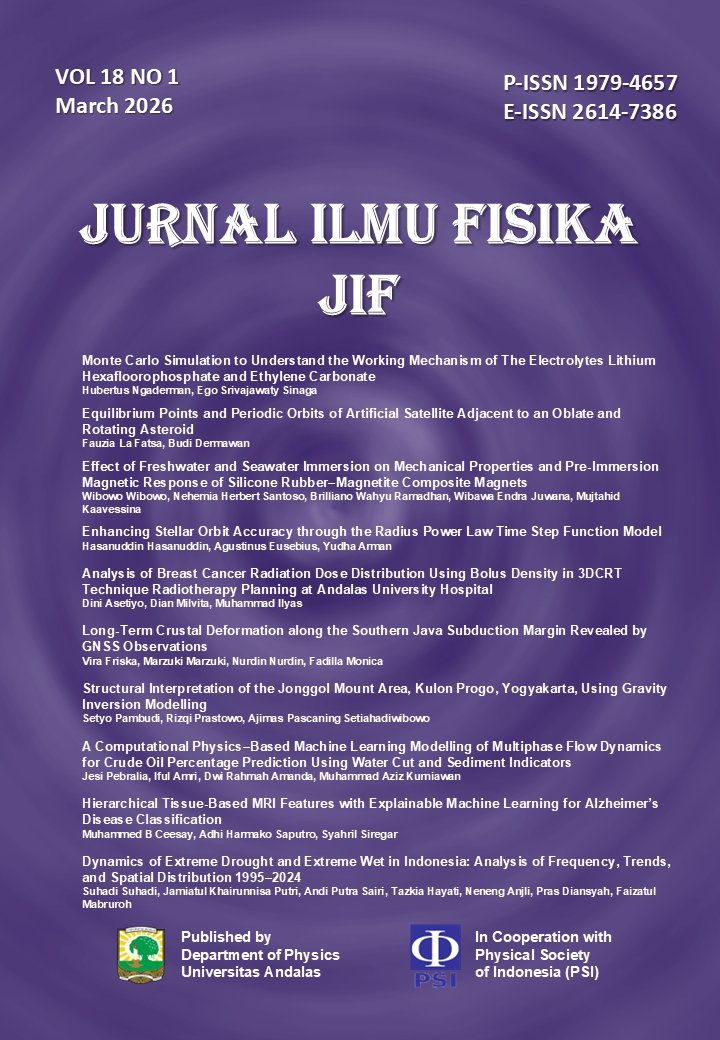
A Computational Physics–Based Machine Learning Modelling of Multiphase Flow Dynamics for Crude Oil Percentage Prediction Using Water Cut and Sediment Indicators
DOI:
https://doi.org/10.25077/jif.18.1.80-92.2026Keywords:
Basic sediment and water, Crude oil, Linear model, Machine learning, PredictionAbstract
Existing crude oil percentage prediction methods often rely on direct measurements and historical data, neglecting the coupled multiphase characteristics of oil–water–sediment systems, which limits predictive accuracy. This study develops a computational physics–based machine learning model integrating key multiphase production parameters, including water cut, basic sediment, and BS&W, using samples from PT. Pertamina Puspa Field Jambi. Data were split into two sets: one for model development and one for validation to prevent overfitting. Linear Regression, Support Vector Machine (SVM), and Random Forest algorithms were applied, with Linear Regression achieving the best performance. For the test dataset, the model yielded a Mean Absolute Error of 0.022168, a Mean Squared Error of 0.001227, and an accuracy of 0.99877, demonstrating precise capture of multiphase interactions. The proposed computational physics–based modelling framework provided improved predictive reliability and consistency. Correlation analyses indicated a coefficient of determination (R²) of 0.99 and a perfect negative correlation (r = −1) between BS&W and oil content, showing that higher BS&W corresponds to lower oil percentage. This framework offers improved predictive reliability and consistency for crude oil quality assessment.
Downloads
References
Abdalla, R., Al-Hakimi, W., Perozo, N., & Jaeger, P. (2023). Real-Time Liquid Rate and Water Cut Prediction From the Electrical Submersible Pump Sensors Data Using Machine-Learning Algorithms. ACS Omega, 8(14), 12671–12692. https://doi.org/10.1021/acsomega.2c07609
Al-Mudhafar, W. J. (2020). Integrating machine learning and data analytics for geostatistical characterization of clastic reservoirs. Journal of Petroleum Science and Engineering, 195(April), 107837. https://doi.org/10.1016/j.petrol.2020.107837
Alfian, G., Saputra, Y. M., Subekti, L., Rahmawati, A. D., Atmaji, F. T. D., & Rhee, J. (2023). Utilizing deep neural network for web-based blood glucose level prediction system. Indonesian Journal of Electrical Engineering and Computer Science, 30(3), 1829–1837. https://doi.org/10.11591/ijeecs.v30.i3.pp1829-1837
Aman, & Chhillar, R. S. (2023). Optimized stacking ensemble for early-stage diabetes mellitus prediction. International Journal of Electrical and Computer Engineering, 13(6), 7048–7055. https://doi.org/10.11591/ijece.v13i6.pp7048-7055
Asadullah, M., Hossain, M. M., Rahaman, S., Amin, M. S., Sumy, M. S. A., Parh, M. Y. A., & Hossain, M. A. (2023). Evaluation of machine learning techniques for hypertension risk prediction based on medical data in Bangladesh. Indonesian Journal of Electrical Engineering and Computer Science, 31(3), 1794–1802. https://doi.org/10.11591/ijeecs.v31.i3.pp1794-1802
Athambawa, A., Johar, M. G. M., & Khatibi, A. (2023). Behavioural intention to adopt cloud computing: A quantitative analysis with a mediatory factor using bootstrapping. Indonesian Journal of Electrical Engineering and Computer Science, 32(1), 458–467. https://doi.org/10.11591/ijeecs.v32.i1.pp458-467
Baruah, B., & Tiwari, P. (2020). Effect of high pressure on nonisothermal pyrolysis kinetics of oil shale and product yield. Energy and Fuels, 34(12), 15855–15869. https://doi.org/10.1021/acs.energyfuels.0c02538
Carleo, G., Cirac, I., Cranmer, K., Daudet, L., Schuld, M., Tishby, N., Vogt-Maranto, L., & Zdeborová, L. (2019). Machine learning and the physical sciences. Reviews of Modern Physics, 91(4), 45002. https://doi.org/10.1103/RevModPhys.91.045002
Chen, H., Zhang, C., Jia, N., Duncan, I., Yang, S., & Yang, Y. Z. (2021). A machine learning model for predicting the minimum miscibility pressure of CO2 and crude oil system based on a support vector machine algorithm approach. Fuel, 290, 1–27. https://doi.org/10.1016/j.fuel.2020.120048
Fan, D., Lai, S., Sun, H., Yang, Y., Yang, C., Fan, N., & Wang, M. (2025). Review of Machine Learning Methods for Steady State Capacity and Transient Production Forecasting in Oil and Gas Reservoir. Energies, 18(4), 1–25. https://doi.org/10.3390/en18040842
Fayomi, O. S. I., Akande, I. G., & Odigie, S. (2019). Economic Impact of Corrosion in Oil Sectors and Prevention: An Overview. Journal of Physics: Conference Series, 1378(2). https://doi.org/10.1088/1742-6596/1378/2/022037
Géron, A. (2019). Hands-on Machine Learning with Scikit-Learn, Keras & TensorFlow (2nd ed.). O’Reilly Media, Inc.
Hanafy, H. H., Macary, S. M., ElNady, Y. M., Bayomi, A. A., & El Batanony, M. H. (1997). A New Approach for Predicting the Cruide Oil Properties. SPE Production Operations Symposium, 439–452. https://www.onepetro.org/doi/10.2118/37439-MS
Harlim, J., Jiang, S. W., Liang, S., & Yang, H. (2021). Machine learning for prediction with missing dynamics. Journal of Computational Physics, 428, 1–31. https://doi.org/10.1016/j.jcp.2020.109922
Hastie, T., Tibshirani, R., & Friedman, J. (2008). The Elements of Statistical Learning: Data Mining, Inference, and Prediction (2nd ed.). Springer Inc. https://www.springerlink.com/index/D7X7KX6772HQ2135.pdf
Huffman, A. R. (2004). The future of pressure prediction using geophysical methods. AAPG Memoir, 76, 217–233. https://doi.org/10.1306/m76870c19
Kamal, B., Abbasi, Z., & Hassanzadeh, H. (2023). Water-Cut Measurement Techniques in Oil Production and Processing—A Review. Energies, 16(17). https://doi.org/10.3390/en16176410
Karniadakis, G. E., Kevrekidis, I. G., Lu, L., Perdikaris, P., Wang, S., & Yang, L. (2021). Physics-informed machine learning. Nature Reviews Physics, 3(6), 422–440. https://doi.org/10.1038/s42254-021-00314-5
Le, M. T., Vo, M. T., Pham, N. T., & Dao, S. V. T. (2021). Predicting heart failure using a wrapper-based feature selection. Indonesian Journal of Electrical Engineering and Computer Science, 21(3), 1530–1539. https://doi.org/10.11591/ijeecs.v21.i3.pp1530-1539
Litvinenko, V. S. (2020). Digital Economy as a Factor in the Technological Development of the Mineral Sector. Natural Resources Research, 29(3), 1521–1541. https://doi.org/10.1007/s11053-019-09568-4
Mair, C., Kadoda, G., Lefley, M., Phalp, K., Schofield, C., Shepperd, M., & Webster, S. (2000). An Investigation of machine learning based prediction systems. Journal of Systems and Software, 53(1), 23–29. https://doi.org/10.1016/S0164-1212(00)00005-4
Masrom, S., Rahman, R. A., Baharun, N., Rohani, S. R. S., & Rahman, A. S. A. (2023). Machine learning with task-technology fit theory factors for predicting students’ adoption in video-based learning. Bulletin of Electrical Engineering and Informatics, 12(3), 1666–1673. https://doi.org/10.11591/eei.v12i3.5037
Muneer, A., Ali, R. F., Alghamdi, A., Taib, S. M., Almaghthawi, A., & Abdullah Ghaleb, E. A. (2022). Predicting customers churning in banking industry: A machine learning approach. Indonesian Journal of Electrical Engineering and Computer Science, 26(1), 539–549. https://doi.org/10.11591/ijeecs.v26.i1.pp539-549
Ngene, S., Tota-Maharaj, K., Eke, P., & Hills, C. (2016). To cite this article: Stanley Ngene, Kiran Tota-Maharaj, Paul Eke, Colin Hills. Environmental and Economic Impacts of Crude Oil and Natural Gas Production in Developing Countries. International Journal of Economy, Energy and Environment, 1(3), 64–73. https://doi.org/10.11648/j.ijeee.20160103.13
Obite, C. P., Chukwu, A., Bartholomew, D. C., Nwosu, U. I., & Esiaba, G. E. (2021). Classical and machine learning modeling of crude oil production in Nigeria: Identification of an eminent model for application. Energy Reports, 7, 3497–3505. https://doi.org/10.1016/j.egyr.2021.06.005
Okan, M., Aydin, H. M., & Barsbay, M. (2019). Current approaches to waste polymer utilization and minimization: a review. Journal of Chemical Technology and Biotechnology, 94(1), 8–21. https://doi.org/10.1002/jctb.5778
Onuoha, M. E., & Elegbede, I. O. (2018). The Oil Boom Era: Socio-Political and Economic Consequences. In The Political Ecology of Oil and Gas Activities in the Nigerian Aquatic Ecosystem. Elsevier Inc. https://doi.org/10.1016/B978-0-12-809399-3.00006-9
Pebralia, J., Amri, I., & Rifa’i, A. I. (2022). Measuring convective heat transfer in a room equipped with an air conditioner. Physics Education, 57(5). https://doi.org/10.1088/1361-6552/ac832e
Qaim, M., Sibhatu, K. T., Siregar, H., & Grass, I. (2020). Environmental, economic, and social consequences of the oil palm boom. Annual Review of Resource Economics, 12, 321–344. https://doi.org/10.1146/annurev-resource-110119-024922
Raljević, D., Parlov Vuković, J., Smrečki, V., Marinić Pajc, L., Novak, P., Hrenar, T., Jednačak, T., Konjević, L., Pinević, B., & Gašparac, T. (2021). Machine learning approach for predicting crude oil stability based on NMR spectroscopy. Fuel, 305(August). https://doi.org/10.1016/j.fuel.2021.121561
Ramírez-Pradilla, J. S., Blanco-Tirado, C., Hubert-Roux, M., Giusti, P., Afonso, C., & Combariza, M. Y. (2019). Comprehensive Petroporphyrin Identification in Crude Oils Using Highly Selective Electron Transfer Reactions in MALDI-FTICR-MS. Energy and Fuels, 33(5), 3899–3907. https://doi.org/10.1021/acs.energyfuels.8b04325
Ruble, I. (2019). The U.S. crude oil refining industry: Recent developments, upcoming challenges and prospects for exports. Journal of Economic Asymmetries, 20(August 2019), e00132. https://doi.org/10.1016/j.jeca.2019.e00132
Saad, M. A., Kamil, M., Abdurahman, N. H., Yunus, R. M., & Awad, O. I. (2019). An overview of recent advances in state-of-the-art techniques in the demulsification of crude oil emulsions. Processes, 7(7). https://doi.org/10.3390/pr7070470
Seko, A., Hayashi, H., Nakayama, K., Takahashi, A., & Tanaka, I. (2017). Representation of compounds for machine-learning prediction of physical properties. Physical Review B, 95(14), 1–11. https://doi.org/10.1103/PhysRevB.95.144110
Sun, L., Fang, C., Li, F., Zhu, R., Zhang, Y., Yuan, X., Jia, A., Gao, X., & Su, L. (2015). Innovations and challenges of sedimentology in oil and gas exploration and development. Petroleum Exploration and Development, 42(2), 143–151. https://doi.org/10.1016/S1876-3804(15)30001-X
Wlazlowski, S. (2007). Crude oil — end‐product linkages in the European petroleum markets. OPEC Review, 31(2), 73–90. https://doi.org/10.1111/j.1468-0076.2007.00177.x
Downloads
Published
How to Cite
Issue
Section
Citation Check
License
Copyright (c) 2025 Jesi Pebralia, Iful Amri, Dwi Rahmah Amanda, Muhammad Aziz Kurniawan

This work is licensed under a Creative Commons Attribution-NonCommercial 4.0 International License.
Please find the rights and licenses in JIF (Jurnal Ilmu Fisika).
1. License
The non-commercial use of the article will be governed by the Creative Commons Attribution license as currently displayed on Creative Commons Attribution-NonCommercial 4.0 International License.
2. Author's Warranties
The author warrants that the article is original, written by stated author(s), has not been published before, contains no unlawful statements, does not infringe the rights of others, is subject to copyright that is vested exclusively in the author and free of any third party rights, and that any necessary written permissions to quote from other sources have been obtained by the author(s).
3. User Rights
JIF's spirit is to disseminate articles published are as free as possible. Under the Creative Commons license, JIF permits users to copy, distribute, display, and perform the work for non-commercial purposes only. Users will also need to attribute authors and JIF on distributing works in the journal.
4. Rights of Authors
Authors retain the following rights:
- Copyright, and other proprietary rights relating to the article, such as patent rights,
- The right to use the substance of the article in future own works, including lectures and books,
- The right to reproduce the article for own purposes, provided the copies are not offered for sale,
- The right to self-archive the article.
5. Co-Authorship
If the article was jointly prepared by other authors, the signatory of this form warrants that he/she has been authorized by all co-authors to sign this agreement on their behalf, and agrees to inform his/her co-authors of the terms of this agreement.
6. Termination
This agreement can be terminated by the author or JIF upon two months's notice where the other party has materially breached this agreement and failed to remedy such breach within a month of being given the terminating party's notice requesting such breach to be remedied. No breach or violation of this agreement will cause this agreement or any license granted in it to terminate automatically or affect the definition of JIF.
7. Royalties
This agreement entitles the author to no royalties or other fees. To such extent as legally permissible, the author waives his or her right to collect royalties relative to the article in respect of any use of the article by JIF or its sublicensee.
8. Miscellaneous
JIF will publish the article (or have it published) in the journal if the article's editorial process is successfully completed and JIF or its sublicensee has become obligated to have the article published. JIF may conform the article to a style of punctuation, spelling, capitalization, referencing and usage that it deems appropriate. The author acknowledges that the article may be published so that it will be publicly accessible and such access will be free of charge for the readers.