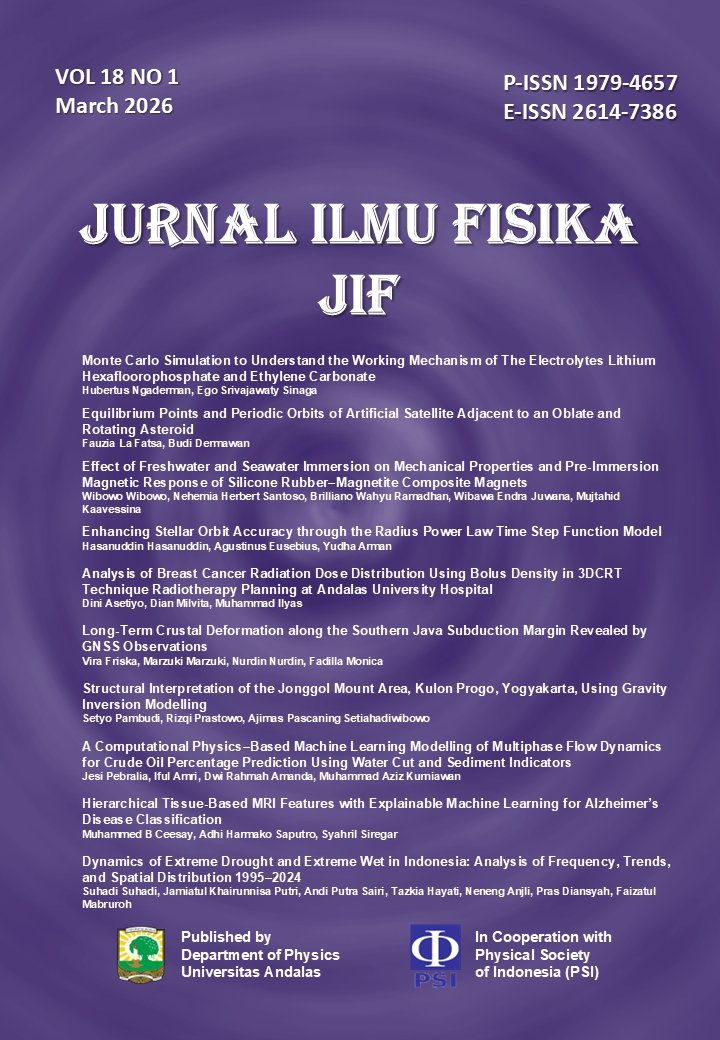
Analysis of Breast Cancer Radiation Dose Distribution Using Bolus Density in 3DCRT Technique Radiotherapy Planning at Andalas University Hospital
DOI:
https://doi.org/10.25077/jif.18.1.45-54.2026Keywords:
3DCRT, Bolus, Conformity Index, Homogeneity Index, Treatment Planning SystemAbstract
Analysis of breast cancer radiation dose distribution using bolus density in radiotherapy planning of the Three-Dimensional Conformal Radiotherapy (3DCRT) technique has been conducted. This research aims to analyze radiation dose distribution in breast cancer patients using bolus density in radiotherapy planning of the 3DCRT technique. Five images of breast cancer patients were processed using TPS Eclipse software. The bolus density values used were a mixture of beeswax and petroleum jelly, playdough, silicone rubber, and 3D Polylactic Acid. CI and HI values were calculated based on the International Commission on Radiation Units and Measures (ICRU) Reports 62 and 83. Radiation dose in OAR was verified based on the Quantitative Analysis of Normal Tissue Effect in the Clinic (QUANTEC) standard. The results showed that all four bolus densities can be used in breast cancer patients, with CI values the CI value ranges from 0.93 to 0.98 by ICRU Report 62 standards and HI values close to ICRU Report 83 standards. In cardiac OAR, one patient exceeded the QUANTEC standard, while for lung OAR, all patients were below the QUANTEC standard. Using bolus density provides optimal radiation dose distribution on breast cancer targets.
Downloads
References
Aisyah, S., Carina, C. C. C., Nazara, T., Sekartaji, G., Nainggolan, A., & Endarko. (2020). A Comparative Study of Dosimetric Characterization of Bolus Based on Natural Rubber (Hevea Brasiliensis) and Clinical Bolus for Therapy with Megavolt Electron Radiation. Journal of Physics: Conference Series, 1505(1), 012026.
Aras, S., Tanzer, İ. O., & İkizceli, T. (2020). Dosimetric Comparison of Superflab and Specially Prepared Bolus Materials Used in Radiotherapy Practice. European Journal of Breast Health, 16(3), 167–170.
Chantika, L., Hanif, V. F., Defira, E., Oktamuliani, S., Muttaqin, A., & Ilyas, M. (2022). Comparison of Absorbed Dose in Plasticine Bolus and Silicone Rubber Bolus. Journal of Physics: Theories and Applications, 6(1), 25–33.
Carina, C. C. C., Sekartaji, G., Aisyah, S., Nazara, T., Nainggolan, A., & Endarko. (2020). Evaluation of Dosimetric Characterization of Homemade Bolus for Radiation Therapy. Journal of Physics: Conference Series, 1505(1), 012026.
Endarko, E., Aisyah, S., Carina, C. C. C., Nazara, T., Sekartaji, G., & Nainggolan, A. (2021). Evaluate dosimetric properties of handmade bolus for megavoltage electron and photon radiation therapy. Journal of Biomedical Physics and Engineering, 11(6), 735–746.
Fitriani, R., Subagiada, K., Muliyono, S., Stevenly, R. J., & Suryaningsih, S. (2022). Analisis Penggunaan Bolus Berbahan Plastisin pada Pasien Fibrosarcoma dengan Treatment Planning System (TPS). Progressive Physics Journal, 3(1), 100–109.
GLOBOCAN. (2025). International Agency for Research on Cancer. 12 December 2025. World Health Organization. https://gco.iarc.fr/today/en
Guswantoro, T., Supratman, A. S., & Asih, I. S. (2020). Karakteristik Alginat Sebagai Bahan Setara dengan Jaringan Lunak untuk Radioterapi. Jurnal EduMatSains, 4(2), 125–138.
ICRU Report 62. (1999). Prescribing, Recording, and Reporting Photon Beam Therapy (Supplement to ICRU Report 50). 24 December 2024. International Commission on Radiation Units and Measurements. https://www.icru.org/report/prescribing-recording-and-reporting-photon-beam-therapy-report-62/
ICRU Report 83. (2010). Prescribing, Recording, and Reporting Photon-Beam Intensity-Modulated Radiation Therapy (IMRT). 1 December 2024. International Commission on Radiation Units and Measurements. https://www.icru.org/report/prescribing-recording-and-reporting-intensity-modulated-photon-beam-therapy-imrticru-report-83/
Khan, F. M., & Gibbons, J. P. (2014). The Physics of Radiation Therapy. Philadelphia: Lippincott Williams & Wilkins.
Mayles, P., Nahum, A., & Rosenwald, J. C. (2007). Handbook of Radiotherapy Physics. London: Taylor and Francis Group.
Ningsih, D. Y., Adrial, R., & Diyona, F. (2022). Analisis Dosis Serap Bolus Berbahan Campuran Beeswax dan Petroleum Jelly Dalam Radioterapi Menggunakan Elektron 6 MeV Pada LINAC. Jurnal Fisika Unand, 11(4), 462–466.
Podgorsak, E. B. (2005). Radiation Oncology Physics: A Handbook for Teachers and Students. Austria: International Atomic Energy Agency Wagramer.
Pramita, N., Adrial, R., & Ilyas, M. (2023). Perbandingan Dosis Serap Bolus Berbahan Playdough, Plastisin, dan Silicone Rubber pada Radioterapi Berkas Elektron 6 MeV dan 9 MeV. Jurnal Fisika Unand, 12(4), 577–583.
Rafli, R., Diyona, F., Ilyas, M., & Kanie, M. A. (2021). Dosimetry verification of chest wall radiotherapy planning using virtual bolus compared to plasticine bolus for 3DCRT and IMRT. Cite as: AIP Conference Proceedings. Padang, Indonesia.
Su, S., Moran, K., & Robar, J. L. (2014). Design and Production of 3D Printed Bolus for Electron Radiation Therapy. Journal of Applied Clinical Medical Physics, 15(4), 194–211.
Symonds, P., Mills, J. A., & Dexbury, A. (2012). Textbook of Radiotherapy Radiation Physics, Therapy and Oncology. UK: Elsevier.
Tian, L., Mao, R., Li, D., Guo, W., Li, B., Lou, Z., & Guo, L. (2024). Superficial Dosimetry Study of the Frequency of Bolus Using in Volumetric Modulated Arc Therapy after Modified Radical Mastectomy. Technology in Cancer Research and Treatment, 23(127), 1–7.
Yuliandari, A., Harmadi, H., Diyona, F., Ilyas, M., Pratama, A., & Oktamuliani, S. (2024). Characteristics of polylactic acid 3D-printed bolus for electron radiotherapy. 3rd Conference on Innovation in Technology and Engineering Science 2022. Padang, Indonesia.
Downloads
Published
How to Cite
Issue
Section
Citation Check
License
Copyright (c) 2025 Dini Asetiyo, Dian Milvita, Muhammad Ilyas

This work is licensed under a Creative Commons Attribution-NonCommercial 4.0 International License.
Please find the rights and licenses in JIF (Jurnal Ilmu Fisika).
1. License
The non-commercial use of the article will be governed by the Creative Commons Attribution license as currently displayed on Creative Commons Attribution-NonCommercial 4.0 International License.
2. Author's Warranties
The author warrants that the article is original, written by stated author(s), has not been published before, contains no unlawful statements, does not infringe the rights of others, is subject to copyright that is vested exclusively in the author and free of any third party rights, and that any necessary written permissions to quote from other sources have been obtained by the author(s).
3. User Rights
JIF's spirit is to disseminate articles published are as free as possible. Under the Creative Commons license, JIF permits users to copy, distribute, display, and perform the work for non-commercial purposes only. Users will also need to attribute authors and JIF on distributing works in the journal.
4. Rights of Authors
Authors retain the following rights:
- Copyright, and other proprietary rights relating to the article, such as patent rights,
- The right to use the substance of the article in future own works, including lectures and books,
- The right to reproduce the article for own purposes, provided the copies are not offered for sale,
- The right to self-archive the article.
5. Co-Authorship
If the article was jointly prepared by other authors, the signatory of this form warrants that he/she has been authorized by all co-authors to sign this agreement on their behalf, and agrees to inform his/her co-authors of the terms of this agreement.
6. Termination
This agreement can be terminated by the author or JIF upon two months's notice where the other party has materially breached this agreement and failed to remedy such breach within a month of being given the terminating party's notice requesting such breach to be remedied. No breach or violation of this agreement will cause this agreement or any license granted in it to terminate automatically or affect the definition of JIF.
7. Royalties
This agreement entitles the author to no royalties or other fees. To such extent as legally permissible, the author waives his or her right to collect royalties relative to the article in respect of any use of the article by JIF or its sublicensee.
8. Miscellaneous
JIF will publish the article (or have it published) in the journal if the article's editorial process is successfully completed and JIF or its sublicensee has become obligated to have the article published. JIF may conform the article to a style of punctuation, spelling, capitalization, referencing and usage that it deems appropriate. The author acknowledges that the article may be published so that it will be publicly accessible and such access will be free of charge for the readers.