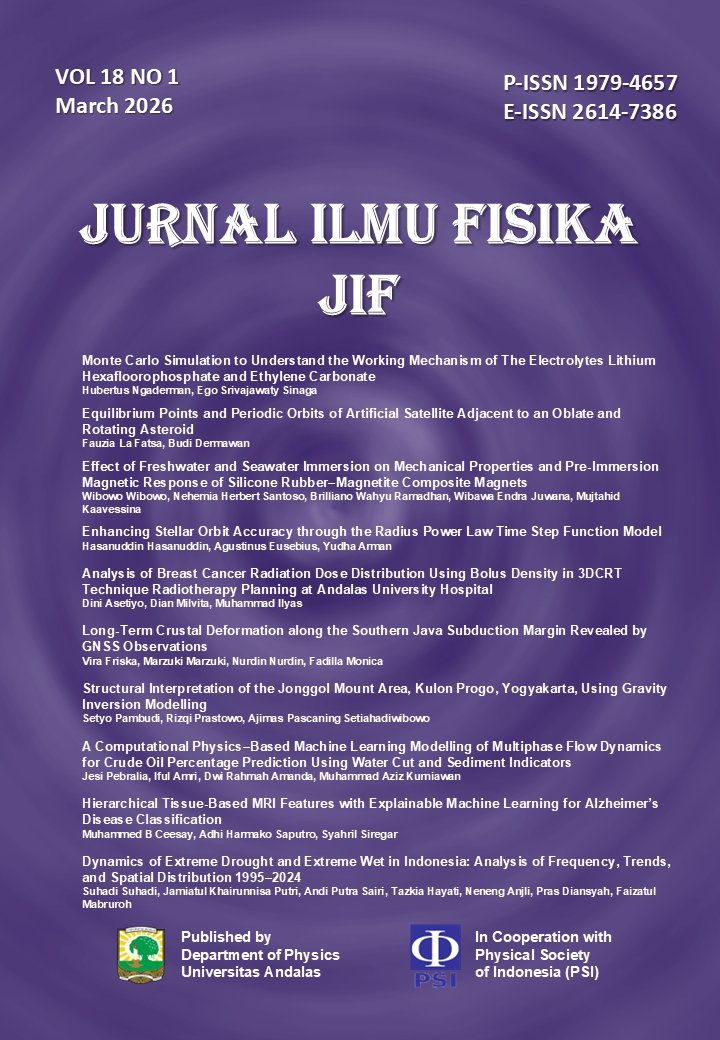
Enhancing Stellar Orbit Accuracy through the Radius Power Law Time Step Function Model
DOI:
https://doi.org/10.25077/jif.18.1.35-44.2026Keywords:
astrophysical systems, numerical integration, stellar orbits, symplectic integrator, time step functionAbstract
Accurately determining stellar orbits within astrophysical systems is paramount for understanding celestial mechanics. This study proposes a novel approach to enhance orbit accuracy by incorporating a radius power law time step function model. The methodology involves the numerical integration of the system's dynamics using a forward fourth-order symplectic integrator, combined with a time step function dependent on the distance of the test particle from the system's center. We conduct simulations on various astrophysical scenarios represented by conservative potentials, including point mass, Plummer, and Hernquist models. Our results demonstrate that employing a power-law time step function with an exponent of 1.5 significantly reduces phase-space error (measured by the ratio of radial to orbital periods) and improves orbit accuracy (measured by the gradient of the relative total energy drift). The method is easy to implement, computationally efficient, and adaptable to N-body and more general dynamical systems. Its solid theoretical basis and numerical reliability make it a practical tool for improving orbit accuracy in diverse astrophysical applications.
Downloads
References
Aarseth, S. J. (2003). Gravitational N-body simulations. In Gravitational N-Body Simulations, by Sverre J.~Aarseth, pp. 430. ISBN 0521432723.~Cambridge, UK: Cambridge University Press, November 2003. Cambridge University Press. DOI: https://doi.org/10.1017/CBO9780511535246
Aarseth, S. J., & Heggie, D. C. (1993). A 6000-body simulation with primordial binaries. In G. H. Smith & J. P. Brodie (Eds.), The Globular Cluster-Galaxy Connection (Vol. 48, p. 701).
Adams, F. C., & Bloch, A. M. (2005). Orbits in Extended Mass Distributions: General Results and the Spirographic Approximation. The Astrophysical Journal, 629(1), 204–218. https://doi.org/10.1086/431455 DOI: https://doi.org/10.1086/431455
Baes, M., & Dejonghe, H. (2002). The Hernquist model revisited: Completely analytical anisotropic dynamical models. Astronomy and Astrophysics, 393(2), 485–497. https://doi.org/10.1051/0004-6361:20021064 DOI: https://doi.org/10.1051/0004-6361:20021064
Binney, J., & Tremaine, S. (2008). Galactic dynamics: Second edition. Princeton University Press. DOI: https://doi.org/10.1515/9781400828722
Bovy, J. (2023). Dynamics and Astrophysics of Galaxies (in Preparation). Princeton University.
Chin, S. A., & Chen, C. R. (2005). Forward Symplectic Integrators for Solving Gravitational Few-Body Problems. Celestial Mechanics and Dynamical Astronomy, 91(3), 301–322. https://doi.org/10.1007/s10569-004-4622-z DOI: https://doi.org/10.1007/s10569-004-4622-z
Dehnen, W. (2017). Towards time symmetric N-body integration. Monthly Notices of the Royal Astronomical Society, 472(1), 1226–1238. https://doi.org/10.1093/MNRAS/STX1944 DOI: https://doi.org/10.1093/mnras/stx1944
Dehnen, W., & Hernandez, D. M. (2017). Symplectic fourth-order maps for the collisional N-body problem. Monthly Notices of the Royal Astronomical Society, 465(1), 1201–1217. https://doi.org/10.1093/mnras/stw2758 DOI: https://doi.org/10.1093/mnras/stw2758
Dehnen, W., & Read, J. I. (2011). N-body simulations of gravitational dynamics. European Physical Journal Plus, 126(5), 55. https://doi.org/10.1140/epjp/i2011-11055-3 DOI: https://doi.org/10.1140/epjp/i2011-11055-3
Hands, T. O., Dehnen, W., Gration, A., Stadel, J., & Moore, B. (2019). The fate of planetesimal discs in young open clusters: implications for 1I/’Oumuamua, the Kuiper belt, the Oort cloud, and more. Monthly Notices of the Royal Astronomical Society, 490(1), 21–36. https://doi.org/10.1093/mnras/stz1069 DOI: https://doi.org/10.1093/mnras/stz1069
Hasanuddin. (2020a). GitHub - hasanastro4/simpthon. Https://Github.Com/Hasanastro4/Simpthon.
Hasanuddin. (2022). Simulasi Orbit Planet Eksentrisitas Tinggi dengan Metode Leapfrog. Jurnal Fisika, 12(1), 1–8. DOI: https://doi.org/10.15294/jf.v12i1.33744
Hasanuddin, H. (2020b). Analisis Galat Energi dan Galat Fase Metode Forward 4th Order Symplectic Chin-Chen untuk Kasus Sistem Osilator Harmonik Sederhana. POSITRON, 10(2), 88–92. https://doi.org/10.26418/positron.v10i2.40023 DOI: https://doi.org/10.26418/positron.v10i2.40023
Heggie, D., & Hut, P. (2003). The Gravitational Million-Body Problem: A Multidisciplinary Approach to Star Cluster Dynamics. In The Gravitational Million-Body Problem: A Multidisciplinary Approach to Star Cluster Dynamics, by Douglas Heggie and Piet Hut. Cambridge University Press, 2003, 372 pp.. Cambridge University Press. DOI: https://doi.org/10.1017/CBO9781139164535
Hernandez, D. M., & Dehnen, W. (2023). Switching integrators reversibly in the astrophysical N-body problem. Monthly Notices of the Royal Astronomical Society, 522(3), 4639–4648. https://doi.org/10.1093/mnras/stad657 DOI: https://doi.org/10.1093/mnras/stad657
Hernquist, L. (1990). An analytical model for spherical galaxies and bulges. Astrophysical Journal, 356, 359–364. https://doi.org/10.1086/168845 DOI: https://doi.org/10.1086/168845
Leimkuhler, B., & Reich, S. (2005). Simulating Hamiltonian Dynamics (1st ed.). Cambridge University Press. https://doi.org/10.2277/0521772907 DOI: https://doi.org/10.1017/CBO9780511614118
Pham, D., Rein, H., & Spiegel, D. S. (2024). A new timestep criterion for N-body simulations. The Open Journal of Astrophysics, 7, 1. https://doi.org/10.21105/astro.2401.02849 DOI: https://doi.org/10.21105/astro.2401.02849
Plummer, H. ~C. (1911). On the problem of distribution in globular star clusters. Monthly Notices of the Royal Astronomical Society, 71, 460–470. https://doi.org/10.1093/mnras/71.5.460 DOI: https://doi.org/10.1093/mnras/71.5.460
Plummer, H. C. (1915). The Distribution of Stars in Globular Clusters. Monthly Notices of the Royal Astronomical Society, 76(2), 107–121. https://doi.org/10.1093/MNRAS/76.2.107 DOI: https://doi.org/10.1093/mnras/76.2.107
Zemp, M., Stadel, J., Moore, B., & Carollo, C. ~M. (2007). An optimum time-stepping scheme for N-body simulations. Monthly Notices of the Royal Astronomical Society, 376(1), 273–286. https://doi.org/10.1111/j.1365-2966.2007.11427.x DOI: https://doi.org/10.1111/j.1365-2966.2007.11427.x
Downloads
Published
How to Cite
Issue
Section
Citation Check
License
Copyright (c) 2025 Hasanuddin, Agustinus Eusebius, Yudha Arman

This work is licensed under a Creative Commons Attribution-NonCommercial 4.0 International License.
Please find the rights and licenses in JIF (Jurnal Ilmu Fisika).
1. License
The non-commercial use of the article will be governed by the Creative Commons Attribution license as currently displayed on Creative Commons Attribution-NonCommercial 4.0 International License.
2. Author's Warranties
The author warrants that the article is original, written by stated author(s), has not been published before, contains no unlawful statements, does not infringe the rights of others, is subject to copyright that is vested exclusively in the author and free of any third party rights, and that any necessary written permissions to quote from other sources have been obtained by the author(s).
3. User Rights
JIF's spirit is to disseminate articles published are as free as possible. Under the Creative Commons license, JIF permits users to copy, distribute, display, and perform the work for non-commercial purposes only. Users will also need to attribute authors and JIF on distributing works in the journal.
4. Rights of Authors
Authors retain the following rights:
- Copyright, and other proprietary rights relating to the article, such as patent rights,
- The right to use the substance of the article in future own works, including lectures and books,
- The right to reproduce the article for own purposes, provided the copies are not offered for sale,
- The right to self-archive the article.
5. Co-Authorship
If the article was jointly prepared by other authors, the signatory of this form warrants that he/she has been authorized by all co-authors to sign this agreement on their behalf, and agrees to inform his/her co-authors of the terms of this agreement.
6. Termination
This agreement can be terminated by the author or JIF upon two months's notice where the other party has materially breached this agreement and failed to remedy such breach within a month of being given the terminating party's notice requesting such breach to be remedied. No breach or violation of this agreement will cause this agreement or any license granted in it to terminate automatically or affect the definition of JIF.
7. Royalties
This agreement entitles the author to no royalties or other fees. To such extent as legally permissible, the author waives his or her right to collect royalties relative to the article in respect of any use of the article by JIF or its sublicensee.
8. Miscellaneous
JIF will publish the article (or have it published) in the journal if the article's editorial process is successfully completed and JIF or its sublicensee has become obligated to have the article published. JIF may conform the article to a style of punctuation, spelling, capitalization, referencing and usage that it deems appropriate. The author acknowledges that the article may be published so that it will be publicly accessible and such access will be free of charge for the readers.