
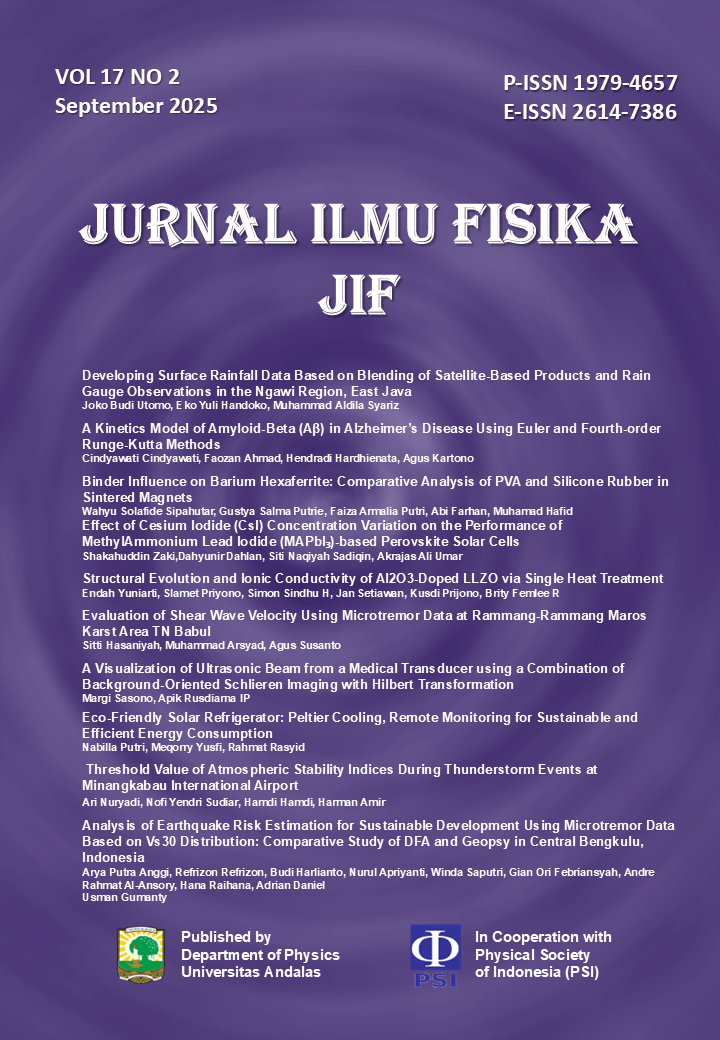
Threshold Value of Atmospheric Stability Indices During Thunderstorm Events at Minangkabau International Airport
DOI:
https://doi.org/10.25077/jif.17.2.201-213.2025Keywords:
Atmospheric Stability Index, Threshold, Thunderstorm, Regression, Confusion MatrixAbstract
Thunderstorms are a significant challenge for aviation operations, especially in tropical regions such as West Sumatra. This study aims to determine threshold values for six atmospheric stability indices—Convective Available Potential Energy (CAPE), K-Index (KI), Lifted Index (LI), Showalter Index (SI), Severe Weather Threat Index (SWEAT), and Total-totals Index (TTI)—to predict thunderstorm events at Minangkabau International Airport (MIA). Radiosonde and daily synoptic reports from 2018–2022 were analyzed using Rawinsonde Observation Programs (RAOB) and Statistical Package for the Social Sciences (SPSS) with a dummy regression approach. The model was validated using a confusion matrix, measuring accuracy, precision, and recall. Results show that the use of locally calibrated thresholds leads to higher and more consistent accuracy, precision, and recall values compared to global benchmarks, due to better adaptation to local weather parameters such as vertical humidity, mid-layer temperature, and wind structure. KI, SI, and TTI showed high sensitivity (recall >88%), while LI and CAPE performed moderately. Monthly variation in index performance was observed, with KI, SI, and TTI dominant in the wet and transition seasons, and SWEAT effective in the dry season when shear-driven convection increases. Thus, locally calibrated indices are recommended for thunderstorm early warning systems in aviation.
Downloads
References
Arora, K., Ray, K., Ram, S., & Mehajan, R. (2023). The Role of Instability Indices in Forecasting Thunderstorm and Non-Thunderstorm Days across Six Cities in India. Climate, 11(1), 1–18. https://doi.org/10.3390/cli11010014
Bangsawan, L. O., & Tjasyono HK, B. (2015). Kajian Ambang Batas Indeks Stabilitas Udara Terkait Kejadian Hujan Lebat Dan Badai Guntur Di Makasar. Stmkg, 0–1.
Bishop, C. M. (2006). Pattern Recognition and Machine Learning. In Springer (Vol. 4, Issue 1). https://doi.org/10.53759/7669/jmc202404020
Cheng, W. Y., Kim, D., & Holzworth, R. H. (2021). CAPE Threshold for Lightning Over the Tropical Ocean. Journal of Geophysical Research: Atmospheres, 126(20), 1–18. https://doi.org/10.1029/2021JD035621
Dutta, D., & Pal, S. K. (2022). Interpretation of black box for short-term predictions of pre-monsoon cumulonimbus cloud events over Kolkata. Journal of Data, Information and Management, 4(2), 167–183. https://doi.org/10.1007/s42488-022-00071-9
Kolay, O., Efe, B., Özdemir, E. T., & Aslan, Z. (2025). A Multi-Year Investigation of Thunderstorm Activity at Istanbul International Airport Using Atmospheric Stability Indices. Atmosphere, 16(4). https://doi.org/10.3390/atmos16040470
Mohammed, J. A. (2024). Trend analysis of the extreme rainfall indices from Lake Tana Sub-Basin of the Upper Blue Nile, Ethiopia. Natural Hazards Research. https://doi.org/10.1016/j.nhres.2024.01.005
Mondal, U., Kumar, A., Panda, S. K., Sharma, D., & Das, S. (2024). Comprehensive study of thunderstorm indices threshold favorable for thunderstorms during monsoon season using WRF–ARW model and ERA5 over India. Geoenvironmental Disasters, 11(1). https://doi.org/10.1186/s40677-023-00262-5
Firdaus, N. Y. (2024). Kajian Literatur Sains Terhadap Sistem Pendeteksi Dini Tornado Atau Tornado Early Detection System. Multidisiplin Sainstek, 3(3), 6–20.
Putri, R. J. A., & Pratama, B. E. (2016). Penentuan Nilai Ambang Batas Indeks Stabilitas Saat Kejadian Badai Guntur di Wilayah Merauke. Jurnal Meteorologi Klimatologi Dan Geofisika (STMKG).
Rabbani, G., Kardani-Yazd, N., & Mansouri Daneshvar, M. R. (2020). Factors affecting severe weather threat index in urban areas of Turkey and Iran. Environmental Systems Research, 9(1). https://doi.org/10.1186/s40068-020-00173-6
Rafiuddin, M., Akter, N., Dewan, A., Adnan, M. S. G., & Holle, R. L. (2025). Pre-monsoon lightning in Bangladesh: Separating most from least active days with thermodynamic and synoptic composites. Atmospheric Research, 325(December 2024), 108261. https://doi.org/10.1016/j.atmosres.2025.108261
Rusdin, A. A., Palloan, P., Subaer, S., & Prasetiyo, A. (2023). Uji Akurasi Ambang Batas Indeks Stabilitas Atmosfer Terhadap Pembentukan Thunderstorm dan Awan Cumulonimbus di Stasiun Meteorologi Kelas I Sultan Hasanuddin. Jurnal Fisika Unand, 12(2), 268–274. https://doi.org/10.25077/jfu.12.2.268-274.2023
Sabri, M. H. M., Ahmad, M. R., Esa, M. R. M., Periannan, D., Lu, G., Zhang, H., Cooray, V., Williams, E., Aziz, M. Z. A. A., Abdul-Malek, Z., Alkahtani, A. A., & Kadir, M. Z. A. A. B. (2019). Initial electric field changes of lightning flashes in tropical thunderstorms and their relationship to the lightning initiation mechanism. Atmospheric Research, 226(April), 138–151. https://doi.org/10.1016/j.atmosres.2019.04.013
Škultéty, F., Jarošová, M., & Rostáš, J. (2022). Dangerous weather phenomena and their effect on en-route flight delays in Europe. Transportation Research Procedia, 59, 174–182. https://doi.org/10.1016/j.trpro.2021.11.109
Sulik, S. (2021). Formation factors of the most electrically active thunderstorm days over Poland (2002–2020). Weather and Climate Extremes, 34. https://doi.org/10.1016/j.wace.2021.100386
Umakanth, N., Satyanarayana, G. C., Simon, B., Rao, M. C., & Ranga Babu, N. (2020a). Climatological analysis of lightning flashes over Kerala. AIP Conference Proceedings, 2220(May). https://doi.org/10.1063/5.0001292
Umakanth, N., Satyanarayana, G. C., Simon, B., & Rao, M. C. (2020b). Satellite based interpretation of stability parameters on convective systems over India and Srilanka. Asian Journal of Atmospheric Environment, 14(2), 119–132. https://doi.org/10.5572/ajae.2020.14.2.119
Vujović, D., & Protić, M. (2017). The behavior of the radar parameters of cumulonimbus clouds during cloud seeding with AgI. Atmospheric Research, 189, 33–46. https://doi.org/10.1016/j.atmosres.2017.01.014
Wahiduzzaman, M., Ali, M. A., Luo, J. J., Wang, Y., Uddin, M. J., Shahid, S., Islam, A. R. M. T., Mondal, S. K., Siddiki, U. R., Bilal, M., Qiu, Z., Dambul, R., Eibek, K., & Haque, M. E. (2022). Effects of convective available potential energy, temperature and humidity on the variability of thunderstorm frequency over Bangladesh. Theoretical and Applied Climatology, 147(1–2), 325–346. https://doi.org/10.1007/s00704-021-03833-4
Yavuz, V. (2023). An analysis of atmospheric stability indices and parameters under air pollution conditions. Environmental Monitoring and Assessment, 195(8), 1–20. https://doi.org/10.1007/s10661-023-11556-4
Yavuz, V. (2024). Performance Analyzes of Thermodynamic Indices and Atmospheric Parameters in Thunderstorm and Non-thunderstorm Days in Istanbul, Turkey. Pure and Applied Geophysics, 181(7), 2297–2316. https://doi.org/10.1007/s00024-024-03521-0
Zahrina, M., Albaar, I., & Pramujo, B. (2017). Cumulonimbus Dan Thunderstorm Di Bandar Udara. Jurnal Meteorologi Klimatologi Dan Geofisika.
Zhao, D., Liu, Y., & Chen, H. (2024). Are Mini and full-size electric vehicle adopters satisfied? An application of the regression with dummy variables. Travel Behaviour and Society, 35(November 2023), 100744. https://doi.org/10.1016/j.tbs.2024.100744
Zhou, W., Cheng, Y., Ding, S., Chen, L., & Li, R. (2021). A grey seasonal least square support vector regression model for time series forecasting. ISA Transactions, 114, 82–98. https://doi.org/10.1016/j.isatra.2020.12.024
Downloads
Published
How to Cite
Issue
Section
Citation Check
License
Copyright (c) 2025 Ari Nuryadi, Nofi Yendri Sudiar, Hamdi Hamdi, Harman Amir

This work is licensed under a Creative Commons Attribution-NonCommercial 4.0 International License.
Please find the rights and licenses in JIF (Jurnal Ilmu Fisika).
1. License
The non-commercial use of the article will be governed by the Creative Commons Attribution license as currently displayed on Creative Commons Attribution-NonCommercial 4.0 International License.
2. Author's Warranties
The author warrants that the article is original, written by stated author(s), has not been published before, contains no unlawful statements, does not infringe the rights of others, is subject to copyright that is vested exclusively in the author and free of any third party rights, and that any necessary written permissions to quote from other sources have been obtained by the author(s).
3. User Rights
JIF's spirit is to disseminate articles published are as free as possible. Under the Creative Commons license, JIF permits users to copy, distribute, display, and perform the work for non-commercial purposes only. Users will also need to attribute authors and JIF on distributing works in the journal.
4. Rights of Authors
Authors retain the following rights:
- Copyright, and other proprietary rights relating to the article, such as patent rights,
- The right to use the substance of the article in future own works, including lectures and books,
- The right to reproduce the article for own purposes, provided the copies are not offered for sale,
- The right to self-archive the article.
5. Co-Authorship
If the article was jointly prepared by other authors, the signatory of this form warrants that he/she has been authorized by all co-authors to sign this agreement on their behalf, and agrees to inform his/her co-authors of the terms of this agreement.
6. Termination
This agreement can be terminated by the author or JIF upon two months's notice where the other party has materially breached this agreement and failed to remedy such breach within a month of being given the terminating party's notice requesting such breach to be remedied. No breach or violation of this agreement will cause this agreement or any license granted in it to terminate automatically or affect the definition of JIF.
7. Royalties
This agreement entitles the author to no royalties or other fees. To such extent as legally permissible, the author waives his or her right to collect royalties relative to the article in respect of any use of the article by JIF or its sublicensee.
8. Miscellaneous
JIF will publish the article (or have it published) in the journal if the article's editorial process is successfully completed and JIF or its sublicensee has become obligated to have the article published. JIF may conform the article to a style of punctuation, spelling, capitalization, referencing and usage that it deems appropriate. The author acknowledges that the article may be published so that it will be publicly accessible and such access will be free of charge for the readers.