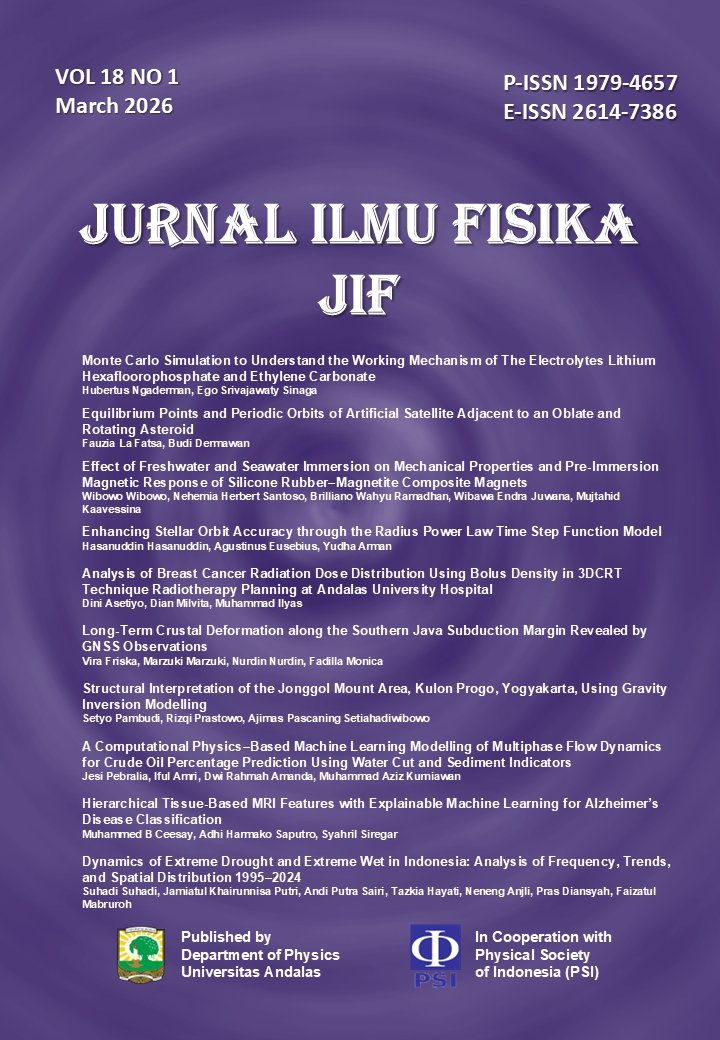
Equilibrium Points and Periodic Orbits of Artificial Satellite Adjacent to an Oblate and Rotating Asteroid
DOI:
https://doi.org/10.25077/jif.18.1.14-24.2026Keywords:
Asteroids, Artificial Satellites, Equilibrium Points, Periodic Orbits, PotentialsAbstract
Asteroids have various shapes (mostly irregular) and physical characteristics. Space missions to asteroids are becoming frequent, and a global mapping scheme is applied to collect the asteroids’ physical properties. Depending on the mission purposes, the mapping scheme can encircle the whole asteroid’s body or utilize the asteroid’s equilibrium points for the least energy consumption. Furthermore, it is essential to construct optimal trajectories to maximize the coverage and science results. Thus, an efficient mission can be achieved by devoting periodic orbits of artificial satellites around the equilibria. This study aims to construct periodic orbits related to the equilibria of an oblate shape and rotating asteroid, under the influences of gravitational and rotational potentials. Equations of motion of the satellite affected by the potentials are formulated in the Cartesian coordinate system. By acquiring mutual zero accelerations (first derivative of the potentials with respect to all directions), the equilibria are then obtained. Adjacent to the asteroid, four equilibria were revealed, and analysis of their stability showed that all of them are unstable. Despite this, some periodic orbits centered at the respective equilibria were successfully constructed using some arbitrary parameters (harmonics) that affect the coverage area for mapping the asteroid.
Downloads
References
Abad, A., Elipe, A., & Ferreira, A. F. S, (2024). Periodic orbits around the 216-Kleopatra asteroid modelled by a dipole-segment. Advances in Space Research, 74(11), 5687-5697.
Aksenov, S. A., & Bober, S. A. (2018). Calculation and study of limited orbits around the L2 libration point of the Sun-Earth system. Cosmic Research, 56(2), 144–150.
Aljbaae, S., Chanut, T. G., Carruba, V., Souchay, J., Prado, A. F., & Amarante, A. (2017). The dynamical environment of asteroid 21 Lutetia according to different internal models. Monthly Notices of the Royal Astronomical Society, 464(3), 3552-3560.
Busch, M. W., Ostro, S. J., Benner, L. A., Brozovic, M., Giorgini, J. D., Jao, J. S., ... & Brisken, W. (2011). Radar observations and the shape of near-Earth asteroid 2008 EV5. Icarus, 212(2), 649-660.
Chanut, T. G. G., Aljbaae, S., & Carruba, V. (2015). Mascon gravitation model using a shaped polyhedral source. Monthly Notices of the Royal Astronomical Society, 450(4), 3742–3749.
Descamps, P., Marchis, F., Michalowski, T., Vachier, F., Colas, F., Berthier, J., … Birlan, M. (2011). Triplicity and physical characteristics of asteroid (216) Kleopatra. Icarus, 211(2), 1022–1033.
Fu, X. & Soldini, S. (2025). Equilibrium point evolution and the associated characteristic curves of an asteroid. Monthly Notices of the Royal Astronomical Society, 538(4), 2245–2254.
Hilst, V. D. R. (2004). Essentials of geophysics. Open Course Ware. MIT. Retrieves from https://ocw.mit.edu/ courses/12-201-essentials-of-geophysics-fall-2004/
Huda, I. N., Dermawan, B., Saputra, M. B. Sadikin, R. & Hidayat, T. (2023). Studying the equilibrium points of the modified circular restricted three-body problem: the case of Sun-Haumea system. Research in Astronomy and Astrophysics, 23(11), #115025.
Huda, I. N., Haz, H. R. S., Dermawan, B., Abdurrazzaq, A., Rachmawati, R. N., & Kuntjoro, Y. D. (2025). Model of potential around natural elongated asteroid with 4th-order polynomial density profile and albedo effects. Journal of the Astronautical Sciences, 72, 2, 12 pp.
Jiang, Y., Baoyin, H., Li, J., & Li, H. (2014). Orbits and manifolds near the equilibrium points around a rotating asteroid. Astrophysics and Space Science, 349(1), 83-106.
Jiang, Y., & Baoyin, H. (2016). Periodic orbit families in the gravitational field of irregular-shaped bodies. The Astronomical Journal, 152(5), 137.
Jiang, Y. & Liu, X. (2019). Equilibria and orbits around asteroid using the polyhedral model. New Astronomy, 69(1), 8–20.
Li, X., Warier, R. R., Sanyal, A. K., & Qiao, D. (2019). Trajectory tracking near small bodies using only attitude control. Journal of Guidance, Control, and Dynamics, 42(1), 109-122.
Liu, H., Jiang, Y., Lang, A., Wang, Y., Zou, X., Ping, J., & Cao, J. (2022). Analysis of the equilibrium points and orbits stability for the asteroid 93 Minerva. Open Astronomy, 31(1), 375–389.
McInnes, A. I. (2009). An introduction to libration point orbits. Retrieved from https://api.semanticscholar.org/ CorpusID:36564510
Mota, M. L., & Rocco, E. M. (2019). Equilibrium points stability analysis for the asteroid 21 Lutetia. In Journal of Physics: Conference Series (Vol. 1365, No. 1, p. 012007). IOP Publishing.
Ni, Y., Jiang, Y., & Baoyin, H. (2016). Multiple bifurcations in the periodic orbit around Eros. Astrophysics and Space Science, 361(5), 170.
Santos, L. T., Prado, A. F. B. D. A., & Sanchez, D. M. (2017). Equilibrium points in the asteroid 2001 SN263. In Journal of Physics: Conference Series (Vol. 911, No. 1, p. 012023). IOP Publishing.
Scheeres, D. J. (2016). Orbital motion in strongly perturbed environments: applications to asteroid, comet and planetary satellite orbiters. Springer.
Scheeres, D. J., Ostro, S. J., Hudson, R. S., & Werner, R. A. (1996). Orbits close to asteroid 4769 Castalia. Icarus, 121(1), 67–87.
Seitz, K., Heck, B., & Abd-Elmotaal, H. (2023). External gravitational field of a homogeneous ellipsoidal shell: A reference for testing gravity modelling software. Journal of Geodesy, 97(6), 54.
Shi, Y., Wang, Y., & Xu, S. (2018). Equilibrium points and associated periodic orbits in the gravity of binary asteroid systems: (66391) 1999 KW4 as an example. Celestial Mechanics and Dynamical Astronomy, 130, 32.
Takahashi, S., & Scheeres, D. J. (2021). Autonomous Exploration of a Small Near-Earth Asteroid. Journal of Guidance, Control, and Dynamics, 44(4), 701–718.
Yu, Y., & Baoyin, H. (2012). Generating families of 3D periodic orbits about asteroids. Monthly Notices of the Royal Astronomical Society, 427(1), 872–881.
Zegmott, T. J., Lowry, S. C., Rożek, A., Rozitis, B., Nolan, M. C., Howell, E. S., ... & Weissman, P. R. (2021). Detection of the YORP effect on the contact binary (68346) 2001 KZ66 from combined radar and optical observations. Monthly Notices of the Royal Astronomical Society, 507(4), 4914-4932.
Downloads
Published
How to Cite
Issue
Section
Citation Check
License
Copyright (c) 2025 La Fatsa Fauzia, Dermawan Budi

This work is licensed under a Creative Commons Attribution-NonCommercial 4.0 International License.
Please find the rights and licenses in JIF (Jurnal Ilmu Fisika).
1. License
The non-commercial use of the article will be governed by the Creative Commons Attribution license as currently displayed on Creative Commons Attribution-NonCommercial 4.0 International License.
2. Author's Warranties
The author warrants that the article is original, written by stated author(s), has not been published before, contains no unlawful statements, does not infringe the rights of others, is subject to copyright that is vested exclusively in the author and free of any third party rights, and that any necessary written permissions to quote from other sources have been obtained by the author(s).
3. User Rights
JIF's spirit is to disseminate articles published are as free as possible. Under the Creative Commons license, JIF permits users to copy, distribute, display, and perform the work for non-commercial purposes only. Users will also need to attribute authors and JIF on distributing works in the journal.
4. Rights of Authors
Authors retain the following rights:
- Copyright, and other proprietary rights relating to the article, such as patent rights,
- The right to use the substance of the article in future own works, including lectures and books,
- The right to reproduce the article for own purposes, provided the copies are not offered for sale,
- The right to self-archive the article.
5. Co-Authorship
If the article was jointly prepared by other authors, the signatory of this form warrants that he/she has been authorized by all co-authors to sign this agreement on their behalf, and agrees to inform his/her co-authors of the terms of this agreement.
6. Termination
This agreement can be terminated by the author or JIF upon two months's notice where the other party has materially breached this agreement and failed to remedy such breach within a month of being given the terminating party's notice requesting such breach to be remedied. No breach or violation of this agreement will cause this agreement or any license granted in it to terminate automatically or affect the definition of JIF.
7. Royalties
This agreement entitles the author to no royalties or other fees. To such extent as legally permissible, the author waives his or her right to collect royalties relative to the article in respect of any use of the article by JIF or its sublicensee.
8. Miscellaneous
JIF will publish the article (or have it published) in the journal if the article's editorial process is successfully completed and JIF or its sublicensee has become obligated to have the article published. JIF may conform the article to a style of punctuation, spelling, capitalization, referencing and usage that it deems appropriate. The author acknowledges that the article may be published so that it will be publicly accessible and such access will be free of charge for the readers.