
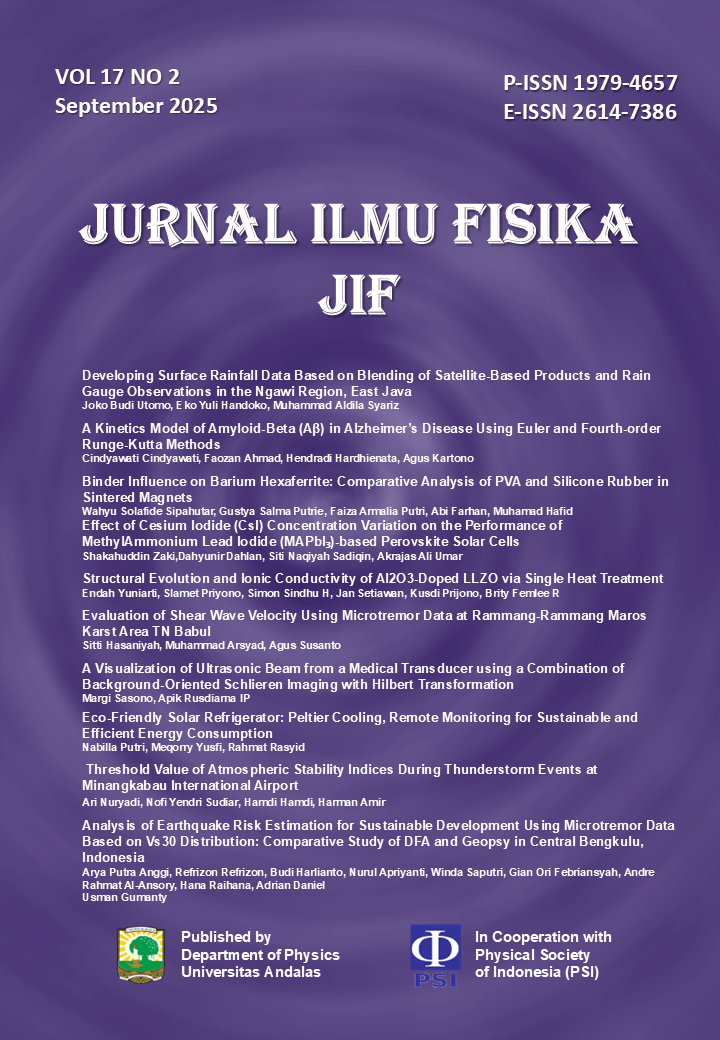
Developing Surface Rainfall Data Based on Blending of Satellite-Based Products and Rain Gauge Observations in the Ngawi Region, East Java
DOI:
https://doi.org/10.25077/jif.17.2.110-124.2025Keywords:
Surface Rainfall, Satellite product, Kriging, Rain gauge, Leave-one-out cross validationAbstract
Rainfall estimation can be performed using various methods, including direct satellite observations (RR-Satellite). However, these estimates show discrepancies when compared to actual observations in-situ rain gauges (RR-Obs). To address this challenge, one potential solution is integrating RR-Satellite with RR-Obs. The Kriging with External Drift (KED) interpolation method is a blending technique that incorporates RR-Satellite as external drift. This study utilized four satellite dataset, namely CHIRP, CMORPH, GSMAP_V8, and IMERG as auxiliary information to generate monthly rainfall estimates (RR-Blended) at 26 rain gauges in Ngawi, East Java, for the period 2001 - 2023. The performance of each satellite dataset was evaluated using Leave-One-Out Cross Validation (LOOCV). The results indicated that RR-Blended using CHIRP (bCHIRP) demonstrated the best accuracy at the climatological scale, with KGE > 0.3 and TSS > 0.65, outperforming other satellite dataset. At the monthly scale, bCHIRP, bCMORPH, and bIMERG showed better performance in different months throughout the year. In terms of spatial accuracy, bCMORPH achieved the highest performance. Our findings suggest that each satellite offers unique advantages based on the time and location of observation. Therefore, we recommend using a weighted combination of RR-Blended from four satellites as the most effective approach for obtaining the best rainfall estimates.
Downloads
References
Aldrian, E., & Dwi Susanto, R. (2003). Identification of three dominant rainfall regions within Indonesia and their relationship to sea surface temperature. International Journal of Climatology, 23(12), 1435–1452. https://doi.org/10.1002/joc.950
Bai, L., Shi, C., Li, L., Yang, Y., & Wu, J. (2018). Accuracy of CHIRPS satellite-rainfall products over mainland China. Remote Sensing, 10(3). https://doi.org/10.3390/rs10030362
Beck, H. E., Vergopolan, N., Pan, M., Levizzani, V., Van Dijk, A. I. J. M., Weedon, G. P., Brocca, L., Pappenberger, F., Huffman, G. J., & Wood, E. F. (2017). Global-scale evaluation of 22 precipitation datasets using gauge observations and hydrological modeling. Hydrology and Earth System Sciences, 21(12), 6201–6217. https://doi.org/10.5194/hess-21-6201-2017
BMKG. (2021). Buku Peta Rata-rata Curah Hujan dan Hari Hujan Periode 1991-2020 Indonesia. BMKG. https://iklim.bmkg.go.id/bmkgadmin/storage/buletin/20220511_BukuNormal_Lengkap_FormatBuku.pdf
Cantet, P. (2017). Mapping the mean monthly precipitation of a small island using kriging with external drifts. Theoretical and Applied Climatology, 127(1–2), 31–44. https://doi.org/10.1007/s00704-015-1610-z
Chappell, A., Renzullo, L. H., Raupach, T. J., & Haylock, M. (2013). Evaluating geostatistical methods of blending satellite and gauge data to estimate near real-time daily rainfall for Australia. Journal of Hydrology, 493, 105–114. https://doi.org/10.1016/j.jhydrol.2013.04.024
Chua, Z. W., Kuleshov, Y., Watkins, A. B., Choy, S., & Sun, C. (2022). A Two‐Step Approach to Blending GSMaP Satellite Rainfall Estimates with Gauge Observations over Australia. Remote Sensing, 14(8). https://doi.org/10.3390/rs14081903
Fatkhuroyan, & TrinahWati. (2018). Accuracy Assessment of Global Satellite Mapping of Precipitation (GSMaP) Product over Indonesian Maritime Continent. IOP Conference Series: Earth and Environmental Science, 187(1). https://doi.org/10.1088/1755-1315/187/1/012060
Funk, C., Peterson, P., Landsfeld, M., Pedreros, D., Verdin, J., Shukla, S., Husak, G., Rowland, J., Harrison, L., Hoell, A., & Michaelsen, J. (2015). The climate hazards infrared precipitation with stations - A new environmental record for monitoring extremes. Scientific Data, 2. https://doi.org/10.1038/sdata.2015.66
Goshime, D. W., Absi, R., & Ledésert, B. (2019). Evaluation and bias correction of CHIRP rainfall estimate for rainfall-runoff simulation over Lake Ziway Watershed, Ethiopia. Hydrology, 6(3). https://doi.org/10.3390/hydrology6030068
Groisman, P. ya, & Legates, D. R. (1994). The Accuracy SS of United States Precipitation Data. Bulletin of the American Meteorological Society, 75(3), 215–228. https://doi.org/10.1175/1520-0477(1994)075<0215:TAOUSP>2.0.CO;2
Hengl, T., Heuvelink, G. B. M., & Stein, A. (2003). Comparison of kriging with external drift and regression-kriging *. In ITC, Technical Note. ITC, Technical Note. https://www.itc.nl/library/Academic
Hou, A. Y., Kakar, R. K., Neeck, S., Azarbarzin, A. A., Kummerow, C. D., Kojima, M., Oki, R., Nakamura, K., & Iguchi, T. (2014). The global precipitation measurement mission. Bulletin of the American Meteorological Society, 95(5), 701–722. https://doi.org/10.1175/BAMS-D-13-00164.1
Huffman, G. J., Bolvin, D. T., Nelkin, E. J., & Tan, J. (2019). Integrated Multi-satellitE Retrievals for GPM (IMERG) Technical Documentation. In IMERG Tech Document.
Jewell, S. A., & Gaussiat, N. (2015). An assessment of kriging-based rain-gauge-radar merging techniques. Quarterly Journal of the Royal Meteorological Society, 141(691), 2300–2313. https://doi.org/10.1002/qj.2522
Jiang, Q., Li, W., Wen, J., Fan, Z., Chen, Y., Scaioni, M., & Wang, J. (2019). Evaluation of satellite-based products for extreme rainfall estimations in the eastern coastal areas of China. Journal of Integrative Environmental Sciences, 16(1), 191–207. https://doi.org/10.1080/1943815X.2019.1707233
Joyce, R. J., Janowiak, J. E., Arkin, P. A., & Xie, P. (2004). CMORPH: A Method that Produces Global Precipitation Estimates from Passive Microwave and Infrared Data at High Spatial and Temporal Resolution. Journal of Hydrology, 5(3), 487–503. https://doi.org/https://doi.org/10.1175/1525-7541(2004)005<0487:CAMTPG>2.0.CO;2
Knoben, W. J. M., Freer, J. E., & Woods, R. A. (2019). Technical note: Inherent benchmark or not? Comparing Nash-Sutcliffe and Kling-Gupta efficiency scores. Hydrology and Earth System Sciences. https://doi.org/10.5194/hess-2019-327
Kubota, T., Shige, S., Hashizume, H., Aonashi, K., Takahashi, N., Seto, S., Hirose, M., Takayabu, Y. N., Ushio, T., Nakagawa, K., Iwanami, K., Kachi, M., & Okamoto, K. (2007). Global precipitation map using satellite-borne microwave radiometers by the GSMaP project: Production and validation. IEEE Transactions on Geoscience and Remote Sensing, 45(7), 2259–2275. https://doi.org/10.1109/TGRS.2007.895337
Lin, A., & Wang, X. L. (2011). An algorithm for blending multiple satellite precipitation estimates with in situ precipitation measurements in Canada. Journal of Geophysical Research Atmospheres, 116(21). https://doi.org/10.1029/2011JD016359
Ly, S., Charles, C., & Degré, A. (2011). Geostatistical interpolation of daily rainfall at catchment scale: The use of several variogram models in the Ourthe and Ambleve catchments, Belgium. Hydrology and Earth System Sciences, 15(7), 2259–2274. https://doi.org/10.5194/hess-15-2259-2011
Mathevet, T., Le Moine, N., Andréassian, V., Gupta, H., & Oudin, L. (2023). Multi-objective assessment of hydrological model performances using Nash–Sutcliffe and Kling–Gupta efficiencies on a worldwide large sample of watersheds. Comptes Rendus - Geoscience, 355. https://doi.org/10.5802/crgeos.189
Michaelides, S., Levizzani, V., Anagnostou, E., Bauer, P., Kasparis, T., & Lane, J. E. (2009). Precipitation: Measurement, remote sensing, climatology and modeling. Atmospheric Research, 94(4), 512–533. https://doi.org/10.1016/j.atmosres.2009.08.017
Michelson, D. B. (2004). Systematic correction of precipitation gauge observations using analyzed meteorological variables. Journal of Hydrology, 290(3–4), 161–177. https://doi.org/10.1016/j.jhydrol.2003.10.005
Muharsyah, R., Fitria Kussatiti, D., Ripaldi, A., Maharani, T., Nur Ratri, D., Hanif Damayanti, R., Denata, M., Yuswantoro, A., & Wahyuni, N. (2021). Mengukur Penambahan Curah Hujan pada 34 Provinsi di Indonesia saat Periode La Nina Menggunakan Blending Curah Hujan Pengamatan In-Situ Dan Satelite (Measuring Rainfall Increament Over 34 Provinces in Indonesia During La Nina Period using Blending Rainfall In-Situ and Satellite Observation). Seminar Nasional Geomatika BIG.
Mulsandi, A., Koesmaryono, Y., Hidayat, R., Faqih, A., & Sopaheluwakan, A. (2024). Detecting Indonesian Monsoon Signals and Related Features Using Space–Time Singular Value Decomposition (SVD). Atmosphere, 15(2), 1–15. https://doi.org/10.3390/atmos15020187
Murphy, B., Yurchak, R., & Müller, S. (2024). GeoStat-Framework/PyKrige: v1.7.2. https://doi.org/https://doi.org/10.5281/zenodo.11360184
Nanding, N., Rico-Ramirez, M. A., & Han, D. (2015). Comparison of different radar-raingauge rainfall merging techniques. Journal of Hydroinformatics, 17(3), 422–445. https://doi.org/10.2166/hydro.2015.001
Novia Nur Rohma. (2022). Estimation of Ordinary Kriging Method with Jackknife Technique on Rainfall Data in Malang Raya. International Journal on Information and Communication Technology (IJoICT), 8(2), 22–39. https://doi.org/10.21108/ijoict.v8i2.678
Oliver, M. A., & Webster, R. (2015). Springer Briefs in Agriculture Basic Steps in Geostatistics: The Variogram and Kriging. Springer. https://doi.org/DOI10.1007/978-3-319-15865-5
Pang, Y., Wang, Y., Lai, X., Zhang, S., Liang, P., & Song, X. (2023). Enhanced Kriging leave-one-out cross-validation in improving model estimation and optimization. Computer Methods in Applied Mechanics and Engineering, 414. https://doi.org/10.1016/j.cma.2023.116194
Peterson, T. C., Easterling, D. R., Karl, T. R., Groisman, P., Nicholls, N., Plummer, N., Torok, S., Auer, I., Boehm, R., Gullett, D., Vincent, L., Heino, R., Tuomenvirta, H., Mestre, O., Tama´, T., Szentimrey, T., Salinger, J., Førland, E. J., Hanssen-Bauer, I., … Parker, D. (1998). A review. International Journal of Climatology: A Journal of the Royal Meteorological Society, 18(13), 1493-1517.
Pratama, A., Agiel, H. M., & Oktaviana, A. A. (2022). Evaluasi Satellite Precipitation Product (GSMaP, CHIRPS, dan IMERG) di Kabupaten Lampung Selatan. Journal of Science and Applicative Technology, 6(1), 32. https://doi.org/10.35472/jsat.v6i1.702
Pririzki, S. J., Sari, N., Agustin, B., Razaf, Y., & Simbolon, E. (2022). Penerapan Model Semivariogram Eksperimental Pada Curah Hujan Bulanan Di Indonesia (Application of Experimental Semivariogram Model on Monthly Rainfall In Indonesia). Jurnal Fraction, 2(1), 1–7.
Ramadhan, R., Marzuki, M., Yusnaini, H., Muharsyah, R., Tangang, F., Vonnisa, M., & Harmadi, H. (2023). A Preliminary Assessment of the GSMaP Version 08 Products over Indonesian Maritime Continent against Gauge Data. Remote Sensing, 15(4). https://doi.org/10.3390/rs15041115
Ramadhan, R., Marzuki, M., Yusnaini, H., Muharsyah, R., Suryanto, W., Sholihun, S., Vonnisa, M., Battaglia, A., & Hashiguchi, H. (2022). Capability of GPM IMERG Products for Extreme Precipitation Analysis over the Indonesian Maritime Continent. Remote Sensing, 14(2). https://doi.org/10.3390/rs14020412
Shen, G., Chen, N., Wang, W., & Chen, Z. (2019). WHU-SGCC: A novel approach for blending daily satellite (CHIRP) and precipitation observations over the Jinsha River basin. Earth System Science Data, 11(4), 1711–1744. https://doi.org/10.5194/essd-11-1711-2019
Sideris, I. V., Gabella, M., Erdin, R., & Germann, U. (2014). Real-time radar-rain-gauge merging using spatio-temporal co-kriging with external drift in the alpine terrain of Switzerland. Quarterly Journal of the Royal Meteorological Society, 140(680), 1097–1111. https://doi.org/10.1002/qj.2188
Taylor, K. E. (2001). Summarizing multiple aspects of model performance in a single diagram. Journal of Geophysical Research Atmospheres, 106(D7), 7183–7192. https://doi.org/10.1029/2000JD900719
van den Besselaar, E. J. M., van der Schrier, G., Cornes, R. C., Suwondo, A., Iqbal, & Tank, A. M. G. K. (2017). SA-OBS: A daily gridded surface temperature and precipitation dataset for Southeast Asia. Journal of Climate, 30(14), 5151–5165. https://doi.org/10.1175/JCLI-D-16-0575.1
Verdin, A., Rajagopalan, B., Kleiber, W., & Funk, C. (2015). A Bayesian kriging approach for blending satellite and ground precipitation observations. Water Resources Research, 51(2), 908–921. https://doi.org/10.1002/2014WR015963
Vernimmen, R. R. E., Hooijer, A., Mamenun, Aldrian, E., & Van Dijk, A. I. J. M. (2012). Evaluation and bias correction of satellite rainfall data for drought monitoring in Indonesia. Hydrology and Earth System Sciences, 16(1), 133–146. https://doi.org/10.5194/hess-16-133-2012
Wati, T., Hadi, T. W., Sopaheluwakan, A., & Hutasoit, L. M. (2021). Evaluation gridded precipitation datasets in Indonesia. IOP Conference Series: Earth and Environmental Science, 893(1). https://doi.org/10.1088/1755-1315/893/1/012056
Yang, X., Yu, X., Wang, Y., He, X., Pan, M., Zhang, M., Liu, Y. I., Ren, L., & Sheffield, J. (2020). The Optimal Multimodel Ensemble of Bias-Corrected CMIP5 Climate Models over China. Journal of Hydrometeorology, 21, 845–863. https://doi.org/10.1175/JHM-D-19
Downloads
Published
How to Cite
Issue
Section
Citation Check
License
Copyright (c) 2025 Joko Budi Utomo, Eko Yuli Handoko, Muhammad Aldila Syariz, Ardhasena Sopaheluwakan

This work is licensed under a Creative Commons Attribution-NonCommercial 4.0 International License.
Please find the rights and licenses in JIF (Jurnal Ilmu Fisika).
1. License
The non-commercial use of the article will be governed by the Creative Commons Attribution license as currently displayed on Creative Commons Attribution-NonCommercial 4.0 International License.
2. Author's Warranties
The author warrants that the article is original, written by stated author(s), has not been published before, contains no unlawful statements, does not infringe the rights of others, is subject to copyright that is vested exclusively in the author and free of any third party rights, and that any necessary written permissions to quote from other sources have been obtained by the author(s).
3. User Rights
JIF's spirit is to disseminate articles published are as free as possible. Under the Creative Commons license, JIF permits users to copy, distribute, display, and perform the work for non-commercial purposes only. Users will also need to attribute authors and JIF on distributing works in the journal.
4. Rights of Authors
Authors retain the following rights:
- Copyright, and other proprietary rights relating to the article, such as patent rights,
- The right to use the substance of the article in future own works, including lectures and books,
- The right to reproduce the article for own purposes, provided the copies are not offered for sale,
- The right to self-archive the article.
5. Co-Authorship
If the article was jointly prepared by other authors, the signatory of this form warrants that he/she has been authorized by all co-authors to sign this agreement on their behalf, and agrees to inform his/her co-authors of the terms of this agreement.
6. Termination
This agreement can be terminated by the author or JIF upon two months's notice where the other party has materially breached this agreement and failed to remedy such breach within a month of being given the terminating party's notice requesting such breach to be remedied. No breach or violation of this agreement will cause this agreement or any license granted in it to terminate automatically or affect the definition of JIF.
7. Royalties
This agreement entitles the author to no royalties or other fees. To such extent as legally permissible, the author waives his or her right to collect royalties relative to the article in respect of any use of the article by JIF or its sublicensee.
8. Miscellaneous
JIF will publish the article (or have it published) in the journal if the article's editorial process is successfully completed and JIF or its sublicensee has become obligated to have the article published. JIF may conform the article to a style of punctuation, spelling, capitalization, referencing and usage that it deems appropriate. The author acknowledges that the article may be published so that it will be publicly accessible and such access will be free of charge for the readers.