
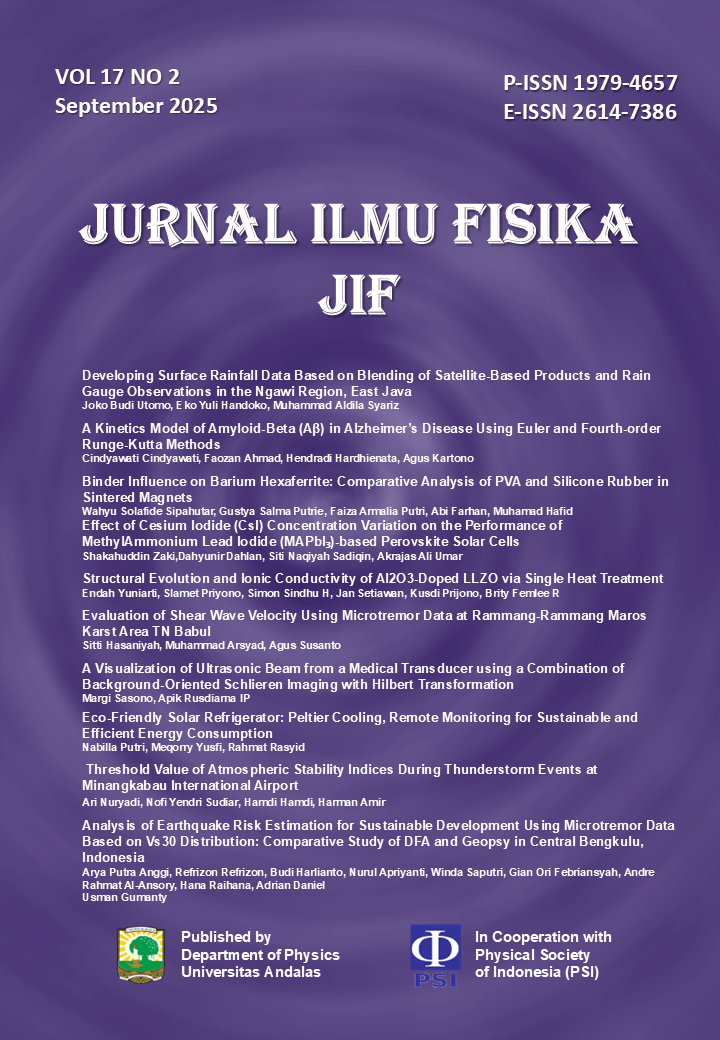
A Kinetics Model of Amyloid-Beta (Aβ) in Alzheimer’s Disease Using Euler and Fourth-order Runge-Kutta Methods
DOI:
https://doi.org/10.25077/jif.17.2.125-134.2025Keywords:
Amyloid-beta (Aꞵ), Alzheimer disease , Euler Method, Runge-Kutta Method, Mathematical modelAbstract
Alzheimer's disease (AD) is a neurological disease that causes decreased brain function. It is known that the accumulation of amyloid-beta (Aβ) plaques in the brain is one of the causes of AD. The accumulation of Aβ plaques in the brain is a dynamic process; it begins with the growth of amyloid-beta monomers (M1). Furthermore, amyloid-beta dimers (M2) and so on, so that this collected into oligomers (O), fibrils (P), and plaques in the brain. This disrupts the communication pathways between nerve cells. In this study, each process of amyloid-beta plaque accumulation is presented with a mathematical model in the form of an ordinary differential equation. Therefore, the coupled ordinary differential equations are given for the entire process of Aβ plaque accumulation. In this study, this coupled model is calculated using numerical methods, such as the Euler and fourth-order Runge-Kutta methods. The Euler methods is simple and efficient, but its accuracy is low and can accumulate errors with larger step sizes. The fourth-order Runge-Kutta methods offers higher accuracy, better numerical stability, and greater control over the accuracy of the solution. These two numerical methods have never been compared for estimating numerical solutions of coupled ordinary differential equations.
Downloads
References
Ackleh, A. S., Elaydi, S., Livadiotis, G., & Veprauskas, A. (2021). A continuous-time mathematical model and discrete approximations for the aggregation of β-Amyloid. Journal of Biological Dynamics, 15(1), 109–136. https://doi.org/10.1080/17513758.2020.1869843
Asili, E., Yarahmadian, S., Khani, H., & Sharify, M. (2019). A Mathematical Model for Amyloid- β Aggregation in the Presence of Metal Ions: A Timescale Analysis for the Progress of Alzheimer Disease. Bulletin of Mathematical Biology. https://doi.org/10.1007/s11538-019-00583-3
C.Senthilnathan. (2018). A Numerical Solutions Of Initial Value Problems (Ivp) For Ordinary Differential Equations (Ode) With Euler And Higher Order Of Runge Kutta Method Using Matlab. International Journal of Engineering Science Invention (IJESI), 7(4), 25–31.
Cohen, S. I. A., Vendruscolo, M., Dobson, C. M., & Knowles, T. P. J. (2012). From macroscopic measurements to microscopic mechanisms of protein aggregation. Journal of Molecular Biology, 421(2–3), 160–171. https://doi.org/10.1016/j.jmb.2012.02.031
Craft, D. L., Wein, L. M., & Selkoe, D. J. (2002). A mathematical model of the impact of novel treatments on the Aβ burden in the Alzheimer’s brain, CSF and plasma. Bulletin of Mathematical Biology, 64(5), 1011–1031. https://doi.org/10.1006/bulm.2002.0304
Fraser, P. E., Duffy, L. K., O’Malley, M. B., Nguyen, J., Inouye, H., & Kirschner, D. A. (1991). Morphology and antibody recognition of synthetic β‐amyloid peptides. Journal of Neuroscience Research, 28(4), 474–485. https://doi.org/10.1002/jnr.490280404
Hampel, H., Hardy, J., Blennow, K., Chen, C., Perry, G., Kim, S. H., Villemagne, V. L., Aisen, P., Vendruscolo, M., Iwatsubo, T., Masters, C. L., Cho, M., Lannfelt, L., Cummings, J. L., & Vergallo, A. (2021). The Amyloid-β Pathway in Alzheimer’s Disease. Molecular Psychiatry, 26(10), 5481–5503. https://doi.org/10.1038/s41380-021-01249-0
Hao, W., & Friedman, A. (2016). Mathematical model on Alzheimer’s disease. BMC Systems Biology, 10(1), 1–18. https://doi.org/10.1186/s12918-016-0348-2
Hill, S. E., Robinson, J., Matthews, G., & Muschol, M. (2009). Amyloid protofibrils of lysozyme nucleate and grow via oligomer fusion. Biophysical Journal, 96(9), 3781–3790. https://doi.org/10.1016/j.bpj.2009.01.044
Knowles, T. P. J., Waudby, C. A., Devlin, G. L., Cohen, S. I. A., Aguzzi, A., Vendruscolo, M., Terentjev, E. M., Welland, M. E., & Dobson, C. M. (2009). An analytical solution to the kinetics of breakable filament assembly. Science, 326(5959), 1533–1537. https://doi.org/10.1126/science.1178250
Kumar, S., & Walter, J. (2011). Phosphorylation of amyloid beta peptides. Aging, 3(8), 803–812. https://doi.org/10.18632/aging.100362
Lede, Y. K., & Mungkasi, S. (2019). Performance of the Runge-Kutta method in solving a mathematical model for the spread of dengue fever disease. AIP Conference Proceedings, 2202. https://doi.org/10.1063/1.5141657
Li, H., & Zhao, H. (2022). Mathematical model of Alzheimer’s disease with prion proteins interactions and treatment. Applied Mathematics and Computation, 433, 127377. https://doi.org/10.1016/j.amc.2022.127377
Lindstrom, M. R., Chavez, M. B., Gross-Sable, E. A., Hayden, E. Y., & Teplow, D. B. (2021). From reaction kinetics to dementia: A simple dimer model of Alzheimer s disease etiology. PLoS Computational Biology, 17(7), 1–24. https://doi.org/10.1371/journal.pcbi.1009114
Linse, S. (2017). Monomer-dependent secondary nucleation in amyloid formation. Biophysical Reviews, 9(4), 329–338. https://doi.org/10.1007/s12551-017-0289-z
Lomakin, A., Teplow, D. B., Kirschner, D. A., & Benedeki, G. B. (1997). Kinetic theory of fibrillogenesis of amyloid β-protein. Proceedings of the National Academy of Sciences of the United States of America, 94(15), 7942–7947. https://doi.org/10.1073/pnas.94.15.7942
Naiki Hironobu, G. F. (1999). Kinetic analysis of amyloid fibril formation. Method in Molecular Biology, 309, 305–318. https://doi.org/10.1007/978-1-4939-7816-8_12
Ni, C., Shi, H., Yu, H., Chang, Y., & Chen, and Y. (2011). Folding stability of amyloid‐β 40 monomer is an important determinant of the nucleation kinetics in fibrillization. The FASEB Journal, 25(4), 1390–1401. https://doi.org/10.1096/fj.10-175539
Prince, M., Comas-Herrera, A., Knapp, M., Guerchet, M., & Karagiannidou, M. (2016). World Alzheimer Report 2016 Improving healthcare for people living with dementia. Coverage, Quality and costs now and in the future. Alzheimer’s Disease International (ADI).
Simangunsong, L., & Mungkasi, S. (2021). Fourth order Runge-Kutta method for solving a mathematical model of the spread of HIV-AIDS. AIP Conference Proceedings, 2353. https://doi.org/10.1063/5.0052550
Statista Alzheimer’s Association. (2019). statistic_id452945_death-rate-due-to-alzheimers-disease-in-the-us-2000-2019.pdf.
Downloads
Published
How to Cite
Issue
Section
Citation Check
License
Copyright (c) 2025 Cindyawati Cindyawati, Faozan Ahmad, Hendradi Hardhienata, Agus Kartono

This work is licensed under a Creative Commons Attribution-NonCommercial 4.0 International License.
Please find the rights and licenses in JIF (Jurnal Ilmu Fisika).
1. License
The non-commercial use of the article will be governed by the Creative Commons Attribution license as currently displayed on Creative Commons Attribution-NonCommercial 4.0 International License.
2. Author's Warranties
The author warrants that the article is original, written by stated author(s), has not been published before, contains no unlawful statements, does not infringe the rights of others, is subject to copyright that is vested exclusively in the author and free of any third party rights, and that any necessary written permissions to quote from other sources have been obtained by the author(s).
3. User Rights
JIF's spirit is to disseminate articles published are as free as possible. Under the Creative Commons license, JIF permits users to copy, distribute, display, and perform the work for non-commercial purposes only. Users will also need to attribute authors and JIF on distributing works in the journal.
4. Rights of Authors
Authors retain the following rights:
- Copyright, and other proprietary rights relating to the article, such as patent rights,
- The right to use the substance of the article in future own works, including lectures and books,
- The right to reproduce the article for own purposes, provided the copies are not offered for sale,
- The right to self-archive the article.
5. Co-Authorship
If the article was jointly prepared by other authors, the signatory of this form warrants that he/she has been authorized by all co-authors to sign this agreement on their behalf, and agrees to inform his/her co-authors of the terms of this agreement.
6. Termination
This agreement can be terminated by the author or JIF upon two months's notice where the other party has materially breached this agreement and failed to remedy such breach within a month of being given the terminating party's notice requesting such breach to be remedied. No breach or violation of this agreement will cause this agreement or any license granted in it to terminate automatically or affect the definition of JIF.
7. Royalties
This agreement entitles the author to no royalties or other fees. To such extent as legally permissible, the author waives his or her right to collect royalties relative to the article in respect of any use of the article by JIF or its sublicensee.
8. Miscellaneous
JIF will publish the article (or have it published) in the journal if the article's editorial process is successfully completed and JIF or its sublicensee has become obligated to have the article published. JIF may conform the article to a style of punctuation, spelling, capitalization, referencing and usage that it deems appropriate. The author acknowledges that the article may be published so that it will be publicly accessible and such access will be free of charge for the readers.