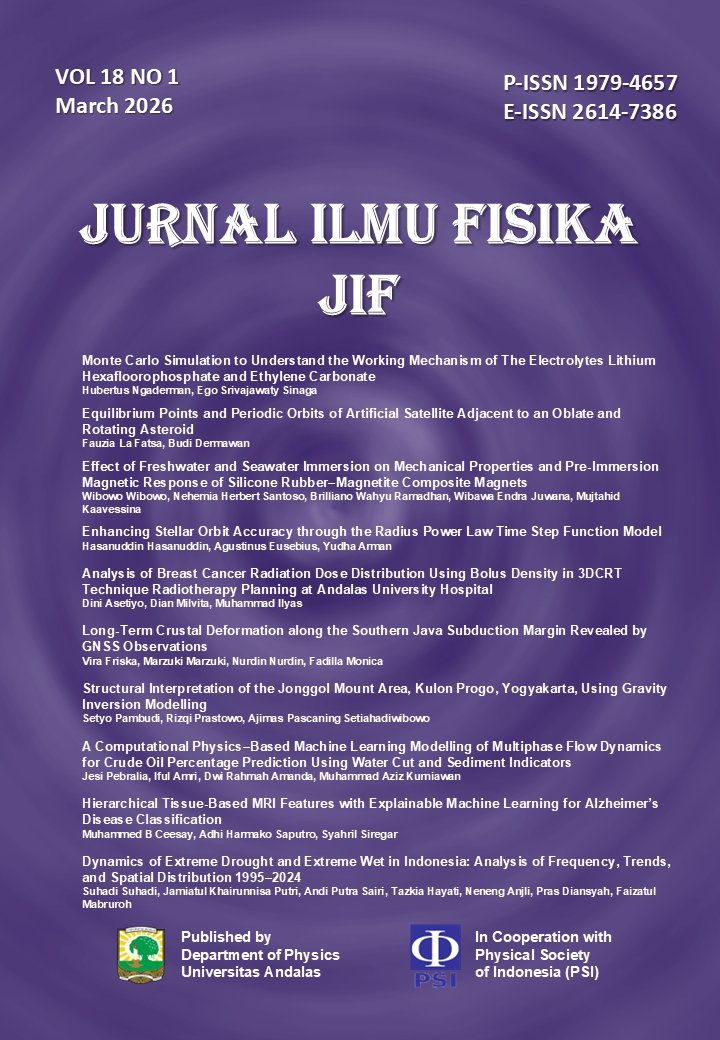
Long-Term Crustal Deformation along the Southern Java Subduction Margin Revealed by GNSS Observations
DOI:
https://doi.org/10.25077/jif.18.1.55-66.2026Keywords:
InaCORS data, Interseismic phase, Plate velocity, Southern Java, Subduction zoneAbstract
This study examines long-term GNSS-derived velocities along southern Java during 2011–2020 to characterize regional crustal deformation. Data from six InaCORS stations operated by BIG were processed using GAMIT/GLOBK to produce time series and estimate horizontal and vertical velocities. Horizontal velocities range from 21.35 mm/yr to 27.54 mm/yr toward the southeast, reflecting strong Eurasian Plate influence. The time series indicates gradual, continuous displacement without significant co-seismic offsets, despite several Mw ~6 earthquakes in the region. Vertical velocities show both uplift and subsidence, ranging from −13.84 mm/yr to 12.61 mm/yr, likely resulting from combined tectonic and non-tectonic processes. Because vertical GNSS measurements generally have higher uncertainty, these results must be interpreted cautiously. Although station motions appear stable, this does not indicate low seismic hazard. Instead, it may suggest ongoing strain accumulation within a seismic gap that could generate a future major earthquake. Overall, these findings enhance understanding of southern Java’s subduction dynamics and support improved earthquake hazard assessment and disaster preparedness.
Downloads
References
Arisa, D., Setiadi, B., & Priyanto, W. S. (2021). Pre-and Coseismic Analysis of the Mw7.6 Padang Earthquake 2009 from Geodetic Approach. IOP Conference Series: Earth and Environmental Science, 789(1), 012069. https://doi.org/10.1088/1755-1315/789/1/012069
Bird, P. (2003). An updated digital model of plate boundaries. Geochemistry, Geophysics, Geosystems, 4(3). https://doi.org/10.1029/2001GC000252
Blewitt, G., & Lavallée, D. (2002). Effect of annual signals on geodetic velocity. Journal of Geophysical Research: Solid Earth, 107(B7), ETG-9.
Bock, Y., Prawirodirdjo, L., Genrich, J. F., Stevens, C. W., McCaffrey, R., Subarya, C., Puntodewo, S. S. O., & Calais, E. (2003). Crustal motion in Indonesia from global positioning system measurements. Journal of Geophysical Research: Solid Earth, 108(B8).
Bradley, K. E., Feng, L., Hill, E. M., Natawidjaja, D. H., & Sieh, K. (2017). Implications of the diffuse deformation of the Indian Ocean lithosphere for slip partitioning of oblique plate convergence in Sumatra. Journal of Geophysical Research: Solid Earth, 122(1), 572–591.
Chaussard, E., Amelung, F., Abidin, H., & Hong, S.-H. (2013). Sinking cities in Indonesia: ALOS PALSAR detects rapid subsidence due to groundwater and gas extraction. Remote Sensing of Environment, 128, 150–161.
Friska, V., Arisa, D., Marzuki, M., & Monica, F. (2022). Indo-Australian Plate Velocity Measurement During Interseismic Phase in 2010–2014 Using Sumatran GPS Array (SuGAr) Data. Proceedings of the International Conference on Radioscience, Equatorial Atmospheric Science and Environment and Humanosphere Science, 2021, 925–934.
Grevemeyer, I., & Tiwari, V. M. (2006). Overriding plate controls spatial distribution of megathrust earthquakes in the Sunda–Andaman subduction zone. Earth and Planetary Science Letters, 251(3–4), 199–208.
Gunawan, E., & Widiyantoro, S. (2019). Active tectonic deformation in Java, Indonesia inferred from a GPS-derived strain rate. Journal of Geodynamics, 123, 49–54.
Hadi, A. L. (2016). Analisa Deformasi Di Wilayah Jawa Tengah Bagian Selatan Menggunakan GPS-CORS Tahun 2013-2015. Jurnal Teknik ITS, 5(2), C70-C74. https://doi.org/10.12962/j23373539.v5i2.17209
Herring, T. A., King, R. W., Floyd, M. A., & McClusky, S. C. (2015). GLOBK Reference Manual. Global Kalman filter VLBI and GPS analysis program Release 10.6. June, 1–95.
Herring, T. A., Melbourne, T. I., Murray, M. H., Floyd, M. A., Szeliga, W. M., King, R. W., Phillips, D. A., Puskas, C. M., Santillan, M., & Wang, L. (2016). Plate Boundary Observatory and related networks: GPS data analysis methods and geodetic products. Reviews of Geophysics, 54(4), 759–808.
Jones, E. S., Hayes, G. P., Bernardino, M., Dannemann, F. K., Furlong, K. P., Benz, H. M., & Villaseñor, A. (2014). Seismicity of the Earth 1900-2012 Java and vicinity. US Geological Survey.
Kopp, H., Flueh, E. R., Petersen, C. J., Weinrebe, W., Wittwer, A., & Scientists, M. (2006). The Java margin revisited: Evidence for subduction erosion off Java. Earth and Planetary Science Letters, 242(1–2), 130–142.
Marzuki, Ramadhan, R., Friska, V., Primadona, H., Ramadhan, R. A., Monica, F., Arisa, D., & Namigo, E. L. (2022). Dynamics of West Coast of Sumatra and Island Arc Mentawai during the Coseismic Phase of the Mentawai Mw7.8 25 October 2010 Earthquake. Journal of Physics: Conference Series, 2309(1), 012030. https://doi.org/10.1088/1742-6596/2309/1/012030
Maulida, P., Rafiq, M., Herawati, Y. A., Kurniawan, A., & Taufik, M. (2023). Current deformation in eastern part of Java derived from GPS observation 2017-2022. IOP Conference Series: Earth and Environmental Science, 1276(1), 12023.
McCaffrey, R. (2009). The tectonic framework of the Sumatran subduction zone. Annual Review of Earth and Planetary Sciences, 37(1), 345–366.
Monica, F., Friska, V., Arisa, D., & Marzuki, M. (2022). Comparison of Deformation Vectors Due to Earthquake in Subduction Zone and Sumatran Fault for Each Phase of Earthquake Cycle. Jurnal Ilmu Fisika | Universitas Andalas, 14(2), 73–85. https://doi.org/10.25077/jif.14.2.73-85.2022
Mori, J., Mooney, W. D., Afnimar, Kurniawan, S., Anaya, A. I., & Widiyantoro, S. (2007). The 17 July 2006 tsunami earthquake in west Java, Indonesia. Seismological Research Letters, 78(2), 201–207.
Nurdin, N., Pujiastuti, D., & Marzuki, M. (2023). Analysis of vertical seismic deformation of the 2018 Palu earthquake using Global Navigation Satellite System (GNSS) data. Journal of Physics: Conference Series, 2596(1), 12037.
PUSGEN. (2017). Peta Sumber Dan Bahaya Gempa Indonesia Tahun 2017. Pusat Penelitian dan Pengembangan Perumahan dan Permukiman. https://simantu.pu.go.id/content/?id=3605
Ramadian, R. R., Meilano, I., Hanifa, N. R., & Efendi, J. (2018). Interseismic coupling off the south of Central Java from GPS-derived baseline change rates. AIP Conference Proceedings, 1987(1), 20105.
Rwabudandi, I., Anjasmara, I. M., & Susilo, S. (2019). Evaluating GPS CORS Data for Crustal Deformation Analysis in East Java. Jurnal Teknik ITS, 8(2). https://doi.org/10.12962/j23373539.v8i2.49686
Schlüter, H. U., Gaedicke, C. H., Roeser, H. A., Schreckenberger, B., Meyer, H., Reichert, C. H., Djajadihardja, Y., & Prexl, A. (2002). Tectonic features of the southern Sumatra‐western Java forearc of Indonesia. Tectonics, 21(5), 11.
Simons, W. J. F., Socquet, A., Vigny, C., Ambrosius, B. A. C., Haji Abu, S., Promthong, C., Subarya, C., Sarsito, D. A., Matheussen, S., & Morgan, P. (2007). A decade of GPS in Southeast Asia: Resolving Sundaland motion and boundaries. Journal of Geophysical Research: Solid Earth, 112(B6).
Tsai, M. C., Yu, S. B., Shin, T. C., Kuo, K. W., Leu, P. L., Chang, C. H., & Ho, M. Y. (2015). Velocity field derived from Taiwan continuous GPS Array (2007-2013). Terrestrial, Atmospheric and Oceanic Sciences, 26(5), 527–556. https://doi.org/10.3319/TAO.2015.05.21.01(T)
USGS. (2025). USGS Earthquake Catalog Search. https://earthquake.usgs.gov/earthquakes/search/
Verstappen, H. T. (2010). Indonesian landforms and plate tectonics. Indonesian Journal on Geoscience, 5(3), 197–207.
Williams, S. D. P., Bock, Y., Fang, P., Jamason, P., Nikolaidis, R. M., Prawirodirdjo, L., Miller, M., & Johnson, D. J. (2004). Error analysis of continuous GPS position time series. Journal of Geophysical Research: Solid Earth, 109(B3).
Xia, Y., Geersen, J., Klaeschen, D., Ma, B., Lange, D., Riedel, M., Schnabel, M., & Kopp, H. (2021). Marine forearc structure of eastern Java and its role in the 1994 Java tsunami earthquake. Solid Earth Discussions, 2021, 1–19.
Downloads
Published
How to Cite
Issue
Section
Citation Check
License
Copyright (c) 2025 Vira Friska, Marzuki Marzuki, Nurdin Nurdin, Fadilla Monica

This work is licensed under a Creative Commons Attribution-NonCommercial 4.0 International License.
Please find the rights and licenses in JIF (Jurnal Ilmu Fisika).
1. License
The non-commercial use of the article will be governed by the Creative Commons Attribution license as currently displayed on Creative Commons Attribution-NonCommercial 4.0 International License.
2. Author's Warranties
The author warrants that the article is original, written by stated author(s), has not been published before, contains no unlawful statements, does not infringe the rights of others, is subject to copyright that is vested exclusively in the author and free of any third party rights, and that any necessary written permissions to quote from other sources have been obtained by the author(s).
3. User Rights
JIF's spirit is to disseminate articles published are as free as possible. Under the Creative Commons license, JIF permits users to copy, distribute, display, and perform the work for non-commercial purposes only. Users will also need to attribute authors and JIF on distributing works in the journal.
4. Rights of Authors
Authors retain the following rights:
- Copyright, and other proprietary rights relating to the article, such as patent rights,
- The right to use the substance of the article in future own works, including lectures and books,
- The right to reproduce the article for own purposes, provided the copies are not offered for sale,
- The right to self-archive the article.
5. Co-Authorship
If the article was jointly prepared by other authors, the signatory of this form warrants that he/she has been authorized by all co-authors to sign this agreement on their behalf, and agrees to inform his/her co-authors of the terms of this agreement.
6. Termination
This agreement can be terminated by the author or JIF upon two months's notice where the other party has materially breached this agreement and failed to remedy such breach within a month of being given the terminating party's notice requesting such breach to be remedied. No breach or violation of this agreement will cause this agreement or any license granted in it to terminate automatically or affect the definition of JIF.
7. Royalties
This agreement entitles the author to no royalties or other fees. To such extent as legally permissible, the author waives his or her right to collect royalties relative to the article in respect of any use of the article by JIF or its sublicensee.
8. Miscellaneous
JIF will publish the article (or have it published) in the journal if the article's editorial process is successfully completed and JIF or its sublicensee has become obligated to have the article published. JIF may conform the article to a style of punctuation, spelling, capitalization, referencing and usage that it deems appropriate. The author acknowledges that the article may be published so that it will be publicly accessible and such access will be free of charge for the readers.