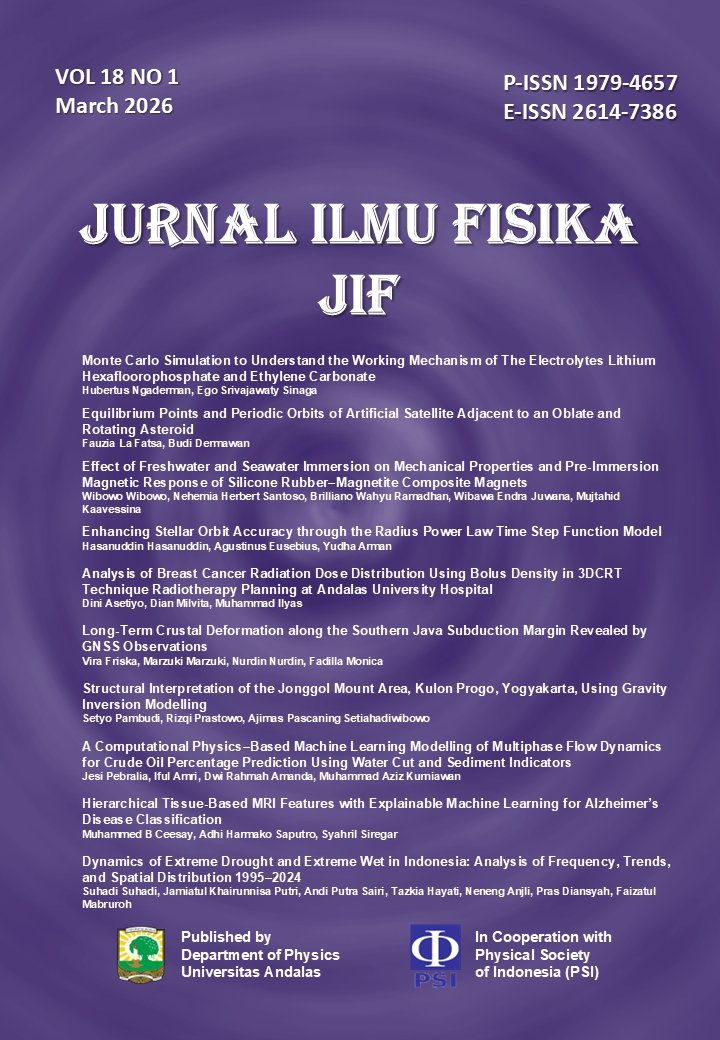
Effect of Freshwater and Seawater Immersion on Mechanical Properties and Pre-Immersion Magnetic Response of Silicone Rubber–Magnetite Composite Magnets
DOI:
https://doi.org/10.25077/jif.18.1.25-34.2026Keywords:
Composite, Fe3O4, Magnetic, Silicone Rubber, Soft magneticAbstract
Magnetite (Fe₃O₄) and RTV 48 silicone rubber-based magnetic composites have potential for outdoor applications due to their flexible and tunable magnetic properties. This study investigates the effect of immersion for 14 days in fresh water and seawater on its mechanical, magnetic, and thermal properties. Specimens were made by mixing 70 wt% Fe₃O₄ powder into RTV 48 matrix, then tested for hardness using Shore A durometer, magnetic properties using Vibrating Sample Magnetometer (VSM), and thermal stability using Thermogravimetric Analysis (TGA). Results showed a decrease in surface hardness due to matrix degradation by water penetration. The magnetic properties continued to exhibit soft magnetic characteristics with low coercivity and remanence. TGA analysis revealed changes in thermal degradation patterns, signaling chemical interactions between the material and the wet environment. These findings suggest that exposure to water can affect the long-term performance of Fe₃O₄-RTV 48 composites, making moisture resistance an important aspect for their outdoor applications.
Downloads
References
Arifin, R. R. N., Lenggana, B. W., Ubaidillah, Wibowo, Aljabri, A., Yunus, N. A., & Al-Hemyari, A. K. A. (2024). Identification of stiffness and damping characteristics of magnetorheological elastomers due to immersion in seawater. Journal of Asian Architecture and Building Engineering, 00(00), 1–17. https://doi.org/10.1080/13467581.2024.2407153
Doloksaribu, M., Virdhian, S., Resmana Djuanda, D., & Afrilinda, E. (2019). Peningkatan Koersivitas dan Remanen pada Magnet Permanen Nd-Fe-B dengan Proses Difusi Batas Butir. Metal Indonesia, 41(1), 18–25.
García-Martín, E., Granados-Miralles, C., Ruiz-Gómez, S., Pérez, L., del Campo, A., Guzmán-Mínguez, J. C., de Julián Fernández, C., Quesada, A., Fernández, J. F., & Serrano, A. (2022). Dense strontium hexaferrite-based permanent magnet composites assisted by cold sintering process. Journal of Alloys and Compounds, 917, 165531. https://doi.org/10.1016/j.jallcom.2022.165531
Grujić, A., Nedeljković, D., Stajić-Trošić, J., Stijepović, M. Z., Alnouri, S., & Perišić, S. (2023). Magneto-mechanical and thermal properties of Nd-Fe-B-epoxy-bonded composite materials. Polymers, 15(8), 1894.
Hojjati-Najafabadi, A., Mansoorianfar, M., Liang, T., Shahin, K., & Karimi-Maleh, H. (2022). A review on magnetic sensors for monitoring of hazardous pollutants in water resources. Science of the Total Environment, 824(86), 153844. https://doi.org/10.1016/j.scitotenv.2022.153844
Hoz, F. O. de la, Saavedra, E., Pereira, A., & Escrig, J. (2023). Static and Dynamic Magnetic Properties of Fe3O4 Nanotubes. 40(4), 3015–3017. https://doi.org//10.3390/nano13071265
Huang, X., Song, G., Shi, J., Ren, J., Guo, R., Li, C., Chen, G., Li, Q., & Zhou, Z. (2022). Thermal stability, mechanical, and optical properties of novel RTV silicone rubbers using octa(dimethylethoxysiloxy)-POSS as a cross-linker. E-Polymers, 22(1), 357–369. https://doi.org/10.1515/epoly-2022-0022
Jubier, N. J., Al-Jorani, K. R., Ali, A. A., Al –Bayaty, S. A., & Al-Uqaily, R. A. H. (2024). Thermal degradation assessment, impact strength, and hardness of combination epoxy and polystyrene powder composite. Kuwait Journal of Science, 51(4), 100271. https://doi.org/10.1016/j.kjs.2024.100271
Kim, A. R., & Yoo, D. J. (2019). A comparative study on physiochemical, thermomechanical, and electrochemical properties of sulfonated poly (ether ether ketone) block copolymer membranes with and without Fe3O4 nanoparticles. Polymers, 11(3), 536.
Li, J., Sepehri-Amin, H., Sasaki, T., Ohkubo, T., & Hono, K. (2021). Most frequently asked questions about the coercivity of Nd-Fe-B permanent magnets. Science and Technology of Advanced Materials, 22(1), 386–403. https://doi.org/10.1080/14686996.2021.1916377
Li, Z., Cao, X., Cong, D., Song, K., Liu, X., Dong, J., & Zhou, Z. (2022). Corrosion Behavior and Magnetic Property Degradation of FeCrNiTi Soft Magnetic Materials in NaCl-containing environments. International Journal of Electrochemical Science, 17, 1–13. https://doi.org/10.20964/2022.09.53
Mazlum, U., & Celik, I. (2025). Experimental determination of the compression behavior of RTV silicone rubber-based magnetorheological (MR) materials under static loading. Journal of Magnetism and Magnetic Materials, 614, 172698.
Nagarajan, B., Wang, Y., Taheri, M., Trudel, S., Bryant, S., Qureshi, A. J., & Mertiny, P. (2021a). Development and characterization of field structured magnetic composites. Polymers, 13(17), 2843.
Ningtyas, R. D., Yanti, D. D., Amin, A. K., & Aji, A. (2024). Fabrication of a Fe3O4/CS/AgNPs Composite from Indigenous Iron Sand for Enhanced Methylene Blue Adsorption. Journal of Cluster Science, 35(5), 1463–1480. https://doi.org/10.1007/s10876-024-02594-0
Ramlan. (2020). Analisa Sifat Fisis, Sifat Mekanik dan Sifat Magnet pada Bonded Magnet NdFeB dengan Perekat Celuna. Journal of Technical Engineering: Journal of Technical Engineering: Piston, 3(2), 1–5.
Rubinsztajn, S., Mizerska, U., Kurjata, J., Kwiatkowska, M., & Cypryk, M. (2025). Aldehyde-Assisted Alkoxysilane Condensation to Form Siloxane Bond: A New Process for Curing Alkoxy-Functional Silicone Resins. Molecules, 30(3), 714.
Wang, Y., Ahmadi Moghaddam, H., Palacios Moreno, J., & Mertiny, P. (2023b). Magnetic filler polymer composites—morphology characterization and experimental and stochastic finite element analyses of mechanical properties. Polymers, 15(13), 2897.
Wibowo, W., Lenggana, B. W., Ubaidillah, U., Ariawan, D., Imaduddin, F., Mazlan, S. A., & Choi, S. B. (2021). Declining performance of silicone-based magnetorheological elastomers after accelerated weathering. Materials, 14(21), 1–14. https://doi.org/10.3390/ma14216389
Yunita, I., Sulistyaningsih, T., & Widiarti, N. (2019). Karakterisasi dan Uji Sifat Fisik Material Zeolit Modifikasi Magnetit sebagai Adsorben Ion Klorida dalam Larutan Berair. Indonesian Journal of Chemical Science, 8(2), 87–92. https://doi.org/10.15294/ijcs.v7i2.20912
Downloads
Published
How to Cite
Issue
Section
Citation Check
License
Copyright (c) 2025 Wibowo Wibowo, Nehemia Herbert Santoso, Brilliano Wahyu Ramadhan, Wibawa Endra Juwana, Mujtahid Kaavessina

This work is licensed under a Creative Commons Attribution-NonCommercial 4.0 International License.
Please find the rights and licenses in JIF (Jurnal Ilmu Fisika).
1. License
The non-commercial use of the article will be governed by the Creative Commons Attribution license as currently displayed on Creative Commons Attribution-NonCommercial 4.0 International License.
2. Author's Warranties
The author warrants that the article is original, written by stated author(s), has not been published before, contains no unlawful statements, does not infringe the rights of others, is subject to copyright that is vested exclusively in the author and free of any third party rights, and that any necessary written permissions to quote from other sources have been obtained by the author(s).
3. User Rights
JIF's spirit is to disseminate articles published are as free as possible. Under the Creative Commons license, JIF permits users to copy, distribute, display, and perform the work for non-commercial purposes only. Users will also need to attribute authors and JIF on distributing works in the journal.
4. Rights of Authors
Authors retain the following rights:
- Copyright, and other proprietary rights relating to the article, such as patent rights,
- The right to use the substance of the article in future own works, including lectures and books,
- The right to reproduce the article for own purposes, provided the copies are not offered for sale,
- The right to self-archive the article.
5. Co-Authorship
If the article was jointly prepared by other authors, the signatory of this form warrants that he/she has been authorized by all co-authors to sign this agreement on their behalf, and agrees to inform his/her co-authors of the terms of this agreement.
6. Termination
This agreement can be terminated by the author or JIF upon two months's notice where the other party has materially breached this agreement and failed to remedy such breach within a month of being given the terminating party's notice requesting such breach to be remedied. No breach or violation of this agreement will cause this agreement or any license granted in it to terminate automatically or affect the definition of JIF.
7. Royalties
This agreement entitles the author to no royalties or other fees. To such extent as legally permissible, the author waives his or her right to collect royalties relative to the article in respect of any use of the article by JIF or its sublicensee.
8. Miscellaneous
JIF will publish the article (or have it published) in the journal if the article's editorial process is successfully completed and JIF or its sublicensee has become obligated to have the article published. JIF may conform the article to a style of punctuation, spelling, capitalization, referencing and usage that it deems appropriate. The author acknowledges that the article may be published so that it will be publicly accessible and such access will be free of charge for the readers.